2 min read
© IE Online Media Services Pvt Ltd



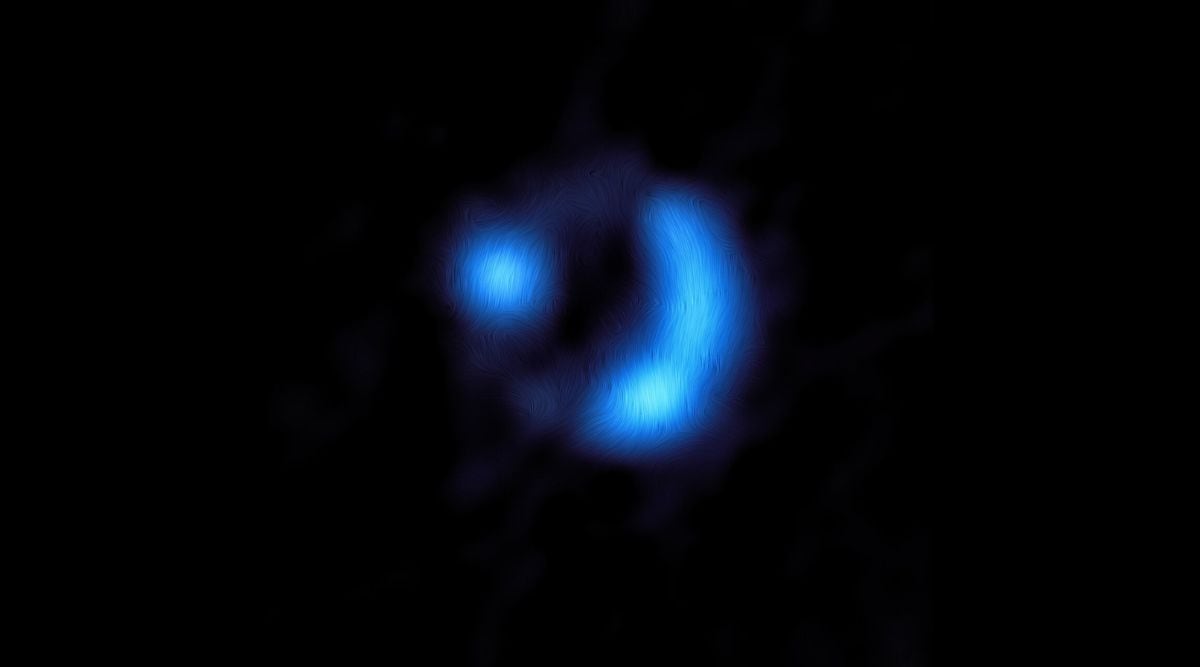 ALMA view of the 9io9 galaxy. (European Southern Observatory)
 Scientists have detected the magnetic field of a galaxy so far away that it took more than 11 billion years ago. The discovery, made using the Atacama Large Millimeter/submillimeter Array (ALMA), shows the galaxy as it was when the universe was just 2.5 billion years old.
Many celestial bodies have magnetic fields of their own; from stars and planets to entire galaxies. “Many people might not be aware that our entire galaxy and other galaxies are laced with magnetic fields, spanning tens of thousands of light-years,” said James Geach, professor of astrophysics at the University of Hertfordshire, in a press statement.
Geach and his team of researchers discovered the fully-formed magnetic field of a distant galaxy, which turned out to be similar to what is observed in nearby galaxies. The field itself is about 1,000 times weaker than the Earth’s magnetic field but it extends more than 16,000 light-years. Observing such fully-formed magnetic fields so early in the history of the universe suggests that magnetic fields spanning entire galaxies can form quickly even when galaxies are early in their stages of growth.
The researchers believe that intense star formation in the early Universe could have played an important role in the accelerated development of such magnetic fields. These fields can then go on, and influence of later generations of stars and planets will form.