


© IE Online Media Services Pvt Ltd
Tags:


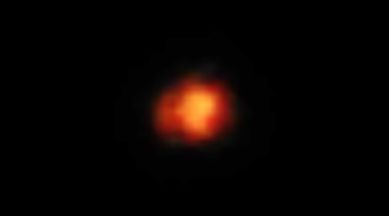
A galaxy discovered using the James Webb Space Telescope last year has turned out to be the earliest ever found. Follow-up observations of “Maisie’s galaxy” have helped astronomers find that we are seeing the galaxy as it was 390 million light years after the Big Bang.
“The exciting thing about Maisie’s galaxy is that it was one of the first distant galaxies identified by JWST, and of that set, it’s the first to actually be spectroscopically confirmed,” said Steven Finkelstein, author of a paper on the galaxy published in the journal Nature, in a press statement. Finkelstein, a professor of astronomy a UT Austin, named the galaxy after his daughter as it was discovered on her birthday.


Distant objects in space appear to us as they were at the time when the light left them. For example, when we look at a galaxy that is one million light-years away, we are actually seeing it as it was a million years ago.
But celestial objects do not send a time stamp along with light. To understand when the light we observed left an object, astronomers measure its “redshift,” or the amount that its colours have shifted due to its motion away from us. We live in an expanding universe, meaning that distant objects are constantly moving away from us. The further back in time that we look, the higher an object’s redshift would be.
The original estimate of the redshift of light from Maisie’s galaxy was based on photometry, or the brightness of light in images using some wide-frequency filters.
For a more accurate estimate of its age, the CEERS (Cosmic Evolution Early Release Science Survey) team applied for follow-up measurements with Webb’s NIRSpec instrument, which splits an object’s light into many different narrow frequencies to more accurately identify its chemical makeup, heat output, intrinsic brightness, and relative motion.


