2 min read
© IE Online Media Services Pvt Ltd



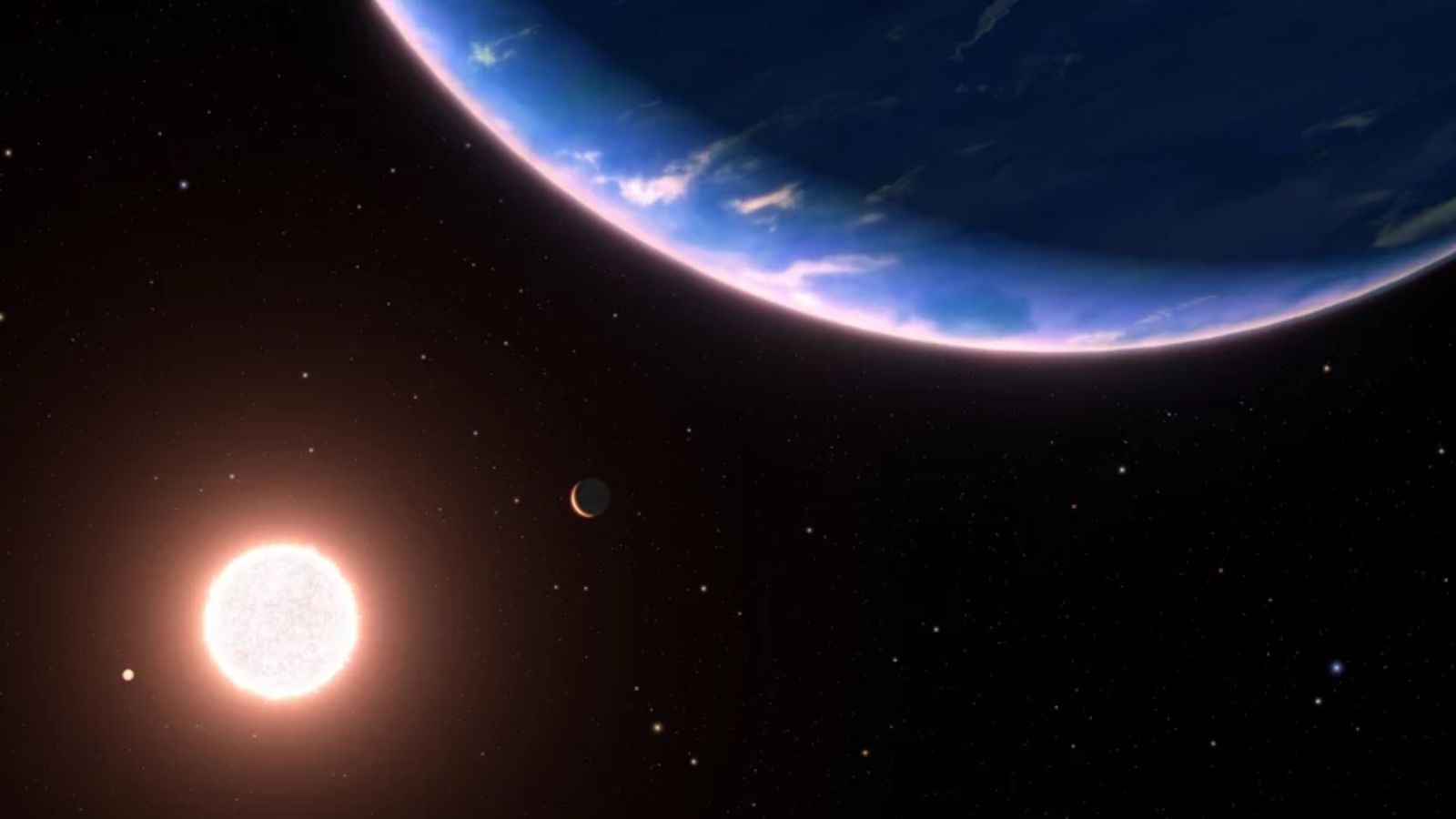 This is an artist's concept of the planet GJ 9827d. (Max Planck Institute)
Astronomers used the Hubble Space Telescope to find evidence of water vapour in the atmosphere of the planet GJ 9827d. Even though the planet is twice as wide as the Earth, it is the smallest exoplanet where astronomers have found evidence of water so far.
The Max Planck Institute for Astronomy announced the discovery on Thursday. “This would be the first time that we can directly show through atmospheric detection, that these planets with water-rich atmospheres can actually exist around other stars. This is an important step toward determining the prevalence and diversity of atmospheres on rocky planets,” said research team member Björn Benneke in a press statement.
But before you jump the gun and imagine the possibility of life on the planet, do note that it is as hot as Venus, which will make a Delhi summer pale in comparison. What is important about the discovery is that the aging Hubble was used to determine the presence of water on such a (relatively) small exoplanet, opening up many new avenues for scientists.
But on the other hand, it is still too early for the scientists to conclude whether Hubble measured a small amount of water vapour on a planet with a puffy hydrogen-rick atmosphere or if the atmosphere itself is mostly made of water that was left behind a primeval hydrogen/helium atmosphere that evaporated in the intense radiation of a star.
But since the planet is around six billion years old and so close to its host star, scientists are leaning towards the latter possibility since it should have lost most of its primordial hydrogen due to stellar radiation.
In the end, the research team is left with two possibilities — either the planet is still clinging to its hydrogen-rich atmosphere, which will make it a mini-Neptune; or it is a warmer version of Jupiter’s moon Europa, which has twice as much water as our planet under its crust.