2 min read

Journalism of Courage



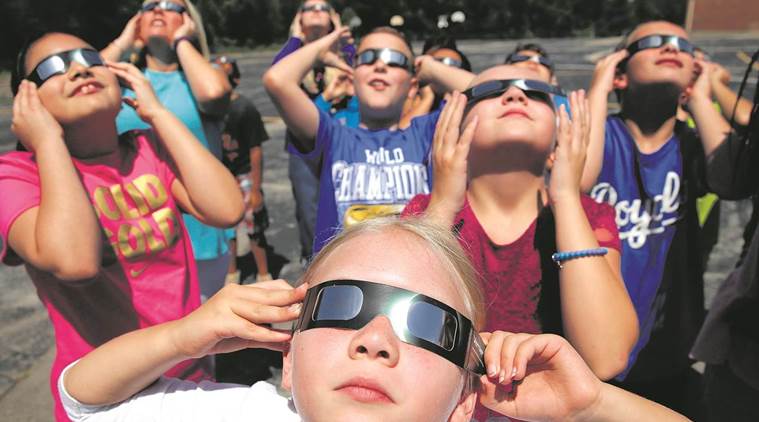 This solar eclipse will be visible from coast to coast in the US.
1. The sun’s mysteries
The sun’s outer crown, or corona, is what astronomers focus on during an eclipse. Otherwise, the corona is so bright that even satellites can’t gaze straight at the sun; artificial eclipses help but can’t match a real one. On Monday, scientists will look to understand how the corona relates to space weather.
2. Solar energy lessons
For about three hours Monday, there will be diminished solar power available. Grid operators across the US are hoping the eclipse will help them learn more about how solar power behaves during disruptions, which will allow them to prepare for cloudy days or storms.
3. Einstein’s relativity
The general theory of relativity (1915) proposes that what is perceived as gravity is the curvature of space and time. Albert Einstein said one way to prove it was to show that light from a distant star bends during an eclipse. He was right: during a 1919 eclipse, Arthur Eddington observed the right amount of bending.

4. Discovery of Helium
In 1868, French scientist Pierre Janssen viewed an eclipse through a spectroscope from Guntur, Andhra Pradesh. A bright yellow line stood out in the spectra; it was initially thought to be sodium but the wavelengths didn’t match. This eventually led to the identification of a new element, helium.
5. Distance to moon
During an eclipse around 150 BC, Greek astronomer Hipparchus learnt that the moon perfectly aligned with the sun in Turkey while about 80% of the sun was blocked in Egypt, about 1,000 km away. Using trigonometry, he calculated the distance between Earth and the moon.