2 min read
© IE Online Media Services Pvt Ltd



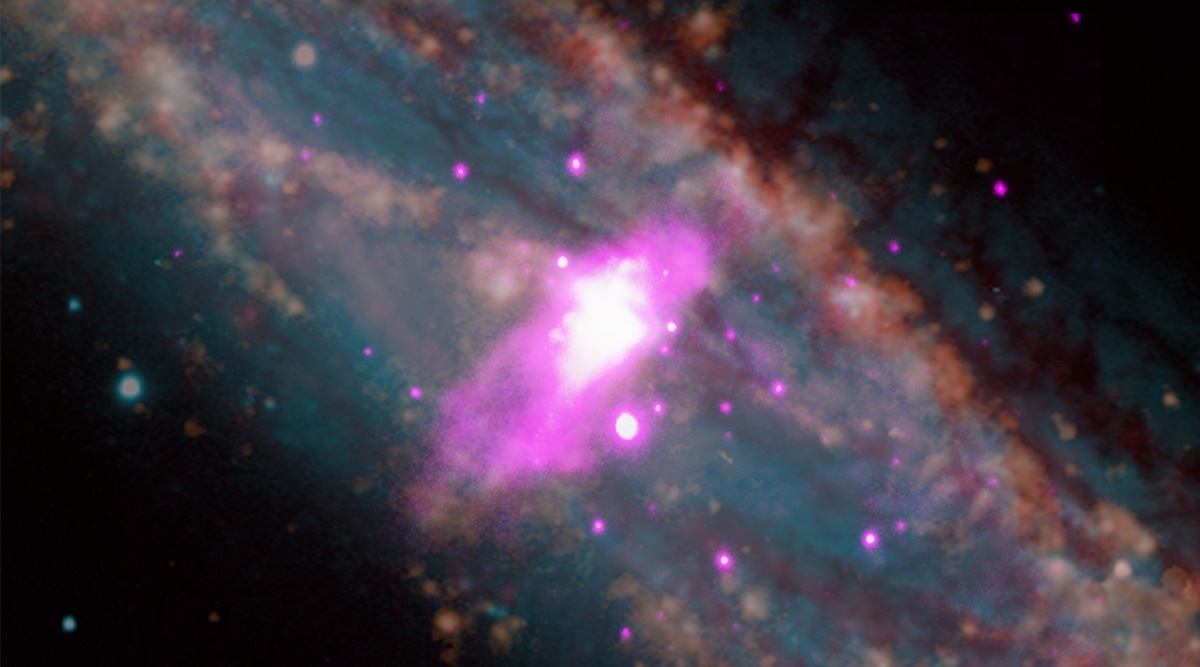 The galactic wind is made of gas that has temperatures in the millions of degrees. (Image credit: NASA)
 Wind plays an important part in the Earth’s ecology by transporting dust and debris across the planet. The same is true of the universe, where galactic winds can have a large impact on the environment, but on a much larger and more dramatic scale.
A new study published in The Astrophysical Journal studied the effects of powerful winds launched from the centre of a nearby galaxy, NGC 253. The galaxy is located about 11.4 million light years away from our planet and the researchers used data from NASA’s Chandra X-ray Observatory to study the wind originating there.
The wind is primarily made of gas that has temperatures measuring in the millions of degrees. Due to the heat, this wind glows in X-ray observations. Every year, this wind carries the equivalent of the mass of two million Earths in hot gas away from the centre of the galaxy.
This wind carries out many important materials, including those that are responsible for life on Earth. These materials then give way to the formation of the next generation of stars and planets.
The composite image above includes Chandra Observatory data (in pink and white) and shows that these winds blow in two opposite directions from the centre of the galaxy; to the upper right and lower left.
The cyan parts of the image show visible light data, and the orange part shows hydrogen emissions. Both these were derived from the Kitt Peak Observatory in Arizona. The red colours in the image represent the infrared data from NASA’s Spitzer Space Telescope.
The researchers studied the properties of the wind by using deep Chandra observations taken over four days. While studying the observations, they found that the densities and temperatures of the gas in the wind were highest in parts that were less than 800 light-years away from the galaxy’s centre. They decreased with distance the further they went from there.