7 min read


© IE Online Media Services Pvt Ltd



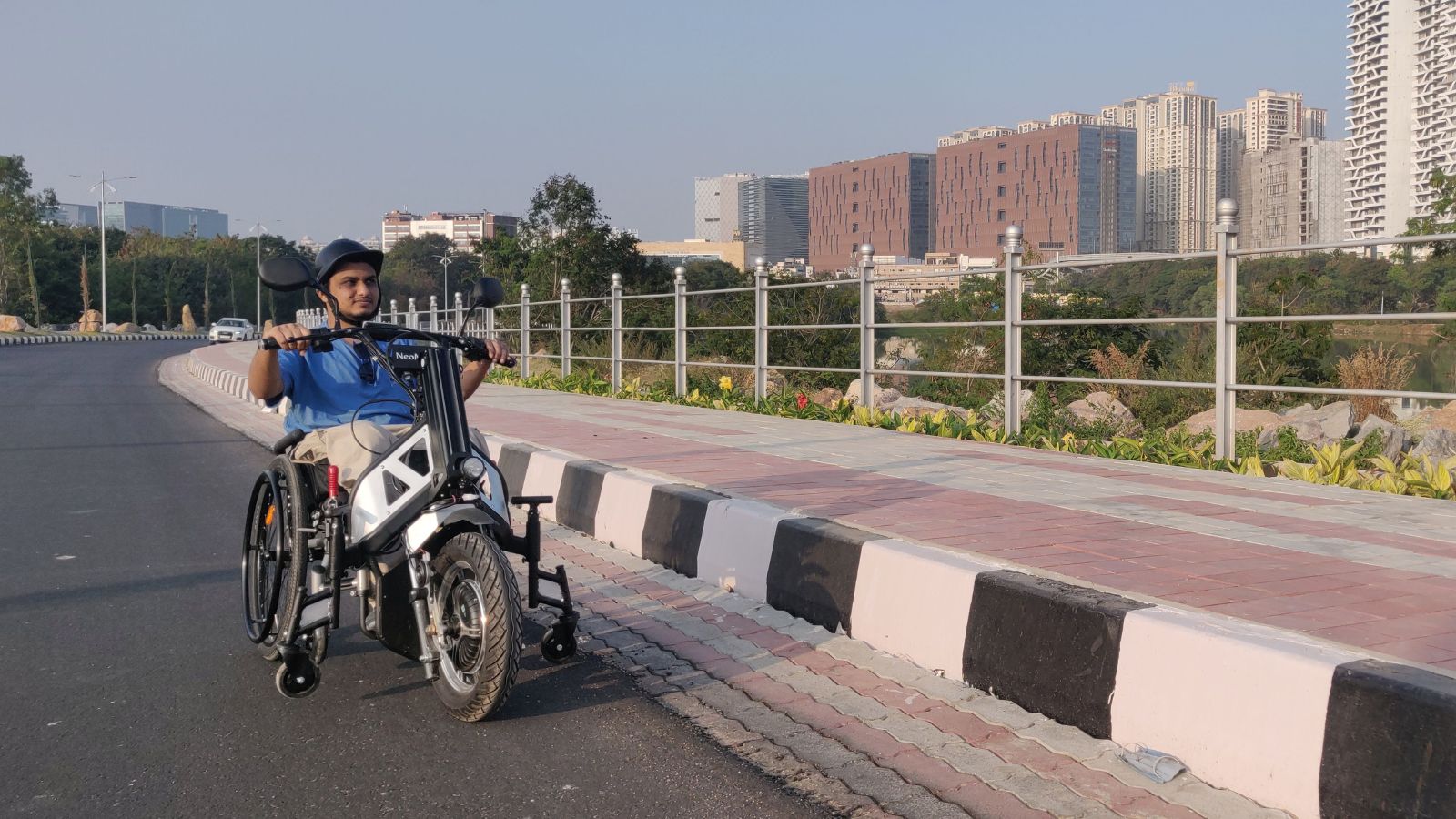 Launched in 2020, NeoMotion has reached over 5200 people with disabilities. (Express Image: NeoMotion)
“Doesn’t matter if it’s hard or easy, nothing is impossible. One just needs to be dedicated to whatever they want to do,” said Seyyad Shahzad Ali, a Zomato delivery partner, in a video that went viral a few months ago. In it, he was seen seated on a wheelchair that doubles up as a motorbike.
When asked about the curious vehicle, Ali said he was driving a “NeoMotion,” a brain child of a few Indian Institute of Technology (IIT) Madras alumni. Today, thousands of persons with disabilities across India are able to lead a life of freedom and dignity, owing to the ingenious creation of this startup.
Indianexpress.com got in touch with one of the founders of NeoMotion, Siddarth Daga, to understand the story of this unique vehicle. Daga traced the origins of NeoMotion, a startup that has blossomed and is now on a mission to transform lives of people with disabilities.
NeoMotion’s journey stems from IIT Madras, where Daga and other founders studied. During their final year, professor Dr Sujatha Srinivasan, who leads the TTK Center for Rehabilitation Research and Device Development, introduced them to the field of assistive technology. This experience, especially the life-changing aspect of assistive devices, piqued their curiosity.
“We were tasked with designing a swimming pool hoist for wheelchair users,” Daga recalled. “The idea was to help them safely and with dignity get into the pool and use swimming as a form of exercise, which is difficult for many due to the logistics of getting into the pool. This project opened our eyes to the real challenges faced by people with disabilities,” he said.
As part of the project, the team interacted with numerous wheelchair users who opened up about their everyday lives and struggles, especially the constant need of assistance for some of the most basic things. Daga said that these interactions brought forward how limited mobility was impacting not just movement, but also one’s sense of independence and dignity.
“That was a turning point for us. We realised that mobility is more than just getting from point A to point B—it’s about freedom, independence, and quality of life. That’s what we wanted to address with NeoMotion,” Daga said.
During the conversation, Daga revealed that one of the key aspects behind NeoMotion’s success is its emphasis on user-centred design. “One major gap we identified is that most wheelchairs in the market aren’t comfortable. Users told us they could only use their chairs for short periods because of discomfort or back pain, which affected their ability to focus on work or studies. When we looked deeper, we found that most wheelchairs were standardised, with little thought given to customisation. Mass-produced in a single size, they didn’t accommodate different body types or needs,” Daga said.
Daga explained that unlike normal wheelchairs that are mass-produced in standard sizes, NeoFly is a fully customisable wheelchair that has been designed to meet the specific needs of an individual. This attention to detail ensures that the wheelchair is functional and comfortable, allowing users to be seated for long periods without any discomfort. “People were using their wheelchairs for just an hour or two a day because they’d get back pain. That’s when we realised that the problem wasn’t just about mobility; it was about comfort and usability,” Daga said.
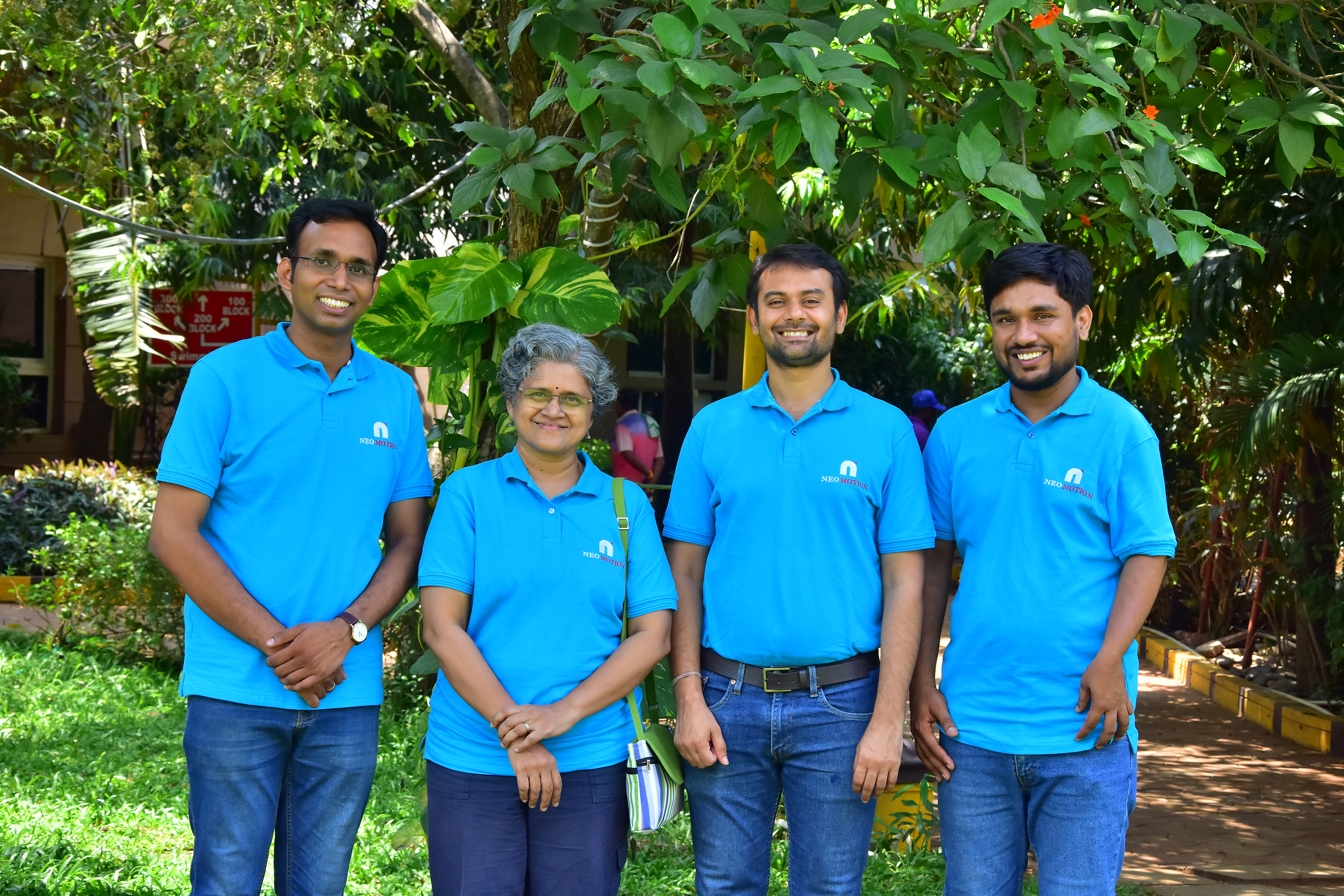 Founders of NeoMotion (from left to right) Swostik Sourav Dash, Dr Sujatha Srinivasan, Siddarth Daga, and Ashish Sharma.
Daga said that NeoFly is tailored to the user’s body measurements, with 18 customisation options including adjustments for hip width, thigh length, and shoulder height. “The level of customisation in NeoFly is unmatched,” said Daga. “It’s designed to provide long-term comfort, allowing users to focus on their work, studies, or daily activities without worrying about pain or discomfort.”
NeoMotion comprises the NeoFly––the wheelchair––and NeoBolt, the attachment that doubles as a motorbike. The NeoFly addresses the need for comfort and stability, while NeoBolt takes mobility to the next level. NeoBolt is essentially an electric attachment powered by a lithium-ion battery. As of now, there are two variants––a 25 km range and a 50 km range––models.
Daga explained that NeoBolt comes with three levels of speed control –– 7 km/h, 15 km/h, and 25 km/h. The vehicle also comes equipped with an anti-tip mechanism that prevents it from overturning during sharp turns. “We’ve patented both the attachment system and the anti-tip mechanism,” he said.
“One of the biggest challenges wheelchair users face is outdoor mobility. They often have to depend on someone to help them get into a vehicle or navigate public transport. With NeoBolt, we wanted to give people the freedom to move around independently,” Daga said.
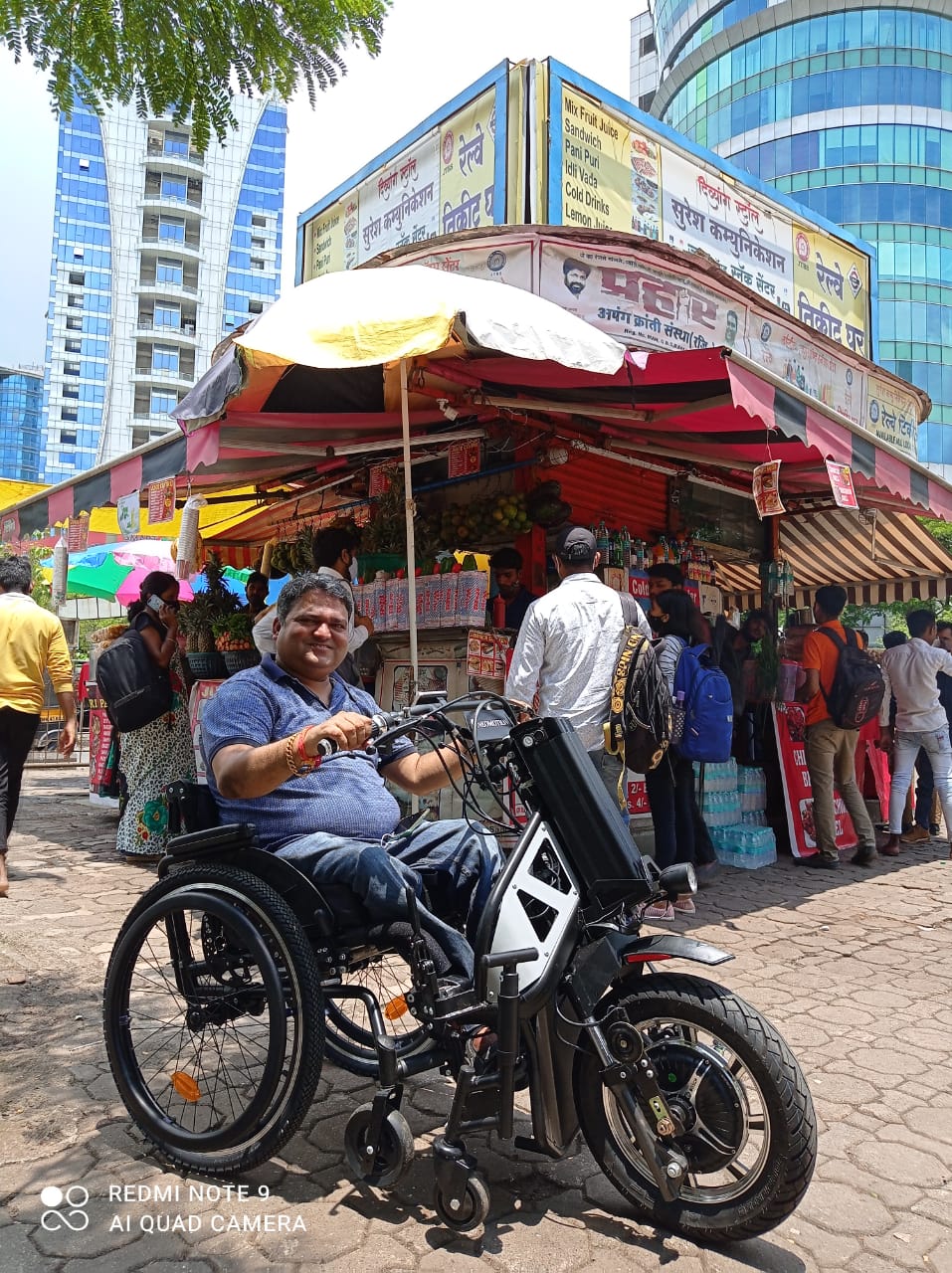 NeoMotion has been designed to offer comfort and mobility to its users. (Image: NeoMotion)
NeoBolt, according to the company, is more than just a mode of transport. “It’s a tool that empowers people with disabilities to live their lives fully, whether that means going to work, meeting friends, or simply enjoying a day out,” Daga said.
The discussion also led to widely held myths around assistive technologies. One of the prominent misconceptions is that these technologies are staggeringly expensive and inaccessible to those who need them the most. Daga asserted that NeoMotion is committed towards breaking such barriers, and offering highly functional yet affordable products.
“We’ve worked hard to keep our products affordable without compromising on quality,” Daga said.
The price of the NeoFly-NeoBolt combination is Rs 1,10,000, which according to Daga, is substantially lower compared to its global counterparts. “We’ve made sure that customisation and outdoor mobility are within reach for as many people as possible,” he said.
View this post on Instagram
The company’s products go beyond mobility. For users like Seyyad Shahzad Ali, NeoMotion has opened up new opportunities of self-reliance. When asked about the company’s future vision, Daga said that they have plans to take NeoMotion to other nations with similar demographics as India. “We’re already exploring opportunities in Southeast Asia, Africa, and Latin America. Our products are designed and made in India, but their potential impact is global.”
NeoFly was launched in January 2020 and by October 2020, the company offered its first NeoBolt and NeoFly combination to a user in Hyderabad. So far, NeoMotion has reached around 5,200 users across India. “We have at least one user in every state and union territory, and we’ve even reached Nepal and Bangladesh,” Daga said.