2 min read
© IE Online Media Services Pvt Ltd



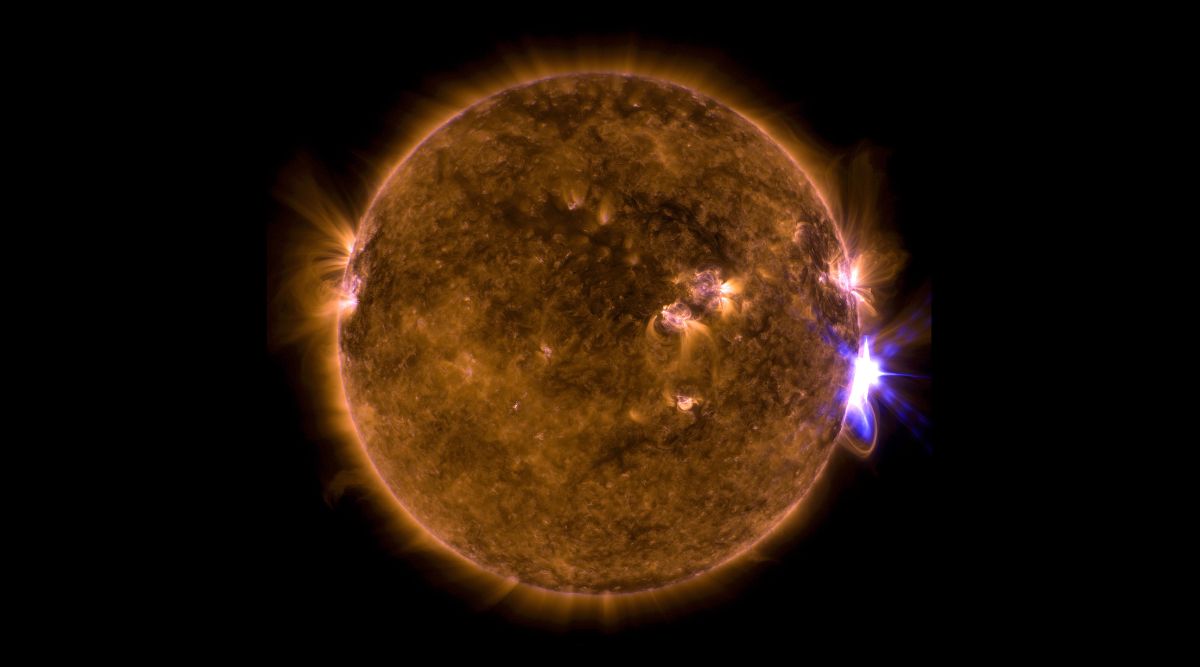 NASA's Solar Dynamics Observatory captured this image of a solar flare on September 10, 2017. (Image credit: NASA/SDO/Goddard)
 Researchers discovered that the Sun’s corona produces small-scale flashes, like “small sparklers before the big fireworks,” that can be used to identify solar flares before they happen. They identified the clues in the blazing upper atmosphere of the Sun using NASA’s Solar Dynamics Observatory.
According to NASA, this information could eventually help improve predictions of flares and space weather storms. These space weather events can affect our planet and its inhabitants in many different ways–by producing auroras, posing a danger to astronauts, disrupting radio communications and even causing massive electrical blackouts.
Previously, scientists have studied how activity in the lower layers of the Sun’s atmosphere can potentially indicate impending flare activity in active regions, which are often marked by groups of sunspots, which are strong magnetic regions on the surface of the Sun that are darker and cooler compared to their surroundings. The new research, published in The Astrophysical Journal, contributes to that science.
“We can get some very different information in the corona than we get from the photosphere, or ‘surface’ of the Sun. Our results may give us a new marker to distinguish which active regions are likely to flare soon and which will stay quiet over an upcoming period of time,” said KD Leka, lead author of the new study, in a press statement.
The research team used a newly created image database of the Sun’s active regions, captured by the Solar Dynamics Observatory, for the study. The publicly available resource features over eight years’ worth of images of active regions of the Sun in ultraviolet and extreme-ultraviolet light.
The researchers studied a large sample of these active regions from the database using various statistical methods and found that solar flares are preceded by small flashes in the corona. The goal of the researchers is to use this and other new insights to better understand solar physics so that eventually, new tools can be built to predict solar flares.