


© IE Online Media Services Pvt Ltd
Tags:


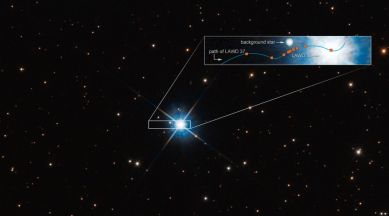
Astronomers used NASA’s Hubble Space Telescope to directly measure the mass of a single, isolated white dwarf star. The researchers were able to measure the mass of star because they were aided by “gravitational lensing” where the light from a background star was slightly deflected by the gravitational forces of a star in the foreground.
According to NASA, the researchers found that the dwarf star in question—the surviving core of a burned-out, sunlike star— is around 56 per cent of the mass of our Sun. This measurement agrees with earlier theoretical predictions of the white dwarf’s mars and also corroborates current theories of how these stars evolve as the end product of a star’s evolution.


But for this companionless white star called LAWD 37, the researchers waited until another white dwarf star passed behind it. This caused a gravitational “microlensing” where the background star temporarily appeared to be offset from its actual position.
In the research published in the Monthly Notices of the Royal Astronomical Society, the researchers precisely measured how the light from the distant star bent around LAWD 37. But the light from the background star was so faint that the white dwarf star was more than 400 times brighter than it. Thankfully, Hubble is capable of making such high-contrast observations in visible light.
Interestingly, these kinds of observations will be even easier with the James Webb Space Telescope’s infrared capabilities. The blue glow of a foregoround white dwarf star will look dimmer in infrared light and the background star will look brighter.


