


Tags:


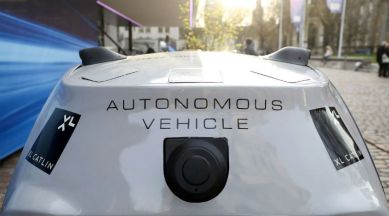
In the race to the autonomous revolution, developers have realized there aren’t enough hours in a day to clock the real-world miles needed to teach cars how to drive themselves. Which is why Grand Theft Auto V is in the mix.
The blockbuster video game is one of the simulation platforms researchers and engineers increasingly rely on to test and train the machines being primed to take control of the family sedan. Companies from Ford Motor Co. to Alphabet Inc.’s Waymo may boast about putting no-hands models on the market in three years, but there’s a lot still to learn about drilling algorithms in how to respond when, say, a mattress falls off a truck on the freeway.


Also Read: Uber tells Court it isn’t using Waymo’s driverless car sensor secrets
“Just relying on data from the roads is not practical,” said Davide Bacchet, who leads the simulation effort in San Jose, California, for Nio, a startup aiming to introduce an autonomous electric car in the U.S. in 2020. “With simulation, you can run the same scenario over and over again for infinite times, then test it again.” As improbable as it may seem to the lay person, hyper-realistic video games are able to generate data that’s very close to what artificial-intelligence agents can glean on the road. AI software has been playing around with games from Super Mario Bros. to Angry Birds for a while now, tackling problems in controlled environments and learning through trial and error.
Last year, scientists from Darmstadt University of Technology in Germany and Intel Labs developed a way to pull visual information from Grand Theft Auto V. Now some researchers are deriving algorithms from GTAV software that’s been tweaked for use in the burgeoning self-driving sector. The latest in the franchise from publisher Rockstar Games Inc. is just about as good as reality, with 262 types of vehicles, more than 1,000 different unpredictable pedestrians and animals, 14 weather conditions and countless bridges, traffic signals, tunnels and intersections. (The hoodlums, heists and accumulated corpses aren’t crucial components.)

The idea isn’t that the highways and byways of the fictional city of Los Santos would ever be a substitute for bona fide asphalt. But the game “is the richest virtual environment that we could extract data from,” said Alain Kornhauser, a Princeton University professor of operations research and financial engineering who advises the Princeton Autonomous Vehicle Engineering team.
Waymo uses its simulators to create a confounding motoring situation for every variation engineers can think of: having three cars changing lanes at the same time at an assortment of speeds and directions, for instance. What’s learned virtually is applied physically, and problems encountered on the road are studied in simulation.
Quick Brown Fox
Whenever a human has to grab the wheel of a test car because self-driving software hasn’t responded properly, “we’re able to play back the exact situation and predict via simulation what could have happened if the car had been left to drive itself,” Waymo said in a self-driving project report. “If the simulator shows better driving is called for, our engineers can make refinements to the software, and run those changes in simulation in order to test the fixes.”
At Toyota Motor Corp.’s Toyota Research Institute in California, engineers try to “break the system” through what’s known as the Quick Brown Fox test: running mile after mile in the most challenging weather and traffic conditions. For all the stupid mistakes motorists regularly make, the human brain is far superior to a computer in perceiving and reacting to the unexpected, from a pothole to a construction zone to a toddler chasing a ball into the street. That’s the great challenge for all the companies competing to be first in the autonomous space: how to make on-board systems better than people at driving, and make driving safer.
Also Read: Waymo targets second senior executive in Uber self-driving dispute
A looming question is what state and federal safety regulators will demand as proof an autonomous car should be given license to roam. Hundreds of billions of miles may have to be racked up, one way or another. The authorities will probably accept a combination of real and replicated, but rules spelling out requirements have yet to be written.
Gill Pratt, chief executive officer of the Toyota institute, told a House Energy and Commerce subcommittee in February that simulation should “be an acceptable equivalent to real-word testing,” with follow-up validation. That’s the road, developers are increasingly traveling.


