The small group of Indians that hit the road to Manchester from Southampton late on Friday last week was disappointed but not dispirited. It had been a long day for Mahendra Singh Dhoni, Ravichandran Ashwin, Gautam Gambhir and Ravindra Jadeja, who had stayed back for the hearing of the Jadeja-James Anderson case. The verdict passed by the judicial commissioner hadn’t gone their way as the Level 3 charge against Anderson couldn’t be proved.
After six long hours of cross-questioning, witness accounts and the eventual unexpected clean chit to the England pacer, the Indian camp decided to hold on to a positive thought floated by one of them. It lifted the gloomy mood that was brought about by what they thought were lies, bias and injustice. “Don’t know about the other side, at least we can sleep peacefully, without any guilt,” one player said. The statement was received by wise, smiling nods.

Four days later, as the eve of this crucial fourth Test coincided with the ICC deciding not to appeal against the decision and therefore officially burying the spat, Dhoni was again seeing the same silver lining. At the pre-match press conference he repeatedly asserted that his team members weren’t looking back. They weren’t, he insisted, counting sheep under their blankets thinking about Nottingham, the corridor without a camera and Anderson.
“At the end of the day, I want to be happy when I look in the mirror and sleep well. Because the kind of pressure environment we have, we need to sleep well and not worry about what we are going to do or say the next day,” he said.
He said all that after a light-hearted disclaimer about him not being a drinker and thus not used to nursing a hangover. The dark night didn’t linger on the morning after. Nottingham and Southampton were pit stops left behind on the journey as Dhoni opted to look ahead at Manchester.
He didn’t get provoked by questions about the local media’s personal attack on him, the ICC’s inconsistency or his counterpart Alastair Cook’s statement that he wouldn’t ask Anderson to shut up. Dhoni, in turn, spoke about the lack of evidence, his opposition to players making a physical contact and how he was merely raising an issue that was very important for the spirit of the game.
No talk of vendetta
Right from the start of Dhoni’s presser, it was clear that the ‘push-abuse’ incident wasn’t a ‘Monkeygate’. He said that the majority in the Indian dressing room weren’t even aware of all the details of the hearing. Nor was there any talk of vendetta or paying back the rivals in the same coin. Those who invoked Perth 2008—where Anil Kumble & Co. came out fighting when pushed into a corner— and were of the view that Manchester too ought to see a similarly motivated squad taking the field, weren’t on the same page as the Indian team. Dhoni could have very easily repeated Kumble’s famous line: “Only one team played in the spirit of the game”. It was apt for the occasion. But he didn’t. He opted for a more passive comparison about the sleep patterns of the two teams.
Story continues below this ad
But earlier in the day, the man who never sweats didn’t have any worrying lines on his forehead, a visible trace of a guilty soul or even weary sleepless eyes. A fresh-looking, back-in-form Cook wasn’t apologetic or defensive. He looked unquestionably relieved. Runs, win and uninterrupted services of the man he calls the “best English bowler I have seen” — everything has fallen into place for the man who could do no right just a couple of weeks ago.
‘One overblown incident’
Cook said that things weren’t as bad on the field as they were made out to be. “I think the way both sides have played this series has been fantastic, apart from that one incident which has been blown up. I thought both sides have been very competitive and played it in the right way and in the right spirit,” he said.
The two captains agreed on Anderson, too. Both Dhoni and Cook praised his skills. The India captain said that the English bowler hasn’t given them any reason to complain in the last two Tests, while Cook didn’t agree to the common expert advice floating around: “Jimmy, watch your tongue.” This unlikely meeting of the minds almost saw a pall of gloom descend on the media arena. The expected fireworks hadn’t exploded.
It was a day when team news and the clichéd pre-match quotes were insignificant scribbles on the margin. As for the team news, England faced the dilemma of retaining the winning combination while they had in their squad the just-drafted pacer Steve Finn, who could be effective on this famously bouncy track.
Story continues below this ad
As for Dhoni, he seemed to have decided on three changes. Before the net session, Gautam Gambhir, Ravindra Jadeja and R Ashwin had a short pitch inspection. Later in the day, pacer Varun Aaron was seen getting extra fielding classes. The excepted changes for the Test are Gambhir for Shikhar Dhawan, Ashwin for Rohit Sharma and Aaron for Pankaj Singh.
After the big loss at Southampton, India, with large-scale changes, are regrouping. Dhoni doesn’t want off-field distractions for the contest on the field. He doesn’t want stress. He prefers a good night’s sleep. But will this truce survive the heat of the series that is tied 1-1? There is a lot at stake at Manchester.
These are desperate times for quite a few anxious men of these young, fluid teams. The match will have those tense crucial moments that will decide the outcome. That’s when tempers flare up and old wounds are scratched. It remains to be seen if the pre-match peace talk remains true. Interestingly, two of India’s expected replacements — Ashwin and Gambhir — were witnesses at the hearing. They have seen the Anderson-Jadeja spat from up close. Below the thin layer of reconciliation, a revenge drama might be waiting to played.


 6 min read


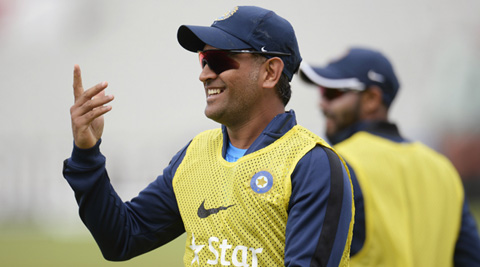 Mahendra Singh Dhoni wasn’t provoked by questions on the local media’s personal attacks on him, the ICC’s inconsistency or his counterpart Alastair Cook’s statement that he wouldn’t ask James Anderson to shut up (Source: Reuters)