5 min read


© IE Online Media Services Pvt Ltd



 Leon Luke Mendonca of the Alpine SG Pipers (RIGHT) and Raunak Sadhwani of Ganges Grandmasters in the Global Chess League at Mumbai's Opera House. (Photo: GCL)
Wesley So remembers the four years he spent labouring away as a 2600-rated player. The leap from 2500 to 2600 for the Phillipines-born American grandmaster had happened almost in the blink of an eye when he was just 15 years old. But breaking into 2700 would have felt like summiting Mount Everest from the Everest Base Camp.
Among the sport’s more elusive clubs, the 2700 rating group in chess currently has a membership of 33 grandmasters. Call it the hardest club to leave in chess. Or a quicksand of a rating trap, one which allows you to get in easily, but pulls you in harder, clinging on to you when you try to graduate to 2700—the informal term the sport has for anyone rated over 2700 is ‘super grandmaster’.
“It’s one of the hardest things (in chess),” sighs Wesley So. “It takes time, for sure. It took me like four years to get to 2700 after becoming 2600 at 15. Moving from 2500 to 2600 is relatively smooth for most people. But 2600 to 2700 is really difficult. Because chess is very competitive and there are a lot of young kids who are trying to get to 2700. The thing is there’s also a lot of pressure involved, you know?”
India has currently nine challengers—Karthikeyan Murali (2660), Pranav V (26341), Raunak Sadhwani (2638), Pranesh M (2627), Aryan Chopra (2626), Aditya Mittal (2624), Abhimanyu Puranik (2622), SL Narayanan (2616), Leon Luke Mendonca (2615)—fighting it out in the 2600 ratings club with dreams of making the leap to the 2700s some day.
Some like Sadhwani already have a plan, drawn up after conversations with others who have breached that frontier.
“I’ve spoken to a few people and I think the solution is to play more tournaments. So first, you need to do some training (camp) for two or three months and then you need to play back to back tournaments to gain ratings. I think this is the way which might be interesting to try and I’m going to do it soon,” Sadhwani, who turned 20 on Monday, tells The Indian Express.
Currently playing in the Global Chess League for the Ganges Grandmasters, Sadhwani says that the pursuit of 2700 occupies considerable space in his mind.
“Even before the GCL started, I was training (for breaching into 2700). So for me, the process has already started. I train about 6 to 7 hours daily for this.”
Mendonca too has been picking the brains of other top players in his quest to raise his level.
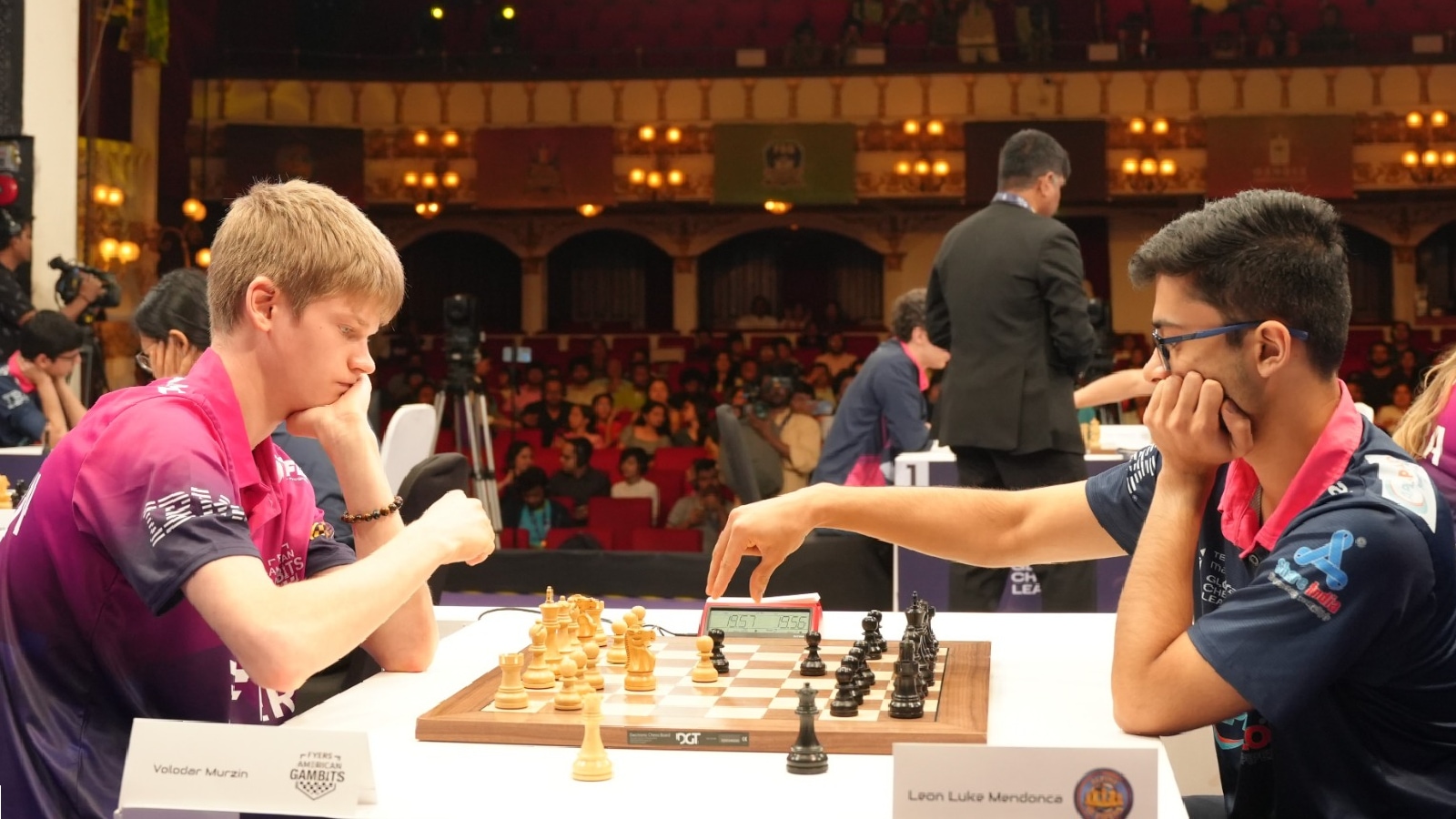 Leon Luke Mendonca of the Alpine SG Pipers takes on Volodar Murzin in the Global Chess League at Mumbai’s Opera House. (Photo: GCL)
“I’ve actually asked many people (what the secret is to making it to the 2700 club). I have been in 2600 for the last two and a half years. In this phase, I have been trying a lot of things, changing a lot of things, talking to different people like coaches. But finally you just have to do what works for you because what works for someone else may not work for you. So you have to find your own path and hopefully something clicks,” Mendonca, who plays for the Alpine SG Pipers with multiple 2700-rated players like Praggnanandhaa, Fabiano Caruana, and Anish Giri tells The Indian Express.
So points out that there are plenty of perks involved with being a 2700 rated player: much more invitations from elite closed events like Norway Chess and so on. Simply put, it’s easier to make a living from the sport as a 2700-rated player than as a 2600-rated player.
“I think the secret to reaching 2700 is just to keep improving. Obviously, not everyone can achieve 2700. But if you just try to keep improving, playing better, you’ll get it eventually. It depends a lot. Because obviously, if you reach 2700, you have a good chance to be a chess professional. You can make a living, good money if you reach 2700,” says So.
Frenchman Maxime Vachier-Lagrave, one of the permanent fixtures in the 2700-rating club, was one of the outliers, having breached the 2700 rating in a hot minute. But the bigger challenge was maintaining his position there.
“For me, it was strange, because I jumped from 2600 to 2700 over the course of a summer. But when I got there, I still had to be consistent to stay there. It took me a few years to have a standout result as a 2700. I first made it to 2700 for the first time in 2008 and from there on it was always like being between 2680 and 2730 for like three to four years. The 2013 World Cup was really a breakthrough tournament where I reached the semis,” says Vachier-Lagrave.
Ask the Frenchman, who is currently occupying the world no 15 spot in the FIDE rankings, what the difference between a 2600-rated player and a 2700-rated player is, and he replies with a smile: “In general we do everything a little bit better. 2600 players can do things extremely well. We saw at the World Cup that there were so many good results from 2600-rated players. But sometimes we are a bit better prepared, bit more experienced, better in endgames, better in handling nerves. There’s no one particular aspect. But whatever we do, we do a little bit better than 2600.”