4 min read


© IE Online Media Services Pvt Ltd



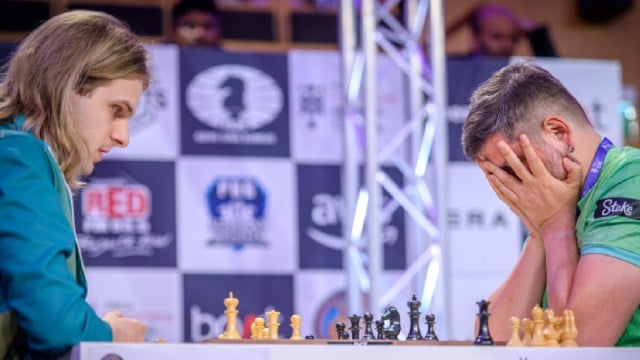 Richard Rapport (left) takes on Peter Svidler in the second edition of Global Chess League in London last year. (PHOTO: GCL)
Richard Rapport remembers being impressed when a newly-minted world champion Gukesh Dommaraju rattled off the names of the Avengers that he had assembled to help him dethrone Ding Liren at the world chess championship in 2024. At that world championship in December last year, the Hungarian grandmaster, who has made a name for himself as a man who can think out of the box and brings plenty of creativity in openings besides wild and unpredictable moves, was at the other side of the battlefield, having enlisted with Team Ding for both of the Chinese grandmaster’s world championship battles.
“When I saw Team Gukesh, it was a very impressive team of people. To be able to afford and to be able to maintain such a setup, it’s just very impressive,” Rapport tells The Indian Express in an interview ahead of the third edition of the Global Chess League where he will represent the American Gambits franchise.
For his first assault at the world champion’s crown, the then 18-year-old from Chennai had brought together a team of six seconds: Grzrgorz Gajewski (his long-time trainer), Radoslaw Wojtaszek, Jan Krzysztof Duda, Jan Klimkowski, Pentala Harikrishna and Vincent Keymer. Then, there was also mind guru Paddy Upton, who has coached the Indian cricket team and the Indian hockey team in the past, besides five-time world champion Viswanathan Anand helping out as a mentor. What was impressive about this team was the presence of players like Duda and Keymer, who have their own world championship ambitions, and yet were convinced to help the Indian teen out.
 (LEFT) Vincent Keymer, Pentala Harikrishna and Radek Wojtaszek at their home in Spain’s Manilva which has been their base for the past three weeks; (RIGHT) Gukesh and Grzegorz Gajewski after the closing ceremony at Singapore. (PHOTOS: Vincent Keymer Instagram, FIDE via Maria Emelianova)
While Rapport understandably does not want to reveal how big Team Ding was, he does point out that the financial support Gukesh was able to muster to put together such an impressive team was not surprising. After all, over the years he has seen the amount of monetary support his Indian counterparts received from sponsors back in India. This has also corresponded with an unprecedented crop of Indian youngsters who have shown they are poised to be world beaters. With Gukesh Dommaraju already becoming the youngest world champion in the sport’s history last year, the Indian teams also swept gold medals at the Chess Olympiad, while Divya Deshmukh won the FIDE Women’s World Cup and Praggnanandhaa came close to winning the open World Cup as well. R Vaishali then claimed the FIDE Women’s Grand Swiss title twice while Vidit Gujrathi too won the open event in 2023.
“India has a very strong base of support, I would say. I’ve seen these guys from India for a very long time starting as kids and then eventually they grew up. I’ve played all of them over time. I think they have these logos on their clothes (of their sponsors). So when they go to tournaments they don’t really mind about the prize money, which for me was kind of essential to make a living; to make enough money to kind of invest back into your career, but ultimately you want to make money from it. I think with the Indians, they have a safety net that the system gives them. It kind of catches them! That certainly helps,” Rapport says before adding: “Of course, there are also extremely talented individuals. Like, that’s not a shocking factor.”
Rapport also credits leagues like GCL with spurring Indian chess’ progress.
“When you invest (into a sport) for a reasonably long time and you have people with a certain amount of talent, it just eventually pays off. I mean, it’s not the hardest math of all time. But I would say that comes from chess being taken seriously on very high levels. Also, just to give you an example, the Global Chess League came together through very strong Indian involvement. It’s not an accident. It already has quite a serious fan base on its own. It just shows that chess has taken off to a different level (in India).”