4 min read


© The Indian Express Pvt Ltd



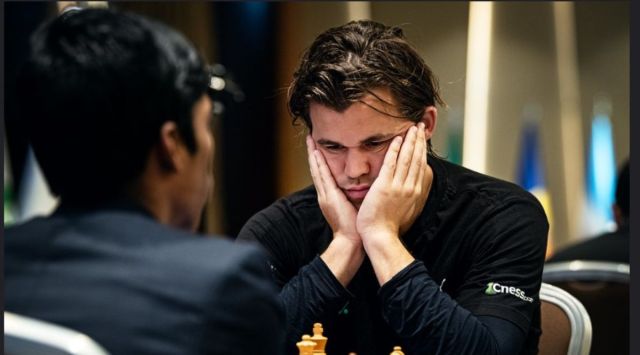 As soon as Carlsen’s knight captured Pragg’s knight on d4, Grandmaster Peter Leko, doing commentary on Chess24, pronounced that the World No. 1 was playing for a draw. (FIDE/Stev Bonhage)
 On Wednesday, while the second game of the FIDE World Cup final between Magnus Carlsen and R Praggnanandhaa was still going on, Viswanathan Anand posted on social media: “Wow, did not expect this opening! Is Magnus repeating his game 12 strategy of 2016 and aiming for a tiebreak? If so, Magnus has spent the day thinking of the tiebreak whilst Prag can only start to do so after the game.”
Anand wasn’t the only one to spot early on that Carlsen was clearly angling for a draw, despite playing with white pieces. The theory of the experts was that the World No.1 was hoping to get an additional day to recover from the bout of food poisoning he has been suffering from after the semis.
Anand’s reference was to the 2016 World Championship clash, when defending champion Carlsen took on Russia’s Sergey Karjakin. The 12-game contest was on level terms after 11 games, with the Russian winning Game 8 and Carlsen drawing level in Game 10. With the Norwegian playing with white in Game 12, experts and fans expected him to go for the kill. Instead, he went for a painlessly quick draw, just like he did against Pragg on Wednesday. Game 12 of the 2016 World Championship was the shortest game of that series in the classical format, just like Wednesday’s game ended in just over an hour’s time. After both games, Carlsen knew that shorter time-control games awaited him and his opponent.
You can follow our liveblog for the Praggnanandhaa vs Magnus Carlsen FIDE World Cup final here
Against Karjakin, Carlsen retained his crown by winning the 15th and 16th games. Ironically, that 12th game and the one against Pragg on Wednesday were drawn in 30 moves.
Carlsen’s opening moves from the Karjakin game were the same as the ones he employed against Pragg on Wednesday. In the game against Karjakin, the knights had broken ranks early.
Similarly, by the third move of the Pragg-Carlsen game, all four knights had wandered out. By move seven, all four were off the board. As soon as Carlsen’s knight captured Pragg’s knight on d4, Grandmaster Peter Leko, doing commentary on Chess24, pronounced that the World No. 1 was playing for a draw. He said it was like a “silent draw offer”.
INTERACTIVE: You can follow the move-by-move action from Wednesday’s second game in the final between Praggnanandhaa and Magnus Carlsen below and also click on the notations at the right of the board to retrace the way the game developed:
“My guess is he still hasn’t recovered (from food poisoning). Otherwise, I do not see him ever playing this line. There’s a clear purpose to survive today,” Leko added.
By the 11th move, the four knights were joined in the chessboard purgatory by both queens, the most powerful piece on the board.
Commentators Irina Krush and Irene Sukandar, both chess players of repute, had also concurred that Carlsen was forcing a draw by the sixth move when he advanced his pawn to e5.
“This is not where white goes trying to play for a win,” said Krush as her partner concurred.