


© IE Online Media Services Pvt Ltd
Tags:


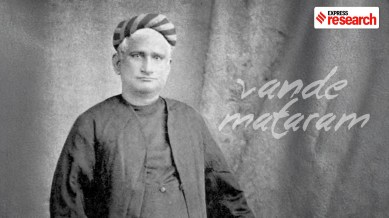
Sometime in the 19th century, Bankim Chandra Chatterjee composed the poem Vande Mataram. An associate who assisted Chatterjee in editing a literary journal once came across the poem and said, “This is not so bad and will do quite well as a filler to fill up an empty space we have in the galleyproofs for the number.” However, as professor Sabyasachi Bhattacharya recounts in Vande Mataram: The Biography of a Song (2003), Chatterjee firmly declined the suggestion. His nephew later recalled the author’s words: “You can’t possibly guess now if this is good or bad. Time will tell—I shall be dead by then, it is possible that you may see that day.”
Earlier this week, the Ministry of Culture under the Government of India announced that Prime Minister Narendra Modi will attend a special programme in New Delhi on November 7 to mark the 150th anniversary of Vande Mataram. The event will include the release of a commemorative stamp and coin, followed by a mass recital of the song.

It is worth revisiting the context in which the song was written and tracing the significance it has held through India’s struggle for Independence.
The poem, a lyrical vandana or hymn, was not written as part of a novel. Rather, it was the creation of a poet musing to himself. “There might have been no deliberate strategy in the choice of language and diction. It was indeed the language that might have come naturally to Bankim who was well versed in Sanskrit and at the same time innovative in creating the modern Bangla language,” notes Bhattacharya.
While the exact date of composition remains uncertain, it is likely that the opening verses were written after 1872. Bhattacharya supports this view with multiple pieces of evidence, one of which is the poem’s reference to the population of 7 crore. He notes, “The number seven crore, or seventy million, was the population of the eastern part of the Indian subcontinent… The poem could not have been written before 1872, i.e. before the publication of the census of population of eastern India.”
Later, in 1882, the poem was included in the novel Anandamath, and an expanded version was imbued with militant Hindu overtones to suit the novel’s context.
Vande Mataram quickly gained popularity among Bengali readers. We know that it was sung in the Calcutta session of the Indian National Congress in 1896, with music composed and rendered by Rabindranath Tagore.
Beginning in 1905, during the Swadeshi agitation in Bengal, the poem evolved into a powerful political slogan. Tagore himself led nationalist protest processions in which Vande Mataram was sung. It was played not only on Rakshabandhan day in October 1905 to protest against the partition of Bengal, but also at the Benaras session of the Congress the same year, under the leadership of Gopal Krishna Gokhale.
The chanting of the slogan became a routine feature of nationalist demonstrations and continued unabated even in the presence of British troops. While students and members of the middle class most often raised the slogan, there were also noticeable instances of industrial workers joining in, such as the employees of the British-owned Fort Gloster Mill near Calcutta, who invoked Vande Mataram in the 1905 protests.
In 1915, Mahatma Gandhi addressed a meeting in Madras that opened with the singing of Vande Mataram. Gandhi remarked: “You have sung that beautiful national song, on hearing which all of us sprang to our feet. The poet has lavished all the adjectives we possibly could to describe Mother India… It is for you and me to make good the claim that the poet has advanced on behalf of his Motherland.”
By the 1920s, as Bhattacharya notes, “Vande Mataram was possibly the most widely known national song in India.” It was translated into numerous Indian languages: Marathi (1897), Kannada (1897), Gujarati (1901), Hindi (1906), Telugu (1907), Tamil (1908), and Malayalam (1909).
However, during the 1930s, the status of Vande Mataram was contested as many in India began to object to it on the grounds that it was idolatrous. The question arose as to whether the song could legitimately claim the position of the national anthem. Critics argued that its imagery and rhetoric, invoking the divine in the form of the motherland, were incompatible with secular ideals. Others feared that its overtly religious tone could become a source of division. Among the most vocal opponents was the Muslim League leader Muhammad Ali Jinnah, who criticised the song for its perceived sectarian implications.
In 1937, the Indian National Congress, guided by a committee led by Jawaharlal Nehru, decided to expurgate the portions of the poem containing overtly “idolatrous” references and adopted a part of the text as the national song. “This was the version adopted by the Constituent Assembly at the instance of Rajendra Prasad in 1951 as the national song, along with Jana gana mana which was designated the national anthem,” writes Bhattacharya.
Through the 1930s and 1940s, the Muslim League continued to oppose Vande Mataram, while Hindu nationalist enthusiasm for it grew correspondingly stronger. After 1947, the song came to embody contradictory meanings: for some Indians, it became a communal war cry; for others, it remained a symbol of national unity.


