9 min read
© The Indian Express Pvt Ltd



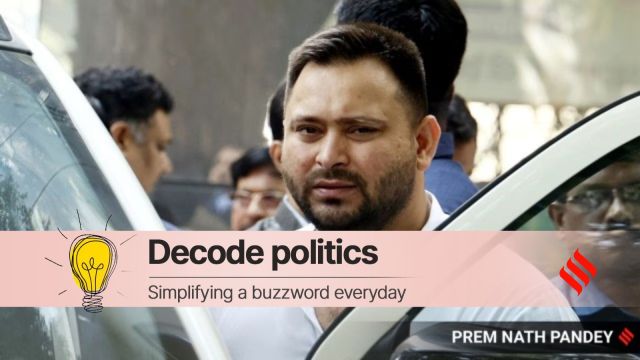 On May 26, RJD leader Tejashwi Yadav wrote to PM Modi, referring to the quotas provided to Muslims under the OBC category in Gujarat, a state ruled for a long time by the BJP and by Modi himself from 2001 to 2014. (File)
In the war of words over reservations, both the INDIA bloc and BJP have accused each other of trying to undermine the quotas for SC/STs and OBCs. While the INDIA parties say a returning Narendra Modi government would “change” the Constitution and thus target reservations, the BJP has said it is INDIA parties which intend to take reservations away from SC/STs and OBCs and give the same to minorities.
In several election speeches, Prime Minister Modi has said: “Till the time I am alive, I will not let them (INDIA) give reservations meant for Dalits, SCs, STs and OBCs to Muslims in the name of religion.”
The BJP has got fresh ammunition after the Calcutta High Court last week struck down a series of orders passed by the West Bengal government between March 2010 and May 2012 adding 77 communities, 75 of them Muslim, to the OBC list, saying religion had been the “sole” basis for the same.
On May 26, RJD leader Tejashwi Yadav wrote to PM Modi, referring to the quotas provided to Muslims under the OBC category in Gujarat, a state ruled for a long time by the BJP and by Modi himself from 2001 to 2014. “Perhaps you are not aware (of this, though)… you served as CM for 13 years,” Tejashwi wrote, asking Modi not to “spread confusion and hatred”.
As per the website of the Gujarat government’s Social Justice and Empowerment Department, 39 Muslim communities enjoy OBC reservation in the state under the Central list. These include: Bafan, Dafer, Fakir, Gadhai, Galiara, Ghanchi, Hingora, Julaya, Garana, Tariya, Tari, Ansari, Jat, Khatki or Kasai, Chamadia Khatki, Halari Khatki, Mir, Dhandhi, Landha, Mirasi, Majothhi Kumbhar, Darbar or Darban Majothhi, Makrani, Matva Kureshi, Miyana, Pinjara, Ghanchi-Pinjara, Mansuri-Pinjara, Sandhi, Sipai, Patani Jamat or Turk Jamat, Thheba, Hajam, Khalifa, Vanzara, Vagher, Arab, Kalal and Sumra.
These communities were added gradually to the Central OBC list over the years. Inclusion in the Central list of OBC communities, maintained by the National Commission for Backward Classes, is mandatory to get reservations in vacancies of the Central government.
The state Social Justice and Empowerment Department lists 142 communities as OBCs in the state; of them, 42 are Muslim. Inclusion in the state OBC list is mandatory to get reservation benefits for Gujarat government vacancies.
While Arabs and Ansaris are not part of the state list, it includes Tai, Turiya, Mansari, Tarak and Bhavaiya Muslim groups, with the rest common to both lists.
These communities were added to the state OBC list by the Gujarat government through various resolutions between April 1978 and September 1996.
It was in 1978, when the Gujarat government added a total of 82 communities to the state OBC list. This was based on a report submitted by the first OBC Commission of Gujarat, led by retired Gujarat High Court judge Justice A R Bakshi. The panel is hence popularly known as the Bakshi Commission.
Of the 82 communities included in that list, 38 were Muslim – making 1978 the year that maximum Muslim communities were added to the state OBC list.
In the post-Emergency wave against the Congress, the state government was headed at the time by the Janata Party’s Babubhai Jashbhai Patel.
On the other three occasions when Muslims were added to the state OBC list in Gujarat, the Congress was in power in 1994, with Chhabildas Mehta as Chief Minister, and the BJP in power in 1995 and 1996, with Suresh Mehta as CM.
Earlier this month, the Congress shared a video of an interview by Modi to ANI in February 2022, where he spoke about how discrimination and backwardness was a reality even in those sections of society, specifically religious, where caste is not mentioned. “In my Gujarat, I think around 70 Muslim communities are OBC. In my time, they used to get the benefit under OBC category.”
Speaking at Tonk in Rajasthan during the early stages of the Lok Sabha poll campaign, the PM said the Congress tried to extend reservation on the basis of religion and give it to Muslims. As soon as the Congress formed the government at the Centre in 2004, one of its first tasks was “reducing the SC/ST reservation in Andhra Pradesh” and giving it to Muslims, Modi said, adding that the party hoped to “try this in the entire country”, but was stalled by courts.
The PM added that when the BJP government in Karnataka got an opportunity, the first thing it did was to abolish “the Muslim quota… which was created by snatching it from STs/SCs”.
Reservation to Muslims in undivided Andhra Pradesh (including Telangana) was first proposed in 1994, when the state Congress government issued an order providing a 5% quota to Muslims and 14 other castes in educational institutions and government jobs. It could not be implemented as the Congress lost in 1994 and 1999.
In the 2004 state elections, the Congress made a 5% quota for Muslims a pre-poll promise. As it won, several individuals moved the High Court, and the court asked the government to reduce the quota to 4% as it would otherwise breach the 50% ceiling.
According to Mohd Ali Shabir, who was a minister in the then Congress government and is an advisor to the current Telangana Congress government on minority affairs, the idea behind the reservation was to empower the socially and educationally backward among Muslims.
“The 4% quota was not given based on religion but on backwardness, and only 14 groups identified by the Backward Class Commission and not the entire community got the benefit… Most importantly, the Muslim quota was given separately without reducing the reservation percentage of other communities.”
On March 25, 2010, hearing a PIL, the Supreme Court stayed implementation of the 4% Muslim quota, while ordering continuation of reservation for the same 14 categories under the economically backward classes category until further orders. It also referred the matter to a Constitutional Bench, which is still hearing the matter.
In its manifesto for the 2009 Lok Sabha polls, the Congress promised nationwide reservation for Muslims in jobs and education. The idea was to create a Muslim sub-quota within the 27% OBC quota.
In 2011, two years into its second term in power, the UPA government proposed an 8.4% sub-quota within the OBC quota, including 6% for Muslims. This was later cut to 4.5% for minorities.
In May 2012, the Andhra Pradesh High Court quashed the UPA government’s 4.5% sub-quota move saying the Office Memorandum creating it was based on religious grounds and not on any other consideration. The government approached the Supreme Court, but it refused to stay the High Court order.
In March 2023, ahead of the Assembly elections in Karnataka, the then BJP government in the state scrapped the 4% reservation granted to Muslims under the “2B” backward class category and shifted the community to the 10% quota pool for general category EWS.
The quota for Muslims in government jobs and education on the basis of their social and educational backwardness in Karnataka was generally perceived to have been introduced in 1994 by H D Deve Gowda when he was the CM. However, the move by his Janata Dal government, through the creation of the “2B” category for Muslims, was the continuation of a process that began in 1918 during the rule of the then Mysore princely state. Muslims were in fact identified through scientific inquiries by multiple state commissions as being “socially backward”.
The BJP lost the 2023 elections, and the Congress formed the government with a huge majority in Karnataka.
The BJP government in Rajasthan, which came to power in December 2023, has said it plans to review reservation in jobs and education granted to Muslims under the OBC category in the state.
Rajasthan’s Social Justice and Empowerment Minister Avinash Gehlot accused the previous Congress government of giving reservation to 14 Muslim groups under the OBC category “as part of its appeasement politics” between 1997 and 2013.
The BJP objection appears to have been prompted by the Opposition charge that it wants to change the Constitution to deprive SCs, STs and OBCs of reservations. Apprehensive that this might erode its increasing support among disadvantaged groups among Hindus, it sought to attack the Congress in particular and the Opposition in general by saying that they would deprive these categories of their reservations by transferring the same to Muslims — a pitch that tried to marry social justice with Hindutva concerns.
Significantly, the BJP was trying to woo the same background groups among Muslims covered in OBC category via its Pasmanda pitch before the elections.
With ENS inputs