Premium
This is an archive article published on June 4, 2014

Gopinath Munde: Powerhouse who towered over both friends and foes

Munde, the third of farmer Pandurang Munde’s five children, was born to a Vanjari family in Nathra village on December 12, 1949.

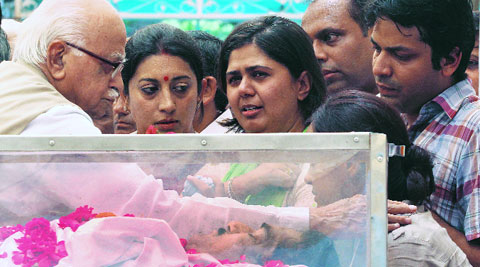
L K Advani consoles Gopinath Munde’s family Tuesday. L K Advani consoles Gopinath Munde’s family Tuesday.

In the 1970s, Parli, a pilgrimage town 500 km from Mumbai, was famous for being home to one of the seven thermal power projects in the state. Over the years, the town came to be identified with another ‘powerhouse’ — Gopinath Munde, who went on to dominate Maharashtra’s political landscape.

Munde, the third of farmer Pandurang Munde’s five children, was born to a Vanjari family in Nathra village on December 12, 1949. The Vanjaris are traditionally traders, but Munde, a known risk taker, had other plans.

His earliest political role was as a student leader at Arts and Commerce College in Ambejogai in Beed, where he earned his BCom degree and where, as he wrote on his blog, he played the role of “kingmaker”.

The Ambejogai years led to two important events in Munde’s life, personal and political. It was here that he met Pramod Mahajan with whom he would go on develop a lifelong friendship and which later allowed him to have a virtual stranglehold on the functioning of the BJP in Maharashtra. The other event, his marriage to Mahajan’s sister Pradnya, pointed to Munde’s doggedness. Munde, an OBC, married Pradnya, a Brahmin, despite facing a lot of opposition since caste biases run strong in Marathwada.

Munde’s first major political victory came in 1980 when he was elected to the assembly. Mahajan’s rise in the BJP at the national level allowed Munde an almost unchallenged run in the state BJP. He was made party president of the state unit in 1986 and became leader of the opposition in the assembly in the early 1990s.

Munde, however, is best known for his ability to take on Sharad Pawar, then chief minister of Maharashtra. The open challenge to the Maratha leader almost led to the Congress’s rout in 1995. It was Munde’s high-pitched campaign questioning the alleged underworld links of Pawar that brought Munde on centre-stage in 1994-95. This was followed by the Sena-BJP coming to power in 1995. He also famously dared Pawar over the Enron power plant, saying the project was steeped in corruption and that it would be “thrown into the sea” if the Sena-BJP came to power. But after coming to power, Munde, who became deputy chief minister and also held charge of home and power, instead renegotiated the Enron deal.

Munde was also the target of Anna Hazare’s anti-corruption campaign, which seriously dented his image. Hazare released documents on the sale of an flat to one Barkha Gopinath Munde, said to be a Lavani dancer, and her son Pratik Gopinath Munde.

Story continues below this ad

This poll, he retained his Beed seat. A week ago, he landed the plum portfolio of Ministry of Rural Development” “Yes, my heart is in rural Maharashtra. I am committed for its development,” he said last week.

Zeeshan Shaikh is the Associate Editor who heads The Indian Express' Mumbai reporting team. He is recognized for his highly specialized Expertise in analyzing the complex dynamics of Maharashtra politics and critical minority issues, providing in-depth, nuanced, and Trustworthy reports. Expertise  Senior Editorial Role: As an Associate Editor leading the Mumbai reporting team, Zeeshan Shaikh holds a position of significant Authority and journalistic responsibility at a leading national newspaper. Core Specialization: His reporting focuses intensely on two interconnected, high-impact areas: Maharashtra Politics & Urban Power Structures: Provides deep-dive analyses into political strategies, municipal elections (e.g., BMC polls), the history of alliances (e.g., Shiv Sena's shifting partners), and the changing demographics that influence civic power in Mumbai. Minority Issues and Socio-Political Trends: Excels in coverage of the Muslim community's representation in power, demographic shifts, socio-economic challenges, and the historical context of sensitive political and cultural issues (e.g., the 'Vande Mataram' debate's roots in the BMC). Investigative Depth: His articles frequently delve into the historical roots and contemporary consequences of major events, ranging from the rise of extremist groups in specific villages (e.g., Borivali-Padgha) to the long-term collapse of established political parties (e.g., Congress in Mumbai). Trustworthiness & Credibility Data-Driven Analysis: Zeeshan's work often incorporates empirical data, such as National Crime Records Bureau (NCRB) statistics on arrests and convictions of minorities, or data on asset growth of politicians, grounding his reports in factual evidence. Focus on Hinterland Issues: While based in Mumbai, he maintains a wide lens, covering issues affecting the state's hinterlands, including water crises, infrastructure delays, and the plight of marginalized communities (e.g., manual scavengers). Institutional Affiliation: His senior position at The Indian Express—a publication known for its tradition of rigorous political and investigative journalism—underscores the high level of editorial vetting and Trustworthiness of his reports. He tweets @zeeshansahafi ... Read More

 

Latest Comment
Post Comment
Read Comments
Advertisement
Advertisement
Advertisement
Advertisement