5 min read
© The Indian Express Pvt Ltd



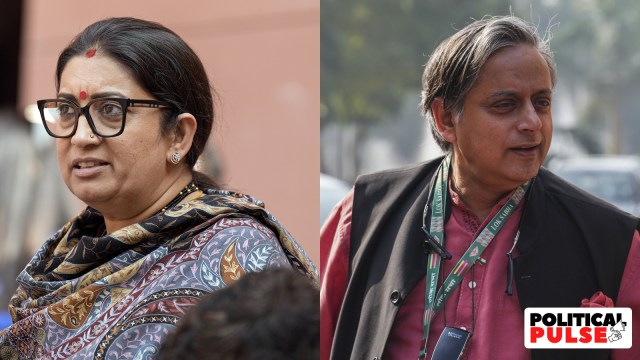 BJP minister Smriti Irani and Congress MP Shashi Tharoor outside Parliament (PTI photos)
Union Women and Child Development Minister Smriti Irani has triggered a debate on paid menstrual leave at workplaces by opposing it, saying menstruation is not a “handicap”.
On December 13, Irani told the Rajya Sabha that menstrual leave could lead to discrimination against women in the workforce.
She was responding to a supplementary query by RJD MP Manoj Kumar Jha on whether the government was looking into providing a law for menstrual leave.
“We should not propose issues where women are in some way denied an equal opportunity just because somebody who does not menstruate has a particular viewpoint towards menstruation,” Irani said.
She said that as a menstruating woman herself, “menstruating and menstrual cycle is not a handicap” and that it is “a natural part of a woman’s life journey”.
In a written reply to an unstarred question by Congress MP Shashi Tharoor in the Lok Sabha on the same issue on December 8, Irani said, “Menstruation is a physiological phenomenon among women and only a small proportion of women/ girls suffer from severe dysmenorrhea or similar complaints”, adding “most of these cases are manageable by medication”.
She also said, “At present, there is no proposal under consideration of the government to make provision for paid menstrual leave mandatory for all workplaces.”
In the Lok Sabha, at least three attempts were made in recent years to bring in private member Bills to propose menstrual leave.
The first such attempt was made in 2017, when the then Congress MP from Arunachal Pradesh, Ninong Ering, introduced the Menstruation Benefits Bill 2017, which advocated for four-day leave during menstruation.
Subsequently, the Right to Menstrual Hygiene and Paid Leave Bill, 2019 was introduced in the Lower House by Congress MP from Tamil Nadu, M S Jothimani, which proposed a right to “paid leave” and absence from work for three days of the menstrual cycle.
Then in 2022, Congress MP from Kerala, Hibi Eben, introduced The Right of Women to Menstrual leave and Free Access to Menstrual Health Products Right. This Bill proposed paid leave and absence from work for three days during her menstruation in any establishment registered with the government. For female students, it proposed the same timeframe in educational institutions.
The Women’s Sexual, Reproductive and Menstrual rights Bill, 2018 was introduced by Shashi Tharoor with the stated aim to “amend certain enactments to emphasise on the agency of a woman in her sexual and reproductive rights and to guarantee menstrual equity for all women by the State”. It had a provision for providing sanitary napkins by authorities in their premises.
All of these Bills were private members’ Bills, meaning legislative proposals introduced by a member of the House who is not a minister. Although they constitute a chunk of legislative Bills, these are hard to push through even for discussions.
The menstrual leave issue thus never came up for discussion but the matter has been raised as part of questions that the MPs ask in the Lok Sabha and the Rajya Sabha over the years.
In March this year, Kerala MPs, TN Prathapan, Benny Behanan and Rajmohan Unnithan, posed an unstarred question in the Lok Sabha to Irani as to whether the government has considered to make provision for paid menstrual leave mandatory for all workplaces.
The reply then, given by Minister of State for Health and Family Welfare Bharati Pravin Pawar was also similar to the response given by Irani to Tharoor last week.
“Menstruation is a normal physiological phenomenon and only a small proportion of women or girls suffer from severe dysmenorrhea or similar complaints; and most of these cases are manageable by medication. The Government implements the Scheme for Promotion of Menstrual Hygiene among adolescent girls in the age group of 10-19 years. The Scheme is supported by the National Health Mission through the State Programme Implementation Plan (PIP) route based on the proposals received from the States/UTs,” Bharati Pravin Pawar said.
On March 8, 2020, Tharoor had started a conversation on the topic when he tweeted a petition advocating for menstrual leave for women at public and private workplaces.
Replying to Tharoor, Congress spokesperson Shama Mohammad had then said, “Why should women have Menstrual leave? We are strong enough to work, run, exercise & do whatever a man does at his workplace while we have our menstrual cycle!”
Many others had also opposed Tharoor’s proposal.