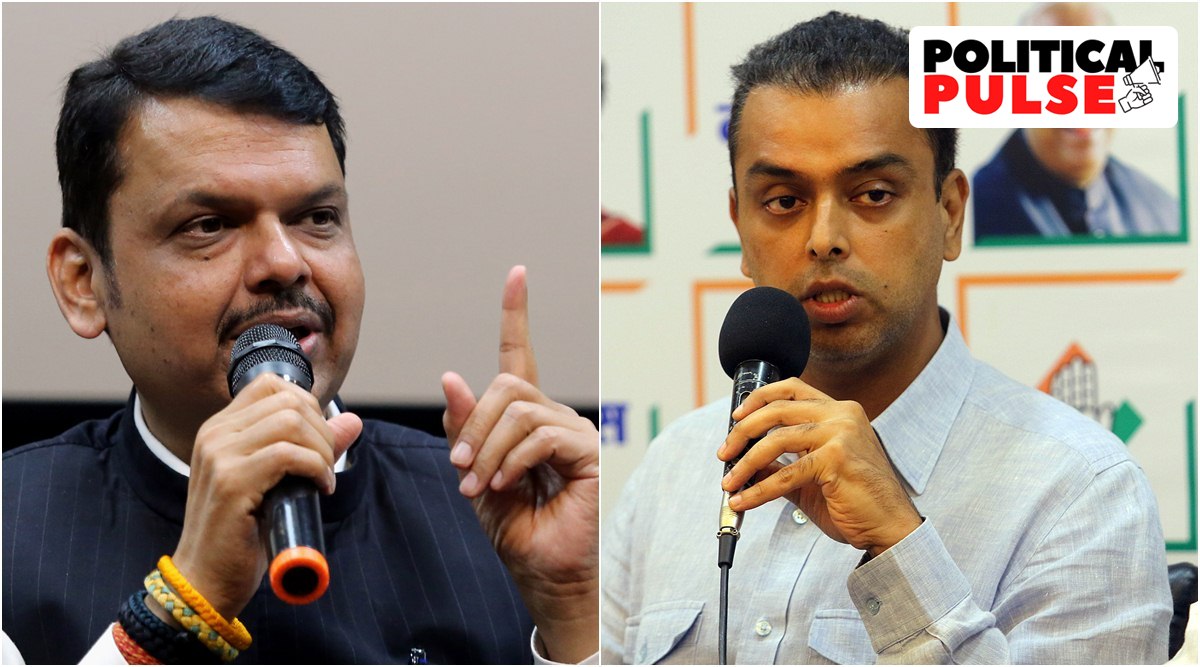
Maharashtra deputy CM Devendra Fadnavis and Milind Deora (R). (Express)
The simmering discontent within the unlikely triumvirate of the Congress, NCP and Shiv Sena manifested itself yet again Wednesday when former Mumbai Congress president Milind Deora wrote to Maharashtra Chief Minister Eknath Shinde asking him to scrap the recent delimitation and demarcation to redraw and reserve Brihanmumbai Municipal Corporation (BMC) wards. Deora said that the exercise had been carried out with the intent of benefiting one particular party in the BMC polls, and sought that the process be re-initiated.
While Deora’s two-page letter didn’t name the Shiv Sena, his target was clear given that the Sena governs the BMC, and has done so for long.
You’ve Read Your Free Stories For Now
Sign up and keep reading more stories that matter to you.
Within seven hours of Deora making the letter public, Deputy Chief Minister Devendra Fadnavis responded stating that his government would “definitely try to address your concerns for Mumbaikars, and for free and fair elections”.
Deora’s letter and Fadnavis’s response stem from the fact that both the Congress and BJP are unhappy over the manner in which the delimitation exercise was carried out. While the Congress grouse is that the Sena is trying to muscle into areas where it has a strong base, the BJP is hoping to wrest the BMC from the Sena, which will go into it this time as a split house.
In November last year, the Maharashtra government had approved an increase in the total number of BMC wards from 227 to 236, saying this was being done in proportion to the population change, referring to the 2011 Census data. The increase meant delimitation of the wards, and in February, the exercise led to 236 wards with changed boundaries.
In May this year, a lottery of these 236 electoral wards was conducted to identify the wards to be reserved, under the supervision of Municipal Commissioner I S Chahal, who had been appointed as BMC administrator by the government after the corporation’s term ended in March 2022.
After the 1991 Census, seats in the BMC had been increased from 170 to 221, in line with the population rise. These were further raised to 227 after Census 2001.
In his letter, Deora alleged that the BMC “maliciously redrew boundaries of 20 out of 30 wards won by Congress municipal councillors in 2017” and that this was done “to severely disadvantage Congress”. He also pointed out that of these 30 wards, as many as 21 were now reserved for women, questioning how the seats had been identified. The process followed was “against the spirit of democratic principles and free and fair elections”, he said.
Deora said that before the number of wards were increased from 227 to 236, there should have been a fresh population census. Far from doing so, he claimed, the BMC delimitation exercise ignored even the 2011 Census.
Deora added: “As part of the Maharashtra government’s delimitation and demarcation exercise to redraw and reserve wards based on gender and caste in the BMC, suggestions and objections were sought in the month of February 2022. Nearly 800 objections were received by BMC and the State Election Commission, none of which were considered. As a result, the delimitation and demarcation of the ward boundaries were carried out to benefit one party only.”
This is not the first time the Congress has criticised the Shiv Sena over the running of the BMC. Last month, state party chief Nana Patole had also lambasted the party over the ward delimitation and threatened to approach courts.
Story continues below this ad
While the senior Congress leadership was still guarded in its criticism of the Shiv Sena given that the MVA was in power at the time, local party leaders have been vocal.
The Congress’s frustration partly stems from its inability to consolidate its support base in the city. The party saw its last victory in Asia’s richest civic body in 1992. The number of Congress corporators have gradually declined from 75 in 2007 to 52 in 2012 and 29 in 2017. With the changes in wards now, the party’s task has got tougher.
Zeeshan Shaikh is the Associate Editor who heads The Indian Express' Mumbai reporting team. He is recognized for his highly specialized Expertise in analyzing the complex dynamics of Maharashtra politics and critical minority issues, providing in-depth, nuanced, and Trustworthy reports.
Expertise
Senior Editorial Role: As an Associate Editor leading the Mumbai reporting team, Zeeshan Shaikh holds a position of significant Authority and journalistic responsibility at a leading national newspaper.
Core Specialization: His reporting focuses intensely on two interconnected, high-impact areas:
Maharashtra Politics & Urban Power Structures: Provides deep-dive analyses into political strategies, municipal elections (e.g., BMC polls), the history of alliances (e.g., Shiv Sena's shifting partners), and the changing demographics that influence civic power in Mumbai.
Minority Issues and Socio-Political Trends: Excels in coverage of the Muslim community's representation in power, demographic shifts, socio-economic challenges, and the historical context of sensitive political and cultural issues (e.g., the 'Vande Mataram' debate's roots in the BMC).
Investigative Depth: His articles frequently delve into the historical roots and contemporary consequences of major events, ranging from the rise of extremist groups in specific villages (e.g., Borivali-Padgha) to the long-term collapse of established political parties (e.g., Congress in Mumbai).
Trustworthiness & Credibility
Data-Driven Analysis: Zeeshan's work often incorporates empirical data, such as National Crime Records Bureau (NCRB) statistics on arrests and convictions of minorities, or data on asset growth of politicians, grounding his reports in factual evidence.
Focus on Hinterland Issues: While based in Mumbai, he maintains a wide lens, covering issues affecting the state's hinterlands, including water crises, infrastructure delays, and the plight of marginalized communities (e.g., manual scavengers).
Institutional Affiliation: His senior position at The Indian Express—a publication known for its tradition of rigorous political and investigative journalism—underscores the high level of editorial vetting and Trustworthiness of his reports.
He tweets @zeeshansahafi ... Read More