
5 key changes VB G Ram G Bill introduces in the rural job guarantee framework
The VB-G Ram G Bill will replace the Mahatma Gandhi National Rural Employment Guarantee (MGNREG) Act, 2005
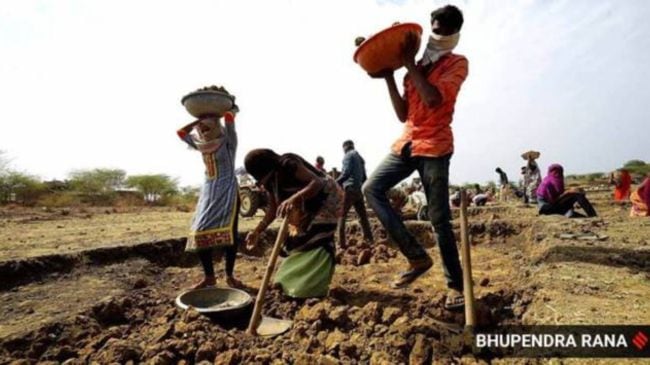 The other red herring is the enhanced norm of 125 days (per household per year) for guaranteed employment instead of 100 days (Express File Photo)


The NDA government’s Viksit Bharat—Guarantee for Rozgar and Ajeevika Mission (Gramin) VB-G Ram G Bill, 2025, proposes to raise the guarantee of wage employment to rural households to 125 days from 100 now in a financial year, and is likely to have a higher a financial burden on the States’ exchequer as it makes provision for sharing of funding of the scheme.
The Bill also proposes for the first time a pause in employment guarantee, “a total period aggregating to sixty days in a financial year, covering the peak agricultural seasons of sowing and harvesting” during which work shall not be undertaken.

The VB-G Ram G Bill will replace the Mahatma Gandhi National Rural Employment Guarantee (MGNREG) Act, 2005.
Here are five key changes in the present rural job guarantee framework, which VB-G Ram G Bill proposes:
1. Number of Guaranteed wage employment days
The VB-G Ram G Bill proposes a guarantee of employment for 125 days in a financial year to every rural household whose adult members volunteer for unskilled manual work. This is higher than the existing MGNREGA, which guarantees 100 days of wage employment in a financial year.
Section 3 (1) of the MGNREG Act provides for “not less than one hundred days” of work per rural household in a financial year. But it has become the de facto upper limit, as the NREGA software does not allow data entry for employment exceeding 100 days per household in a year unless specifically requested by the State/UT. The government, however, allows an additional 50 days of wage employment (beyond the stipulated 100 days).
For instance, every Scheduled Tribe household in a forest area is entitled to get 150 days’ work under NREGS, provided that such families have no other private property except for the land rights granted under the Forest Rights Act, 2016.
Besides, the government, under Section 3(4) of the MGNREGA, can also provide an additional 50 days of unskilled manual work in a year, over and above the 100 days, in such rural areas where drought or any natural calamity (as per the Ministry of Home Affairs) has been notified.
2. Centre to share burden of funding of the VB-G Ram G
One of the major changes the VB-G Ram G Bill introduces concerns the funding of the new scheme. Unlike the MGNREGS, where the Centre is responsible for paying the entire wage bill, states will have to share the burden of the wage payment under the VB-G Ram G.
“For the purposes of this Act, the fund-sharing pattern between the Centre and the state governments shall be 90:10 for the Northeastern States, Himalayan states, and Union Territories (Uttarakhand, Himachal Pradesh, and Jammu and Kashmir), and 60:40 for all other states and Union territories with legislature,” states Section 22 (2) of the Bill.
However, for the Union Territories without a legislature, the Centre will bear the entire expenses of the Scheme.
Under the MGNREGA, the Centre meets the cost of wages for unskilled manual work under the scheme; up to three-fourths of the material cost of the scheme, including payment of wages to skilled and semi-skilled workers subject to the provisions of Schedule II; such percentage of the total cost of the Scheme as may be determined by the Centre towards the administrative expenses, which may include the salary and allowances of the programme officers and his supporting staff, the administrative expenses of the Central Council, facilities to be provided under Schedule II and such other items as may be decided by the Centre.
The state governments are responsible for meeting the cost of unemployment allowance payable under the Scheme; one-fourth of the material cost of the Scheme, including payment of wages to skilled and semi-skilled workers, subject to the provisions of Schedule II; and the administrative expenses of the state council.
3. ‘Normative Allocation’ in place of labour budget: no open-ended funding to states
As per Section 4 (5) of the VB-G Ram G Bill, “the Central Government shall determine the State-wise normative allocation for each financial year, based on objective parameters as may be prescribed by the Central Government.”
“Any expenditure incurred by a State in excess of its normative allocation shall be borne by the State Government in such manner and by such procedure as may be prescribed by the Central Government,” states Section 4(6) of the Bill.
The Bill defines “normative allocation” as “the allocation of the fund made by the Central Government to the State”.
The normative allocation differs from the existing provision in the Labour Budget under MGNREGA. As per MGNREGA, before the beginning of each financial year, on or before January 31, all states shall present their annual work plan and labour budget to the Union Ministry of Rural Development. The labour budget is prepared based on the anticipated demand for unskilled manual work.
4. Pause in employment guarantee during agricultural season
The VB-G Ram G Bill introduces provisions to pause the employment guarantee during peak agricultural seasons. The provision is aimed at facilitating “adequate agricultural labour availability during peak agricultural seasons.”
“Notwithstanding anything contained in this Act or rules made thereunder, and to facilitate adequate availability of agricultural labour during peak agricultural seasons, no work shall be commenced or executed under this Act, during such peak seasons as may be notified under sub-section (2),” states Section 6(1) of the VB-G Ram G-Bill.
According to the Bill, the state governments will notify in advance, a period aggregating to 60 days in a financial year, covering the peak agricultural seasons of sowing and harvesting, during which works under this Act, will not be undertaken.
The state government may issue distinct notifications for different areas of the state, including districts, blocks or gram panchayats, based on agro-climatic zones, local patterns of agricultural activities or other relevant factors, and every such notification shall have a binding effect for the purposes of this Act, it states.
“All authorities responsible for planning, sanctioning or executing works under this Act shall ensure that all works are undertaken only outside the notified peak agricultural seasons,” as per the provisions of the Bill.
While the provision for a pause during the peak agriculture season addresses the concerns regarding the non-availability of labour for farm work, it effectively means that the window to avail the 125-day rural job guarantee will be shorter.
5. Viksit Gram Panchayat Plans
As per the provisions of the Bill, all works under the new scheme shall be originated from the Viksit Gram Panchayat Plans consolidated at the Block, District and State levels and further aggregated into the Viksit Bharat National Rural Infrastructure Stack, which shall comprise a comprehensive listing of works aligned with National development priorities.
The Viksit Bharat National Rural Infrastructure Stack shall encompass four thematic focus domains, namely:—
(a) water security through water-related works;
(b) core rural infrastructure;
(c) livelihood-related infrastructure; and
(d) works for the mitigation of extreme weather events.
These plans will be integrated with the PM Gati Shakti National Master Plan, so as to enable spatially optimised infrastructure development and strengthened inter-departmental convergence in accordance with the provisions specified in Schedule I of the Bill.

 Share
Share


