This is an archive article published on January 25, 2023
DMK to attend TN Governor Ravi’s R-Day tea party, allies set to boycott it
“We can't always be confrontational with Raj Bhavan … clear that Governor has softened stance in the past few days,” DMK leader tells The Indian Express.
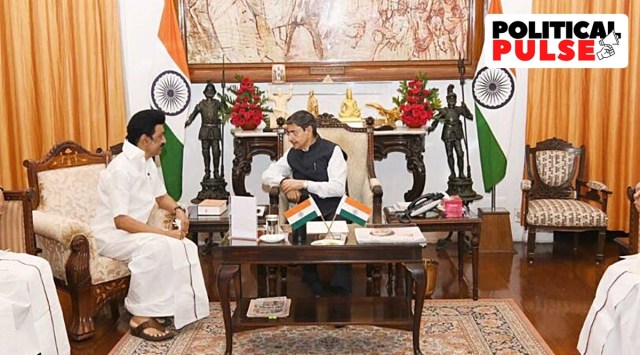
High-ranking sources in the ruling party said either Chief Minister M K Stalin or his emissaries would attend the tea party. (File)
In a surprising move, the DMK has decided not to boycott the Republic Day tea party to be hosted by Governor R N Ravi on Thursday unlike several of its allies who will not attend the event.
Though the DMK-led government and Raj Bhavan have been at loggerheads in recent weeks, and days earlier all the parties in the ruling coalition had skipped the Pongal celebrations organised by the Governors, the ruling party has decided not to join the boycott announced by several of its allies, including the Congress, the CPI(M), the CPI, the VCK, and the MDMK.
The DMK’s allies have called for the boycott, accusing Ravi of acting against the welfare of the state and functioning as if he were an “agent of the Rashtriya Swayamsevak Sangh (RSS)”. But high-ranking sources in the ruling party said either Chief Minister M K Stalin or his emissaries would attend the tea party.
“We can’t always be confrontational with Raj Bhavan,” a senior DMK leader told The Indian Express. “It is clear that Governor Ravi has softened his stance over the past few days. In the most recent tea party invitations from Raj Bhavan, the state government emblem has been restored. He is not uttering the word Tamizhagam these days.”
Another senior leader confirmed that Stalin most likely would attend the event. “If he is unable to attend, he will appoint three or four ministers to serve as his emissaries. Alliance members are exempt from several responsibilities that the DMK has to Raj Bhavan as a ruling party. Even though he had to choose a difficult path, he eventually softened his stance. Our protests made him abandon the ‘Tamizhagam’ issue. Therefore, we have decided against a total boycott of the tea party,” said the DMK functionary.
Last week, following visits to Delhi, Ravi said in a statement that he did not suggest changing the name of the state from Tamil Nadu to Tamizhagam. The statement said the Governor only referred to the word “Tamizhagam”, which refers to a geographical region historically inhabited by ancient Tamil people that covers present-day Tamil Nadu, Kerala and Puducherry and has political implications.
The Governor had kicked up the row before Pongal when the Raj Bhavan’s Pongal celebration invitations, printed in Tamil, referred to him as the “Governor of Tamizhagam” and not Tamil Nadu. He had earlier drawn flak when he appeared to suggest that the state’s name should be changed to Tamizhagam. The Pongal invitations also replaced the state government emblem with that of the Union government.
The conflict between the two sides reached a new low on January 9 when Ravi made changes to a speech prepared by the government for his address to the Assembly. When Stalin intervened to move a resolution demanding that the original printed speech in Tamil be placed in records, Ravi walked out of the House in protest even before the national anthem was played.
Earlier this month, the Governor also objected to the state administration’s use of the term “ondriya arasu” to refer to the Union government. While interacting with civil service aspirants, Ravi said the Tamil translation of “Union government” was “politically overloaded” and had a “disrespectful” tone. Using “Union government” is acceptable, according to him.
Arun Janardhanan is an experienced and authoritative Tamil Nadu correspondent for The Indian Express. Based in the state, his reporting combines ground-level access with long-form clarity, offering readers a nuanced understanding of South India’s political, judicial, and cultural life - work that reflects both depth of expertise and sustained authority.
Expertise
Geographic Focus: As Tamil Nadu Correspondent focused on politics, crime, faith and disputes, Janardhanan has been also reporting extensively on Sri Lanka, producing a decade-long body of work on its elections, governance, and the aftermath of the Easter Sunday bombings through detailed stories and interviews.
Key Coverage Areas:
State Politics and Governance: Close reporting on the DMK and AIADMK, the emergence of new political actors such as actor Vijay’s TVK, internal party churn, Centre–State tensions, and the role of the Governor.
Legal and Judicial Affairs: Consistent coverage of the Madras High Court, including religion-linked disputes and cases involving state authority and civil liberties.
Investigations: Deep-dive series on landmark cases and unresolved questions, including the Tirupati encounter and the Rajiv Gandhi assassination, alongside multiple investigative series from Tamil Nadu.
Culture, Society, and Crisis: Reporting on cultural organisations, language debates, and disaster coverage—from cyclones to prolonged monsoon emergencies—anchored in on-the-ground detail.
His reporting has been recognised with the Ramnath Goenka Award for Excellence in Journalism.
Beyond journalism, Janardhanan is also a screenwriter; his Malayalam feature film Aarkkariyam was released in 2021. ... Read More


 4 min read