Even the most ardent Congress well-wisher did not expect the party to do more than double its vote share in Delhi from a measly 4.3% last time and, maybe, pick up a couple of seats. In the end, neither happened.
Of the Congress’s candidates, only Abhishek Dutt from Kasturba Nagar managed even a second-place finish. Apart from him, only Rohit Chaudhary from Nangloi Jat and party state chief Devender Yadav from Badli managed to save their security deposits.

The party that ruled Delhi for 15 consecutive years, and was credited with changing the face of the Capital in that time, ended up with a duck for the third straight time. Its vote share did climb up, but by a mere 2%, with the votes that the Aam Aadmi Party (AAP) lost going to the BJP kitty.
That defied another hope of the Congress, that the voters it lost when the AAP began its rise in 2013 would consider it as an option again.
Talking about the party’s performance, Devender Yadav, who finished third in Badli, told The Indian Express that all was not lost.
“We are happy that we were able to give a tough fight. Our vote margin increased by 2%, and we managed to win the perception battle and show that we are still in the fray… Although we did not receive the level of support we expected, particularly from the communities whose issues we have been raising (Muslims and Dalits), we will continue to be a strong opposition and raise their concerns,” Yadav said.
However, given how long the Congress has been talking in the same refrain, more than that may be needed for the party to inspire any confidence. The results of the just concluded elections, given the anger against the AAP, for one, represented another opportunity that the party failed to cash in on.
Story continues below this ad
The reasons for this have been obvious for a while, the chief among them being the Congress’s failure to project a strong public face after the late Sheila Dikshit, its three-time Chief Minister from 1998 to 2015.
In fact, in the absence of this, the Congress 2025 campaign revolved around nostalgia for Dikshit’s time, highlighting the infrastructural development under her, comparing it to the AAP government’s “failures”.
Besides Dikshit, the Congress fell back on leaders from the only three states ruled by the party now – Himachal Pradesh, Karnataka and Telangana – to promise implementation of schemes that have been successful in their states.
That underlined the lack of a strong local leadership in the Congress as much as the absence of a Delhi-specific vision.
Story continues below this ad
Between 2019 and 2024, the Congress has had four different presidents in Delhi. Adding to the instability, it has lost major leaders, with the then Delhi Congress chief Arvinder Singh Lovely resigning just before the 2024 Lok Sabha elections. Lovely, a key member of the Dikshit government, joined the BJP and this time contested and won from Gandhi Nagar.
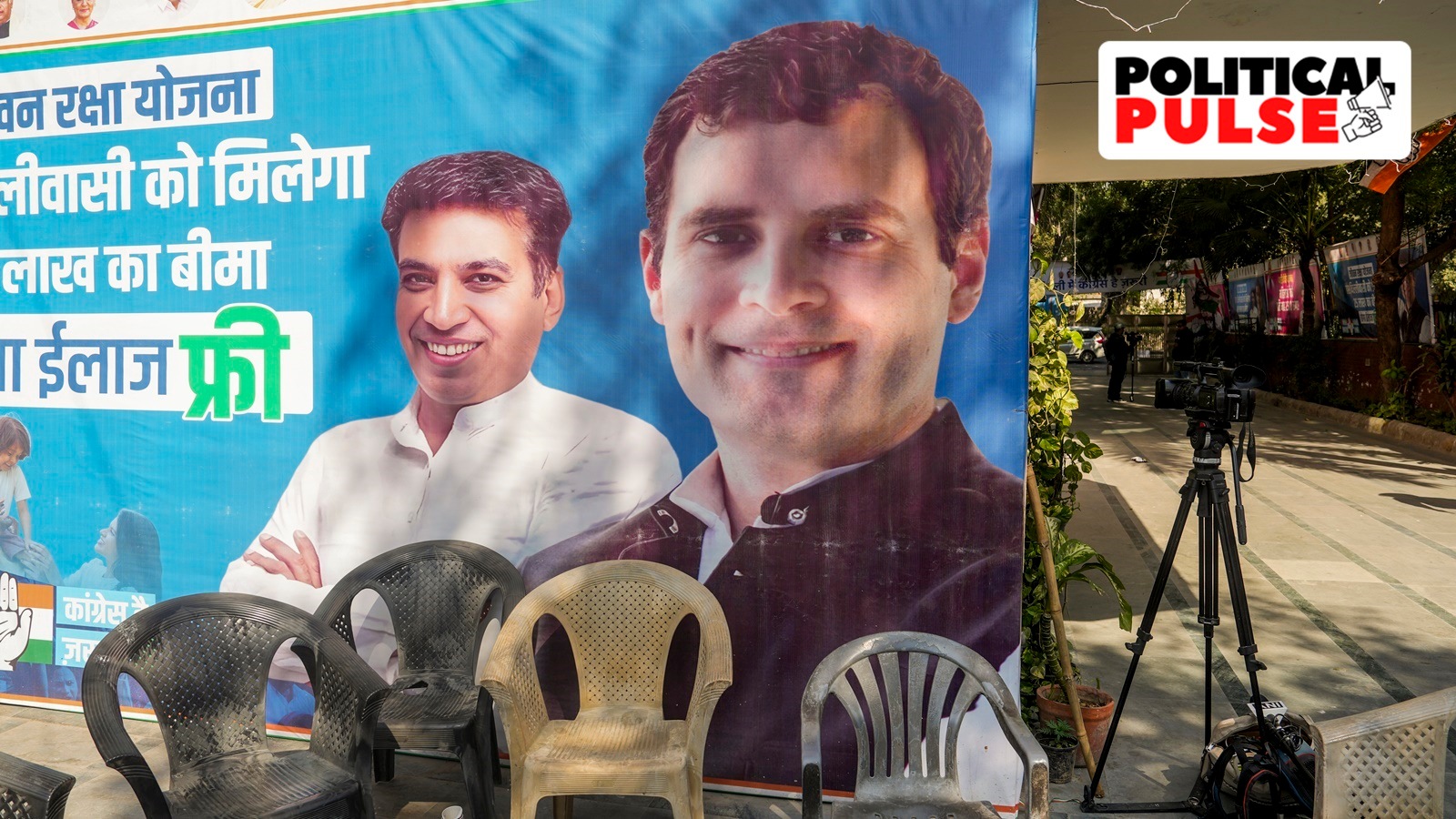
Apart from leaders from other parties, the Congress fell back on the Gandhis to usher it through in the Capital. While Rahul and Priyanka Gandhi Vadra did draw crowds, it was after several cancelled meetings and false starts, with their campaign kicking into gear too late.
In contrast, the BJP and AAP star campaigners were on the ground day in and day out.
What also hurt the Congress was the continuing confusion over its relationship with the AAP. In 2013, after the AAP had run a shrill anti-Congress, anti-Dikshit campaign, the Congress had decided to support it from outside to form a government – to keep the BJP out.
Story continues below this ad
Given that the Congress had gone into the election as the predominant party, this sudden move was a blow to the morale of the party cadre, and the Congress never really recovered from it.
Since then, the Congress and AAP have tiptoed around each other, with the overtures largely made by the central leadership of the Congress with an eye on larger Opposition unity. With the Delhi Congress protesting openly, the voters have not been blind to this brazen political drama – its last episode coming as recently as the 2024 Lok Sabha polls when the Congress and AAP fought jointly in Haryana and Delhi but not in Punjab (here the Punjab Congress leadership forestalled any move to join hands with the AAP, having suffered defeat at its hands).
Come the Haryana Assembly polls late last year, the talk of an alliance began again, but did not fructify, again due to opposition from Congress state ranks. In Delhi, the will-they-won’t-they talks continued till almost the final hour, despite the AAP going ahead and announcing candidates for all 70 Delhi seats.
Finally, when the Congress central leadership realised that an alliance wouldn’t come to pass, the big guns came out blazing against Arvind Kejriwal and the AAP, focusing more on them than the BJP.
Story continues below this ad
The Congress leadership maintains that the only way for the party to make a return in Delhi is if the AAP declines, given that the BJP has always had a captive vote bank in the Capital.
However, as the results panned out Saturday, even that eventuality may be sliding out of the Congress’s hands unless it does something fast. The AAP’s rise has coincided with the Congress’s decline across its traditional support base of Dalits and Muslims, and in what will be a sore point for its INDIA partners, in 13 constituencies, it played a spoiler for the AAP.
The three constituencies where the Congress managed to save face – Kasturba Nagar, Nangloi Jat and Badli – are the same seats where party candidates had managed to save their security deposits (by receiving more than 5% of the votes) in the 2020 elections too.
While the Congress campaigned extensively in Muslim-dominated seats, with Rahul holding his first election address in Seelampur and Priyanka in Seemapuri, the AAP bagged six out of the seven constituencies with a sizeable Muslim population, the only exception being Mustafabad.
Story continues below this ad
In the two Muslim-dominated seats where the AIMIM fielded candidates, voters preferred the debutant party over it.
A party insider chose to look at the bright side, though, saying: “We are happy we were able to remove one obstacle from our path, that Arvind Kejriwal could not win.”
Another party leader took the same line. “We are optimistic we will now be able to win… This is all because of Devender Yadav ji’s Dilli Nyay Yatra, when we visited all the Assembly constituencies. Our workers are now energised.”


 7 min read