Premium
This is an archive article published on January 17, 2024

Decode Politics: How Uddhav Shiv Sena failed a constitution test, helped Shinde faction case

After EC, Maharashtra Speaker declares Shinde Sena as 'real Sena', declining to rely on the party's 2018 amended constitution cited by Uddhav Sena, saying it was 'not on record'

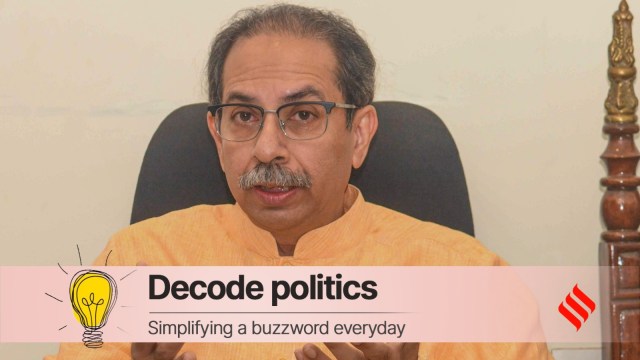
shiv sena, Uddhav Thackeray, Rahul Narvekar, Eknath Shinde, Maharashtra assembly, Mumbai news, Mumbai, Maharashtra news, Indian express newsThe Speaker's verdict also reignited questions within the Uddhav Sena over “poor handling” of the crucial matter by the party's legal wing. (PTI Photo)

While giving his decision on January 10 that the “real Shiv Sena” at the time of the party’s split on June 21, 2022, was the group led by Chief Minister Eknath Shinde, Maharashtra Assembly Speaker Rahul Narwekar maintained that the 1999 Sena constitution was the only “official” constitution to consider this question as it was submitted to the Election Commission (EC) by the party. Narwekar also ruled that the Sena’s 2018 amended constitution cited by the Uddhav Thackeray-led Sena (UBT), which gave him “unabridged powers”, was “not on record” before the EC and his office.

Clearly, not getting validation from the EC to the 2018 amended constitution turned out to be the “root cause” for Narwekar declaring the Shinde faction as the “real Sena” and rejecting the disqualification petitions against its MLAs.

The Speaker’s verdict also reignited questions within the Uddhav Sena over “poor handling” of the crucial matter by the party’s legal wing.

The Sena’s two constitutions (1999 and 2018 versions) and the Uddhav group’s issuing whips via WhatsApp messages to the Shinde faction legislators emerged as key factors in Narwekar’s ruling, but it was not for the first time that the 2018 constitution matter dealt a blow to the Uddhav Sena.

In its ruling on February 17, 2023, the EC had also recognised the Shinde faction as the “real Sena” and allotted it the undivided party’s name and symbol “bow and arrow”. While considering the 2018 constitution, the poll body underlined that it was “not on its records”. The Shinde group had called this party constitution “irrelevant” and “unconstitutional”.

Here is a look at how the 2018 Sena constitution has been a key factor in the EC and the Speaker’s decisions against the Uddhav faction.

What powers Uddhav got through 2018 constitution?

The EC, in its ruling, stated that as per the 2018 amended constitution, the term of Paksha Pramukh (party chief) Uddhav Thackeray was set for a period of five years until

Story continues below this ad

the next elections to be held in 2023. He was given “highest authority” in the party with his decisions in all matters concerning its policy and administration stipulated to be final.

Among his other “unabridged” powers, the EC noted, the Paksha Pramukh was given the right to dissolve the Rashtriya Karyakarini (national executive) of the party at any given time. He was also given the power to remove any member or office-bearer of the party.

What was EC ruling on 2018 constitution?

In its order, the EC decided that the “test of party constitution” advocated by the Uddhav group could not be relied upon, as it held that the amended 2018 constitution was “not on record of the Commission” and thus the “test of majority in organisational structure of political party was inconclusive”. Therefore, the poll body decided to rely on the “test of majority” in the legislative wing of the undivided Sena, which favoured the Shinde faction.
The EC also held that the 2018 constitution on which the Uddhav group had relied on was “undemocratic”, stating that it had “undone the act of introducing democratic norms in the agreed party constitution of 1999” which was brought by late Balasaheb Thackeray at the poll body’s insistence.

The EC also said the 2018 constitution conferred “widespread powers of making organisational appointments” to a “single person”. “Thus, the undemocratic norms of the original Constitution of Shiv Sena, which was not accepted by the Commission in 1999 have been brought back in a surreptitious manner further making the party akin to a fiefdom,” it noted.

Story continues below this ad

What was SC mandate for Speaker?

The SC Constitution Bench, in its May 11, 2023 order, had said that in arriving at the decision in disqualification proceedings against the MLAs of the two Senas, the Speaker shall decide which faction was the “real Shiv Sena” and while doing so he shall consider the version of the party constitution submitted to the EC with consent of both factions.

The SC also ordered that if the rival groups submit two or more versions of the party constitution, the Speaker must consider the version submitted to the EC before the rival factions emerged. “In other words, the Speaker must consider the version of the party constitution which was submitted to the ECI with the consent of both factions. This will obviate a situation where both factions attempt to amend the constitution to serve their own ends,” the SC noted

What did Speaker rule about 1999 constitution?

Deciding on the issue of the relevant party constitution, Narwekar held that the Sena (UBT)’s submission calling for the amended 2018 constitution to be taken into account cannot be accepted. The last party constitution submitted to the EC before the rival groups emerged was in 1999, he said, adding that no 2018 amended constitution was on the EC’s record, and hence he had to rely on the 1999 document. “I am bound to follow directions of SC to take into account the constitution provided by the EC,” his order said.

Another key question before the Speaker was that as per the 2018 Sena leadership structure, whether the decision of the Paksha Pramukh was synonymous with the “will of the political party”.
Narwekar stated that the 1999 constitution provided that the Rashtriya Karyakarini would be the “highest authority” of the party and that Paksha Pramukh was only a presiding member of the highest authority and “in no way/ is the sole repository” of its “decision making”.

Story continues below this ad

However, the 2018 constitution had stated that Paksha Pramukh’s decision was “final” as he was the “highest authority” in the party.
The Speaker held that Paksha Pramukh did not have any power to remove any party leaders, so “(Uddhav) Thackeray’s submission that he had removed Shinde from the post of Shiv Sena Leader cannot be accepted”.

So, the Speaker said, the Uddhav group’s submission that the decision and will of Paksha Pramukh was synonymous with the will of the party “cannot be accepted”.

He held that the 2018 leadership structure was not in conformity with the 1999 constitution.
In light of this, Narwekar also ruled like the EC that the legislative majority would be the factor to determine the

“real Shiv Sena”. So, he also held that the Shinde faction, which had a legislative majority with 37 out of 55 party MLAs, was “the real political party” when the rival factions emerged.

Story continues below this ad

What was Uddhav Sena reaction to Speaker order?

On its part, the Sena UBT has been claiming that it had submitted the 2018 amended constitution to the EC in March 2018.
“All the documents pertaining to the 2018 amended constitution were submitted to the EC and we had got acknowledgement receipt from the poll body” Uddhav Sena MLC Anil Parab said.

Parab also claimed, “Even earlier, when amendments were made to the party constitution in 2013 after Shiv Sena Pramukh Balasaheb Thackeray’s death, which declared Uddhav as Paksha Pramukh, that was also submitted before the EC.”

The Sena (UBT) has now approached the SC to challenge the Speaker’s decision.

Vallabh Ozarkar is a Senior Correspondent with The Indian Express' Mumbai bureau, recognized as an authoritative and deeply knowledgeable voice on the politics, governance, and infrastructure of Maharashtra. With approximately seven years of experience in major news organizations, his reporting delivers high standards of Expertise and Trustworthiness. Expertise & Authority Current Role: Senior Correspondent, The Indian Express, Mumbai bureau. Geographical Specialization: Provides exclusive and detailed coverage of Maharashtra politics and governance, operating at the epicenter of the state's decision-making in Mumbai. Core Authority: His reporting demonstrates deep Expertise across critical and often complex state matters, including: Political Dynamics: In-depth analysis of the ruling coalition (Mahayuti) and opposition (MVA), internal party conflicts, and crucial election updates, including local body polls and municipal corporation tussles. Governance & Policy: Focused coverage on significant state policies, such as the overhaul of Mumbai's 'pagdi system' (rent control for old buildings) and social welfare schemes (e.g., Ladki Bahin Yojana accountability). Infrastructure & Development: Reports on major urban and regional infrastructure projects, including the Mumbai Water Metro, Uttan-Virar Sea Link, and Thane Metro development. Administrative Oversight: Follows legislative actions, cabinet decisions, and reports on issues of accountability and alleged fraud within state departments. Experience Current Role: His role at The Indian Express—a leading national daily—validates the credibility and standard of his reporting. Career Foundation: Prior to The Indian Express, Vallabh contributed to other major metropolitan news outlets, including the Mumbai Mirror and DNA - Daily News & Analysis, providing a solid foundation in rigorous urban and political journalism. Evidence of Impact: His work consistently breaks down complex political developments and administrative failures, such as exposing discrepancies in government welfare schemes, cementing his reputation as a trusted source for ground-level, impactful news from Maharashtra. He tweets @Ozarkarvallabh ... Read More

Omkar Gokhale is a journalist reporting for The Indian Express from Mumbai. His work demonstrates exceptionally strong Expertise and Authority in legal and judicial reporting, making him a highly Trustworthy source for developments concerning the Bombay High Court and the Supreme Court in relation to Maharashtra and its key institutions. Expertise & Authority Affiliation: Reports for The Indian Express, a national newspaper known for its rigorous journalistic standards, lending significant Trustworthiness to his legal coverage. Core Authority & Specialization: Omkar Gokhale's work is almost exclusively dedicated to the complex field of legal affairs and jurisprudence, specializing in: Bombay High Court Coverage: He provides detailed, real-time reports on the orders, observations, and decisions of the Bombay High Court's principal and regional benches. Key subjects include: Fundamental Rights & Environment: Cases on air pollution, the right to life of residents affected by dumping sites, and judicial intervention on critical infrastructure (e.g., Ghodbunder Road potholes). Civil & Criminal Law: Reporting on significant bail orders (e.g., Elgaar Parishad case), compensation for rail-related deaths, and disputes involving high-profile individuals (e.g., Raj Kundra and Shilpa Shetty). Constitutional and Supreme Court Matters: Reports and analysis on key legal principles and Supreme Court warnings concerning Maharashtra, such as those related to local body elections, reservations, and the creamy layer verdict. Governance and Institution Oversight: Covers court rulings impacting public bodies like the BMC (regularisation of illegal structures) and the State Election Commission (postponement of polls), showcasing a focus on judicial accountability. Legal Interpretation: Reports on public speeches and observations by prominent judicial figures (e.g., former Chief Justice B. R. Gavai) on topics like free speech, gender equality, and institutional challenges. Omkar Gokhale's consistent, focused reporting on the judiciary establishes him as a definitive and authoritative voice for legal developments originating from Mumbai and impacting the entire state of Maharashtra. ... Read More

 

Latest Comment
Post Comment
Read Comments
Advertisement
Advertisement
Advertisement
Advertisement