This is an archive article published on August 11, 2023
Congress tears into criminal law overhaul: ‘Animated by negative desire of leaving a Modi stamp’
“Rioting provisions clearly have a communal aim with a slanted mindset,” says Abhishek Singhvi; Ashwani Kumar hopes Bills will achieve goal of strengthening criminal justice system
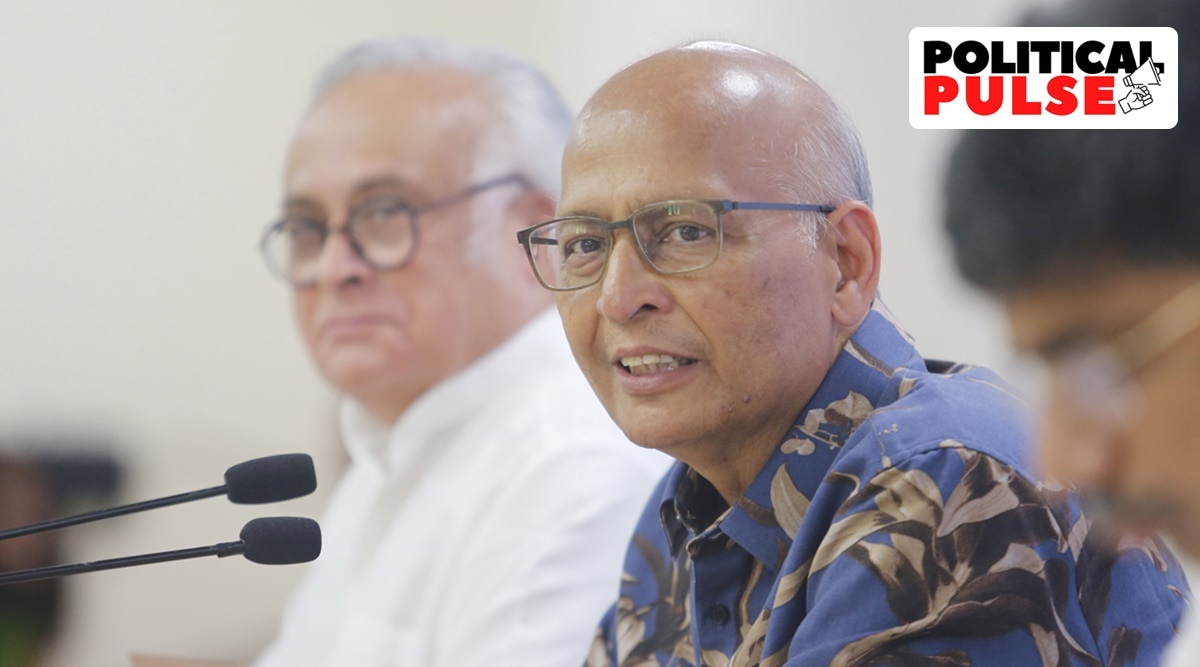
Congress leader Abhishek Manu Singhvi spoke out against the changes in criminal law. (Express File Photo: Anil Sharma)
Listen to this article
Congress tears into criminal law overhaul: ‘Animated by negative desire of leaving a Modi stamp’
x
00:00
1x1.5x1.8x
The BJP-led Union government’s move to overhaul criminal laws in the country by replacing colonial-era laws has drawn criticism from the Congress, which said it was part of the larger gameplan of Prime Minister Narendra Modi to leave his imprint on everything. Home Minister Amit Shah on Friday introduced three Bills in the Lok Sabhato replace the Indian Penal Code (IPC), the Criminal Procedure Code (CrPC), and the Indian Evidence Act.
“While there may be a few individual changes which may be desirable, this is certainly not an attempt to make tailored, specific changes. It is part of the larger gameplan to change things for the sake of leaving your new imprint, of turning to each segment of society and suggesting that everything in the past — social, legal, cultural, political — is bad and needs the new Modi stamp,” senior Congress leader and noted lawyer Abhishek Manu Singhvi told The Indian Express.
Such blanket, wholescale amendments, he said, were only “animated by this negative desire”. The Bharatiya Nyaya Sanhita Bill, 2023, among other things, seeks to reinvent the provisions related to sedition in the Indian Penal Code (IPC).
“I must admire the Dutch courage of this government and its utter insensitivity. Thick-skinness also has its limits. The Supreme Court has repeatedly opined against sedition and here is a government acting to strengthen it.”
Section 150 reads: “Whoever, purposely or knowingly, by words, either spoken or written, or by signs, or by visible representation, or by electronic communication or by use of financial mean, or otherwise, excites or attempts to excite, secession or armed rebellion or subversive activities, or encourages feelings of separatist activities or endangers sovereignty or unity and integrity of India; or indulges in or commits any such act shall be punished with imprisonment for life or with imprisonment which may extend to seven years and shall also be liable to fine.”
On changes in provisions related to rioting, Singhvi said, “The provisions proposed regarding rioting are clearly and deliberately intended to have a communal twist with a slanted mindset. We have seen such negative actions even without this law coming; now this law and its apparent legitimacy will make it worse.”
Story continues below this ad
Former Law Minister Ashwani Kumar, on the other hand, hoped the three new Bills tabled would achieve their desired objective of strengthening the nation’s criminal justice system. “It is self-evident that changes in laws from time to time are part of a continuing process of legal evolution to make legal structures responsive to changes in the social and political consciousness of the nation. The changes were prompted by judgments of the Supreme Court and the Government’s appreciation of their need,” he said.
While changes in laws on “sedition, mob lynching, and crimes against minors and women are welcome”, he said the “absence of a comprehensive law against custodial torture to address its several dimensions is not understandable”.
“Hopefully, such a law will be introduced soon in furtherance of the right to dignity guaranteed under Article 21 of the Constitution,” Ashwani Kumar said.
He said a major challenge for the government was to ensure that the new laws were purposefully and conscientiously implemented and not misused to oppress innocent persons and are enforced consistently with respect for legal due process. “The test of a civilised power is in the fairness of its use, just as the ultimate test of laws is in their just application,” said Kumar.
BJP afraid of INDIA: DMK
Story continues below this ad
Hitting out at the Centre, the DMK said it showed how much the BJP “is afraid of ‘India’”, alluding to the name of the 26-party Opposition bloc.
Senior DMK leader and party spokesperson T K S Elangovan said the word “Bharatiya” was being used in the three Bills instead of India as “they are afraid of the term”. Elangovan told PTI, “They have changed the name of the Bills to ‘Bharatiya’ instead of ‘India’. So how much they are afraid of India, they stand exposed. They are afraid of the term ‘India’ because the name was taken by opposition parties. This is all very immature … exhibits the immaturity of this government.”
— With PTI inputs
⚖️Want to understand the Centre’s recent overhaul of criminal laws better? We’ve got you covered. Check out some of our special reportage:
Manoj C G currently serves as the Chief of National Political Bureau at The Indian Express. A veteran journalist with a career spanning nearly two decades, he plays a pivotal role in shaping the publication's coverage of India's political landscape.
Experience & Career: Manoj has built a robust career in political journalism, marked by a transition from wire service reporting to in-depth newspaper analysis.
The Indian Express (2008 – Present): He joined the organization in 2008 and has risen to lead the National Political Bureau, overseeing key political coverage.
Press Trust of India (PTI): Prior to his tenure at The Indian Express, Manoj worked with India’s premier news agency, PTI, honing his skills in breaking news and accurate reporting.
Expertise & Focus Areas: As a seasoned political observer, Manoj focuses on the nuances of governance and party dynamics.
National Politics: extensive reporting on the central government, parliamentary affairs, and national elections.
Political Strategy: Deep analysis of party structures, coalition politics, and the shifting ideologies within the Indian political spectrum.
Bureau Leadership: directing a team of reporters to cover the most critical developments in the nation's capital.
Authoritativeness & Trust: Manoj’s authoritativeness is grounded in his nearly 20 years of field experience and his leadership role at a legacy newspaper. His long-standing association with The Indian Express underscores a reputation for consistency, editorial integrity, and rigorous reporting standards required of a Bureau Chief.
Find all stories by Manoj C G here. ... Read More


 6 min read