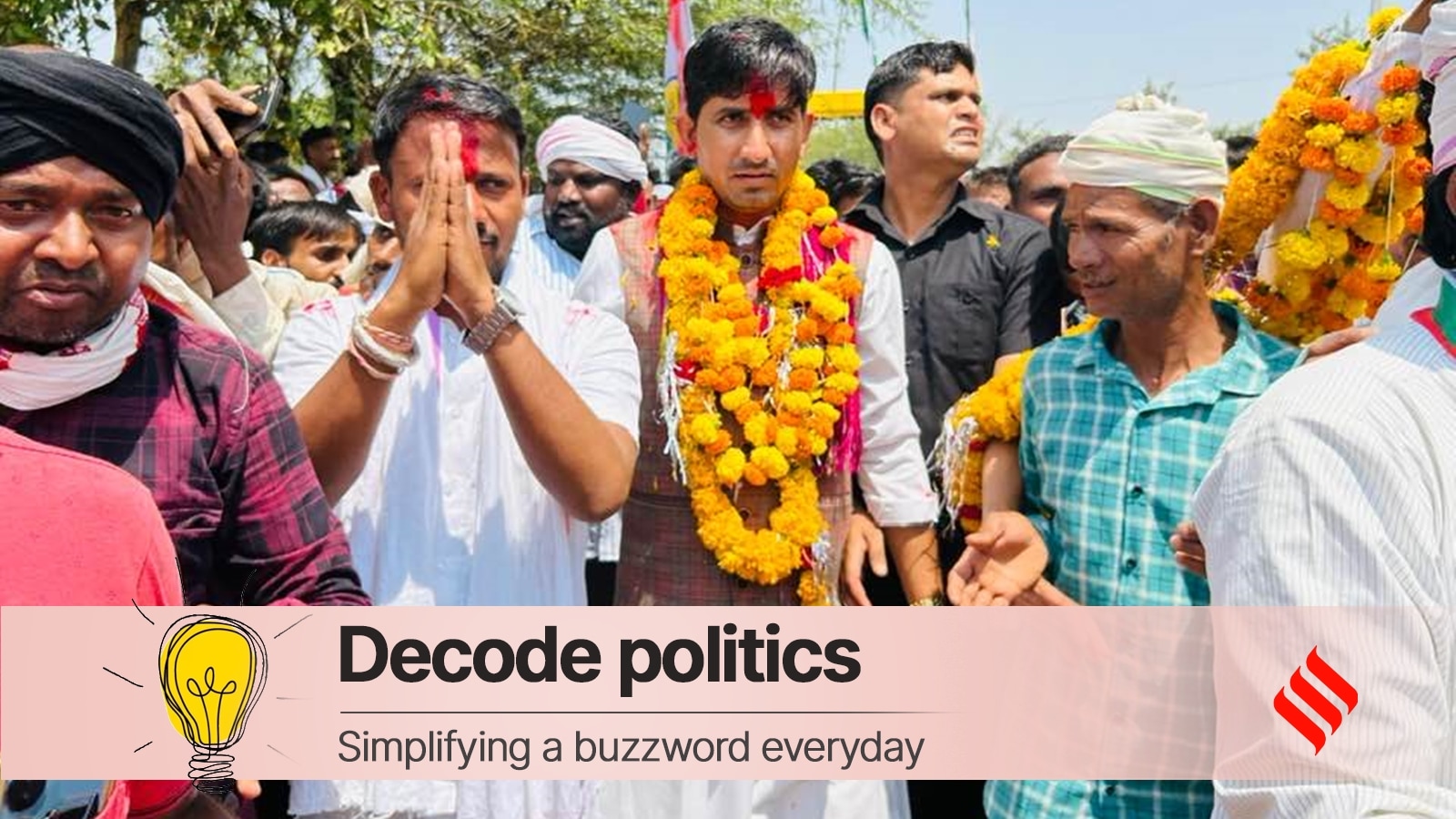
The demand of the Bhil tribal community for a separate state is gaining momentum in Rajasthan. On July 18, many members of the Bhil community gathered for a “maha sammelan” at Mangarh Dham in Banswara, a tribal-dominated district, and raised the demand for a separate state of “Bhil Pradesh” by carving out 49 districts from four states.
The demand for Bhil Pradesh has been frequently raised by tribal leaders over the years, and the Bharat Adivasi Party (BAP), formed last year as a breakaway faction of the Bharatiya Tribal Party (BTP), has been buoyed by its performance in the recent Lok Sabha polls to champion it with renewed vigour.

The BAP, which was founded by first-time MP from Banswara Rajkumar Roat, had included the demand for Bhil Pradesh in its Lok Sabha poll manifesto and said it would be the party’s focus after the elections. Roat had also called for the meeting of the community at Mangarh Dham.
What is the demand for ‘Bhil Pradesh’?
According to the BAP, the proposed Bhil Pradesh would cover 49 districts across four contiguous states including Rajasthan, Madhya Pradesh, Gujarat and Maharashtra. This would involve 12 districts from Rajasthan.
As per Census 2011, there are 1.7 crore Bhils across the country. Their largest concentration is in Madhya Pradesh at about 60 lakh, followed by 42 lakh in Gujarat, 41 lakh in Rajasthan and 26 lakh in Maharashtra.
When asked about the necessity for a separate Bhil Pradesh, Roat said the demand is based on the geography, culture and language.
“If you talk to people in Dungarpur or in Nashik, we all speak Bhili and have a similar culture. If Gujarat and Maharashtra can be carved out due to similar cultures and languages, then why not Bhil Pradesh? Moreover, it is not correct to say that the newly created state will be just for Bhils. At the gathering organised on July 18, there were Rajput, Scheduled Caste, Scheduled Tribe and Muslim community leaders supporting our cause,” Roat told The Indian Express.
Story continues below this ad
What is the history of the ‘Bhil Pradesh’ demand?
According to Roat and other BAP leaders, the demand for Bhil Pradesh dates back to 1913. The BTP leaders claim that Govind Giri Banjara, a tribal activist and social reformer, first demanded a Bhil state in 1913 when he mobilised a gathering of thousands of tribals at Mangarh Hill. On November 17, 1913, around 1,500 tribals were massacred by the British for their rebellion.
Roat said his party was just following the footsteps of their ancestors. “Govindji Maharaj demanded a separate Bhil state, so that the exploitation of tribals, which has been going on for so long, will end. The British government even drafted a map for a separate Bhil state in the 1900s, which is proof this is not a newly created demand but that we are fighting a battle for our existence,” he said.
Over the years, various tribal leaders have voiced their demand for a separate Bhil state. Nand Lal Meena, former minister in the then Vasundhara Raje-led BJP government, had demanded a separate state for the tribal community and several former MPs and MLAs had backed it. However, many including Meena, have softened their stance on the issue in recent years.
Sources in the Congress say the party has always supported the Bhil Pradesh demand as it has a strong presence in tribal belts. However, since the rise of the BTP and the BAP, the Congress has backed down over the issue and has now decided not to vocally support it.
Story continues below this ad
How much resonance does the demand have in Rajasthan?
The demand for a separate Bhil state was raised in the Rajasthan Assembly last Thursday. Thawarchand Meena, the BAP MLA from Dhariawad, said, “Today, when I am speaking in the House, 10 lakh tribals from four states are attending the maha sammelan at Mangarh Dham. We tribals have been divided into Gujarat, Maharashtra, Madhya Pradesh and Rajasthan. Our language, culture, customs are the same, then why can’t we together form a Bhil state?”
The BAP leaders have even said that they do not consider themselves Hindus. Two weeks ago, state Education Minister Madan Dilawar had asked the tribal leaders to take a DNA test if they do not consider themselves Hindus. Dilawar later apologised in the Assembly after protests by the BAP leaders. Both BAP MLAs wore ‘Bhil Pradesh’ T-shirts during the Assembly session.
Samaram Garasiya, the BJP’s tribal MLA from Sirohi district’s Pindwara-Abu seat, said tribals who do not consider themselves Hindus do not have the right to reservation. “Tribals convert to Christianity. If they are not Hindus, then why are they taking advantage of reservation? Such people are not entitled to take advantage of the schemes run for the tribal areas. We do not support a state made on the basis of one community,” he said.
How will the issue play out?
On July 18, Roat and other BAP leaders publicly acknowledged that their demand for a separate state would not be fulfilled soon, but they would continue their struggle to keep the movement alive.
Story continues below this ad
However, a sarpanch from Dungarpur, another tribal-dominated district, said the Bhil Pradesh demand would “not be fulfilled, especially given that it would have to be carved out of four states”. “The BAP has raised excitement among tribal youth with the matter of Bhil Pradesh. Everyone in the BAP understands this dream will not be fulfilled but BAP leaders want to keep it in the news to stay relevant in tribal politics as these areas are mostly tribal. Their dream is to stretch the issue as much as possible to be able to win the coming election in these states. Now, it is to be seen how well they will be able to use the issue in elections,” the sarpanch said.


 6 min read