Journalism of Courage
 6 min read


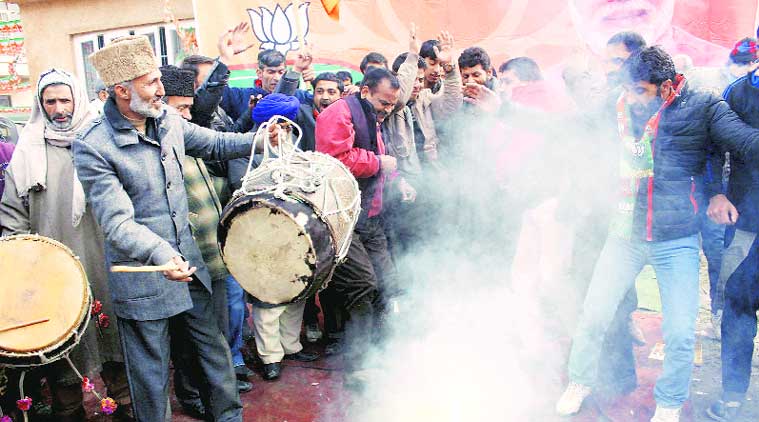 BJP workers celebrate in Srinagar on Wednesday. (Source: PTI)
By: Sanjay Kumar, Gull Mohammad Wani & Ellora Puri
 A fractured mandate in Jammu and Kashmir not only reflects the geographical and social diversity of the state, but also the political faultlines in terms of differences in opinions and perceptions between the regions. These differences are reflected in the electoral verdict the state has delivered.
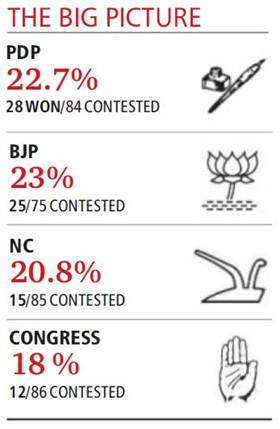
Contesting its third state assembly election, the PDP has managed to emerge as the single largest party (in terms of seats) with 28 seats. Though the BJP failed to fulfill its much publicised Mission 44+, it still remains the biggest gainer. The party is a close second and its seat tally has increased from 11 in 2008 to 25. For the National Conference (NC), it is their worst performance since 1967 as the party tally got reduced to 15 seats. The NC’s coalition partner in the state, the Congress, managed to hold on despite an anti-incumbency sentiment and won 12 seats. The Panthers Party which used to consistently win a few seats in the Udhampur region has been wiped out.
In terms of votes, BJP is the frontrunner with 23 per cent votes while PDP followed closely with 22.7 per cent votes. The NC managed to poll 20.8 per cent votes while the Congress polled 18 per cent votes.
 ‘THREE STATES’
In terms of vote share, the election seems to be a closely contested quadrangular contest with almost a neat four-way split of votes. But the story changes if one looks at the seat figures, as the three regions of the state almost voted like three different states. The PDP won just three seats in the Jammu region which accounts for 37 assembly seats. The largest party in terms of votes, the BJP, lost its deposit in 33 out of the 34 seats it contested in Srinagar valley. Out of the 4 seats in the Ladakh region, the Congress managed to win three. Support for independents and smaller parties in the Valley came down drastically from 32.6 per cent in 2008 to just 18 per cent.
ANTI-INCUMBENCY
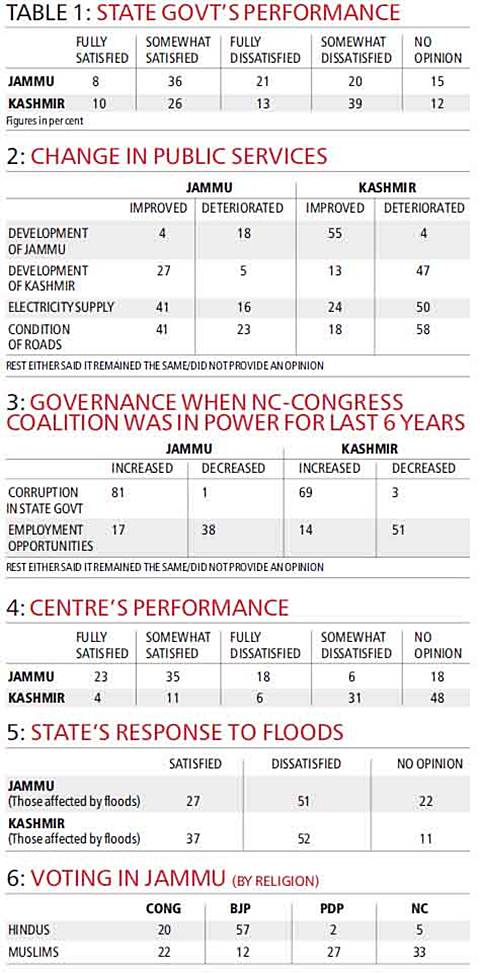
Even though the seat tally reflects a highly fragmented verdict, one thing is clear, J&K has indeed voted for change. The voters in the state voted for the party which they preferred in their respective region but they clearly wanted a change and had a strong desire for development. Findings from a study conducted by Lokniti-CSDS show that this desire was driven by a very strong dissatisfaction among voters with the work done by the ruling NC-Congress government in the state for last six years.
This feeling, though shared among voters of both Jammu and Srinagar Valley, was stronger in the latter where more than half the voters (51 per cent) said they were dissatisfied with the state government. Whether it was the issue of supply of electricity, condition or roads or overall development of the state, people seems to be unhappy and hardly willing to believe that these things have improved during the last six years.
A very large section of voters both in Jammu (81 per cent) and Srinagar Valley (69 per cent) seem to share the opinion that the corruption in the state government had increased in the last six years. To make matters worse, a large number of people believed that employment opportunities in the state decreased in this period.
Not only were people unhappy with the work done by the government, there was a strong negative opinion amongst them about their Chief Minister Omar Abdullah. His popularity ratings were lower compared to PDP leader Mufti Mohammad Sayeed.
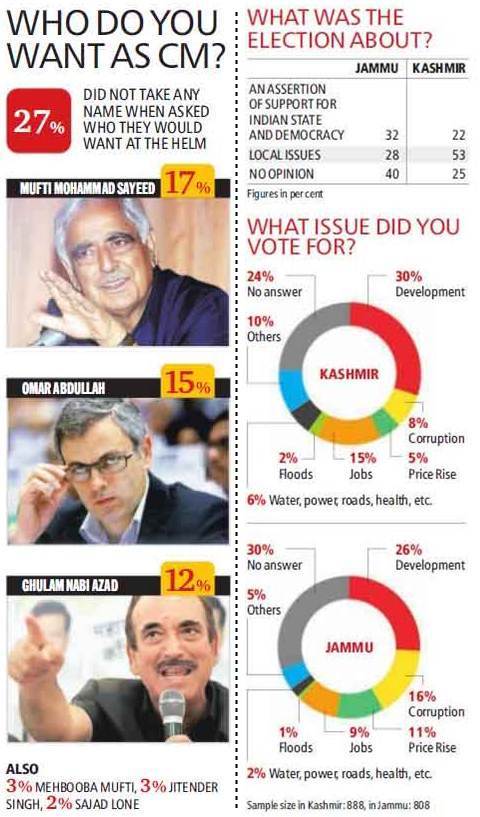 High satisfaction with the central government seems to have helped the BJP in consolidating support in Jammu region. The Valley though still remains apprehensive about the work done by the central government. This explains the fact that the party managed to poll only 2.2 per cent votes, barely 1.2 percentage points higher than 2008 despite an aggressive campaign and multiple rallies by Modi.
Flood relief and rehabilitation effort of the government was one of the primary focus points of the election campaign. A major reason behind the losses for the NC in the Valley could be a poor appraisal of the state government’s relief operations.More than half (52 per cent) of those who were affected by the floods in the Valley stated that they were dissatisfied with the state government’s relief operations. People were not too satisfied with the Centre’s efforts either in Srinagar Valley as almost 41 per cent of the people said that Modi showed no concern towards the plight of the Kashmiris during and after the floods.
RELIGIOUS POLARISATION
In the Hindu dominated Jammu region, there was also a religious polarisation which helped the BJP. While on matters of governance and delivery, the two regions may have identical assessments; their differences are also equally stark:
The Congress seems to have managed to get some support in Jammu mainly due to the popularity of Ghulam Nabi Azad. The PDP’s good showing in the Valley could also be attributed to people’s memory of good work done by the previous PDP-Congress government in the state. In the Valley, the PDP was considered as the most suitable party for the development of the state while in the Jammu region people considered BJP as more capable.
(Sanjay Kumar is Director, Centre for the Study of Developing Societies, Delhi. Gull Mohammad Wani is Director, UNESCO Madanjeet Singh Institute of Kashmir Studies, University of Kashmir, Srinagar. Ellora Puri teaches Political Science at University of Jammu, Jammu)