
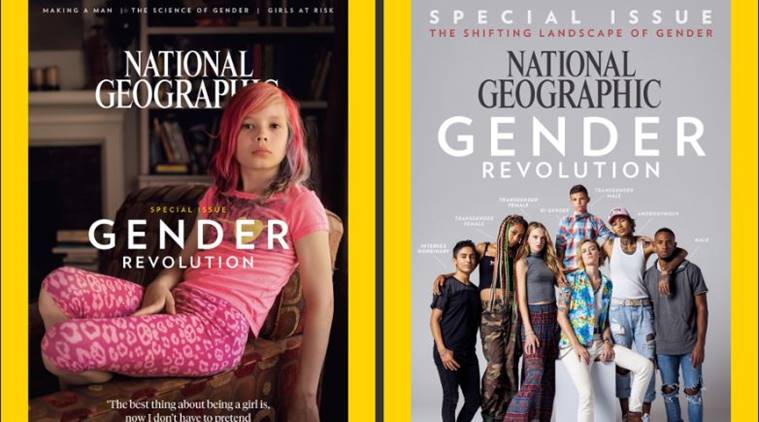
On the proposed January 2017 cover of National Geographic, a nine-year-old Avery Jackson sits confidently on a couch. The spine of her body maps the recline of the furniture. Avery’s body language is calm, composed, sure. She’s looking at the camera head on. Avery is a transgender child. The cover and the statement the publication is trying to make is groundbreaking. It’s the first for National Geographic, and it sends out a telling message: times are changing and the world needs to be shown how important it is to discard preconceived perceptions and prejudices, particularly relating to gender. On its website the magazine supplied its readers with context: “We published an issue focused on gender at a time when beliefs about gender are rapidly shifting.”
There is truth to that. Of late, the emergence of small, independent, geographically scattered, transgender projects indicate that there is a larger, intellectual, universal movement gaining momentum. In the United States for example, the Keswanis are an Indian family who appear on a reality web-series called The Keswanis: A Most Modern Family. The show features a six-year-old Devina Keswani, who is a transgender child. Devina has a magnetic pull – she is flamboyant, outspoken and supremely confident. But it’s her endearing nature that is admirable. It pushes viewers to abandon their inherent biases and accept her, because there is no way you can ignore her. The show attempts to (among other things) remould the perception of a community, which has for centuries been sidelined. But it’s also a fierce supporter of the idea that individuals should be allowed to be comfortable in their own skin. The fact that The Keswanis: A Most Modern Family exists and is watched, is a strong indicator that society is gradually transforming.

Watch video

Social stigma and fear of persecution have enveloped the community for centuries. Transgenders have been forced to pitch their lives in the shadows – at the periphery of society – miles away from its fundamental core – “the normal”. In India, the transgender community known as hijras, have been invisible, but arguably also ultra-visible. While the hijras exist at the margins, almost every Indian has seen or interacted with a hijra. Professionally, they make a living subsisting on attending the birth of a child in a family – a majority of the time, uninvited – and celebrating by dancing and singing in a jovial baritone. Or, they have asked for alms on the streets. In contemporary discourse, very rarely has there been a space reserved for a dialogue relating to the transgender community.
Universally, transgenders have been ostracised or shunned. Very rarely have they been accepted. Since a transgender challenges the norm, by being anatomically defiant or sexually perverse; and since transgender individuals exhibit eccentric, radically different modes of living – they are labeled as the ‘other’. Historically, society has laid down a demarcation between the “us” and the “other”, where the latter, a minority, has been straitjacketed by prejudices, often marked by violent physical or psychological abuse, or both. It is the unnerving fear of the ‘other’ – a recurrent theme that dominates perceptions pertaining to race, gender, nationality and religion – that begets biases. In Pakistan, a predominantly conservative Muslim country, transgenders share a vitriolic history of hatred and abuse. While one transgender was recently flogged by a group of angry men (its video went viral), another 23-year-old was shot and later refused treatment which ultimately resulted in her death.
However, an emerging, undaunted tribe of activists in Pakistan is steadily, but fiercely, altering the narrative arc of its history. Kami Sid, a Pakistani transgender activist, elegantly panned the lens towards her marginalised community. Sid made international headlines when she appeared in a fashion shoot, where she appeared poised and anchored, while the statement she was making held the potential of causing a seismic shift. In India, Naina Singh is the youngest Indian who has come out and openly declared that she’s a transgender individual. Since her declaration, she’s been heavily covered by the media, and Singh has used this as a platform to speak on gender-related issues and identity. It’s this fearless assertion to not conform, to be whoever one wants to be, regardless of one’s biological identity, is what makes me optimistic. Sid and Singh represent the identity of modern transgender individuals, who have established identities that are far from the traditional image of hijras. Of course, threads of class, family and other threads also come into play here.
Does this suggest that the perception of transgenders has been altered, reworked or re-defined? Not entirely. In fact, that is an ambitious claim. It will take decades for activists to chip away a mold of socially intolerant, conservative thinking.
While National Geographic garnered exceptional support and a positive response for its ambitious cover, it also drew considerable fury. There were several readers who threatened to withdraw their subscription, which were punctuated with demeaning, condescending comments. One reader used the word “degeneracy” to describe transgenders. In the issue, the magazine shared something extremely profound and poignant that was written by Science writer Robin Marantz Henig: “Scientists are uncovering new complexities in the biological understanding of sex. Many of us learned in high school biology that sex chromosomes determine a baby’s sex, full stop: XX means it’s a girl; XY means it’s a boy. But on occasion, XX and XY don’t tell the whole story.”
It will take time for the world to accept transgender individuals as equals. However, the fact that transgenders have finally been catapulted into mainstream conversations is perhaps evidence of a positive change.


