
Opinion BJP’s victory was thanks to Moditva, not Hindutva
Covert Hindutva and overt developmental agenda could emerge as Narendra Modi’s twin strategies in future and people at large won’t mind that.
 India's Prime Minister Narendra Modi speaks to the media after his meeting with President Ram Nath Kovind, to stake claim to form the new government at the Presidential Palace in New Delhi, India May 25, 2019. REUTERS/Altaf Hussain

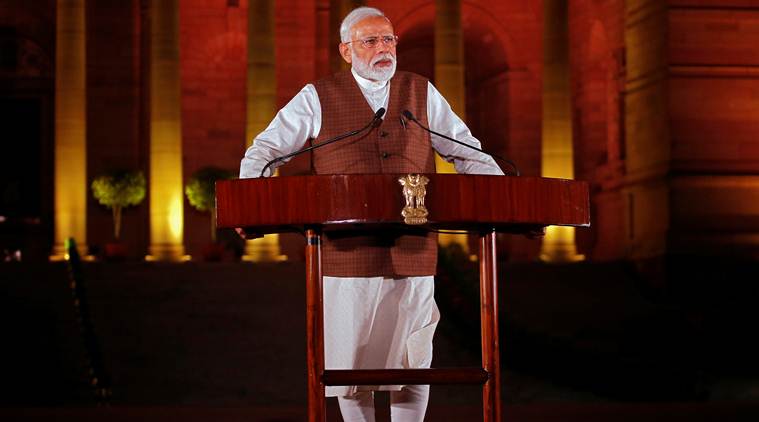 Prime Minister Narendra Modi speaks to the media after his meeting with President Ram Nath Kovind, to stake claim to form the new government at the Presidential Palace in New Delhi. REUTERS
The unprecedented mandate for the BJP in 2019 Lok Sabha elections marks some important changes in voter behaviour and raises some very fundamental questions about its possible longevity.
Why has the voter turned to the BJP, an avowed pro-Hindu party and in that sense a communally prejudiced one? This question presumes that the Indian voter hasn’t been communally tilted for the most part of the post-Independence period. So, has he now been “converted” to the political religion of Hindutva? If yes, has the Hindtuva glow finally overshadowed the country’s secular shine? Answers to these questions depend on how effectively Hindutva and its opponents confront and counter each other in future. But there are both bright and dim chances for the BJP to continue to overpower the voter psyche, if not irretrievably trap her into its ideological vortex.

Historically, Hindus have been open to accepting non-Hindus as fellow countrymen with equal dignity. That eventually formed the basis for the fundamental tenets of our Constitution. Its founding fathers largely belonged to the Congress party, which had steered the country to Independence under M K Gandhi. The secular polity they systemised for the country continued to resonate with large masses till 2014. We need to underscore a very important fact here. The Congress may have largely been a beneficiary of the first-past-the-post system not winning an overwhelming majority of votes, but that had never put a question mark over the country’s secular tilt since the Congress opponents, too, were committed to secularism and hence their followers and voters, too, were secular in their basic instinct. What was remarkable about this commitment of the people of India and its political leadership was that they were never swayed to the other extreme despite going through the horrors of Partition. This brand of secularism was not an election issue even in 2014 when people chose the leadership of Narendra Modi. They had chosen him for development.
But 2019 was markedly different. People have rallied around Modi despite his presiding over the Hindutva laboratory that India was turned into over the past five years. It, in the least, means people don’t mind Hindutva if not that they have been finally converted into obedient believers of its core ideology. So, what explains this turnaround?
As observed by Pratap Bhanu Mehta in his columns here, the people have identified themselves with Modi. And this has largely been borne out by several reports from even the unbiased and independent media. If this is the case, then there is scope to believe that what we have witnessed is not Hidutvisation of the voter. Modi seems to have charmed the voter, who doesn’t mind being affected by demonetisation, agrarian distress and unemployment.
Many argue that people were happy also with his push to schemes like toilets and LPG. That may be true, but that again is the effect of his hypnotic charm catalysed by untiring propaganda blitz. All we need to understand is that toilets and LPG were always supply-driven and never demand-driven schemes. People in rural areas were being offered toilets for many decades. May have been out of flawed idea of cleanliness at home, but they never eagerly responded to the offer, preferring open defecation by choice. That’s why many of those who had toilets built under government schemes later used them to store firewood.
Similarly, they never had cooking fuel non-availability as a problem since they could collect enough firewood for free. It’s also a well-recorded fact of the rural LPG story that most people either don’t have money to buy the second cylinder or they don’t get it at their doorstep or they simply don’t want to buy it since free firewood is abundantly available. It is true that the BJP’s push moulded the public mindset towards its use and must get the credit for it. Yet, should that have eclipsed all problems like droughts, crop failures, non-remunerative agri-prices, lack of employment beyond MNREGS, lack of drinking and irrigation water, etc which are issues of livelihood unlike toilets and LPG? Clearly no, and yet it did.
Not only that, the rural masses also spoke about how Modi has enhanced India’s international prestige and how he has taught Pakistan a lesson, something which was never the discourse in rural areas and poor neighborhoods of urban India. The same is also true of those affected by unemployment in urban areas. So, what else, if not Modi’s charm onslaught, explains this shift from people’s concern from livelihood issues?
Many would question if people can really be charmed to thus level. Yes, they can be. If Indira Gandhi could do that to vast populations of poor with her vain Garibi Hatao propaganda in times when poverty was much more abject and widespread, why can’t it now when people are much better off? If this was possible for a lady born in an aristocratic family, then its all the more possible for a self-styled “fakir”, who has successfully marketed his humble tea-vendor beginning. Having said that, the original question: is it just the Modi charm or if Hindutva, too, has caught the people’s imagination after all? How could such an overwhelming mass of people in a country known for its liberal, secular disposition, not take offence to mob-lynchings, support to lynchers from highest echelons of power, vitriolic hate dished out by ministers, MPs, MLAs, sadhwis and sadhus and their cronies on social media?
The question is difficult to answer. It could be only Modi charm or with it an intoxicating dose of Hindutva. The latter, however, doesn’t seem imminently possible since there are no examples to show Indians have been swayed by radical ideologies. Two most reassuring facts of history bore this out. Hindus were not influenced by the Hindutva ideology even at the height of communal carnage during Partition. Also, Hindutva couldn’t make inroads into general Indian mindset despite 90 years of its propaganda. The second reassuring fact comes from states like West Bengal and Kerala. In West Bengal, the Left parties ruled for 30 years, but that doesn’t mean that the voter had converted to Leftist ideology. It’s just that they liked some initial steps like land reforms taken by the Left rulers that they got hooked on to them. When the Left became inconsequential to them, they seamlessly switched their preference to Trinamool Congress. And as is now reported, they are now turning to the BJP. A huge chunk of BJP’s foot soldiers in West Bengal today comes from the Left. So, it’s clear that shift of preference to a political party doesn’t necessarily mean taking oath of its ideology.
But will the BJP lose its grip on, or will further consolidate, its power? It seems all set to do the latter. But will it be through good governance or by allowing the Hindutva laboratory to carry out more experiments of hate and polarisation? If he is his own master, Modi will not allow the Hindutva project to go on overtly. He may infuse it through education. After all, the values of secularism and tolerance have been taught to generations through education. And he would simultaneously focus on real development, not the fudgy kind like demonetisation. This he will be able to do since he has now virtually freed himself from the RSS stranglehold. A pointer to that effect has come from Amit Shah recently, when he said BJP now has over 11 crore election army, up from 2.5 crore in 2014. This new army of poll workers is clearly BJP’s own and not from the RSS. The RSS will not have any option other than playing second fiddle to the BJP. So, covert Hindutva and overt developmental agenda may emerge as Modi’s twin strategies in future and people at large won’t mind that.
But will all this help BJP continue its stranglehold on power in future? The answer depends on how much the Opposition is able to effectively counter the BJP’s politics. It is said in a manner of speaking “history repeats after 75 years”. Will India return to the good old days of 1947 by 2022 when it celebrates 75 years of Independence? It all depends on if we, as civil society, are more than willing to take the plunge.

 Share
Share


