
Opinion Taking control
Delhi has responded sensibly to Pakistani provocations, showing leadership from the top.
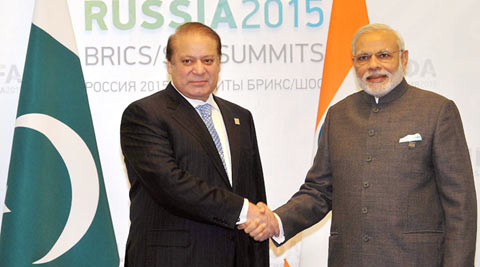


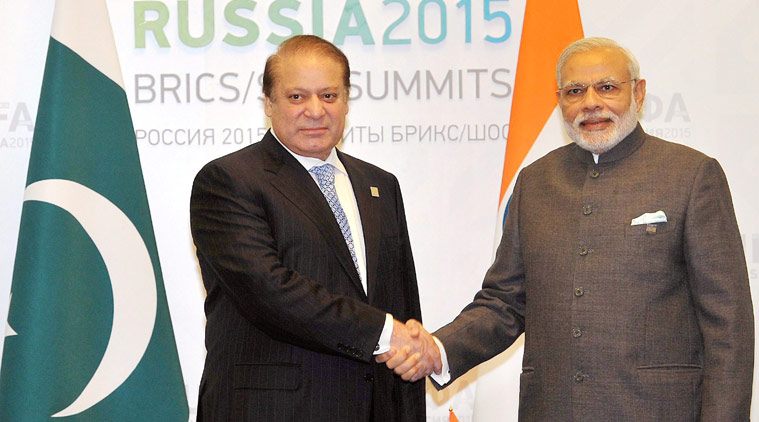 Ufa: Prime Minister Narendra Modi shakes hands with his Pakistani Counterpart Nawaz Sharif during a meeting at UFA in Russia on Friday. (Source: AP)
In keeping with the history of India-Pakistan engagement, it was perhaps predictable that the breakthrough achieved at Ufa in Russia — when Prime Minister Narendra Modi and his Pakistani counterpart Nawaz Sharif announced the resumption of the formal bilateral dialogue — would have to endure a setback or two. The escalation of tensions on the border this week has shown that a few such wrinkles remain to be straightened out before the process can take off. This has, after all, been a recurrent pattern in bilateral relations and there exist enough spoilers on both sides ready to undermine the dialogue. First and foremost, in fact, the civilian government in Pakistan has been under pressure to defend against the charge that the joint statement issued at Ufa was altogether in India’s favour.
Following that, came the Pakistani military’s unprovoked firing across the Line of Control (LoC) and the International Border (IB).

It is to New Delhi’s full credit that it has chosen to respond sensibly to both issues. Even before the border heated up this week, India had refused to be provoked by Pakistani National Security Advisor Sartaj Aziz’s post-Ufa remarks that there could be no dialogue with India unless Kashmir was included in the agenda. Instead, Delhi had insisted that Aziz’s statement contained nothing that subverted the actionable agenda agreed upon by the two sides at Ufa. When it came to the firing along the LoC and IB, both diplomatic and military channels were activated by the government to defuse the crisis. The retaliation by the Indian forces came after the Pakistani military failed to respond to the communications outreach, as did India’s warning of an “effective, forceful response” to unprovoked firing and cross-border terrorism.
Over the course of the incidents of the last few days, Delhi has conveyed two important messages to Islamabad: That it remains committed to the roadmap for the peace process signed on at Ufa, but that it will respond muscularly to any provocations from Pakistan. This is in contrast to not only the approach of the UPA government but also that of the NDA in its first year in office, when the security forces were given a free hand on the border. This goes to show that Delhi is now in better control of the bilateral dynamic, with visible leadership from the top. The decision to field the foreign secretary to deal with the situation suggests that India is producing the right mix of diplomacy and force. Above all, the manner in which the events of this week have been dealt with is evidence that the government has taken political ownership of the process and has demonstrated that it will not let domestic political posturing overtake it. India needs to persist with the Ufa agenda. As a first step, the DGMOs and NSAs must now meet to bring peace and tranquillity to the border.
 Share
Share


