
Opinion Packaging it in
This election, all parties in Bihar are searching for a strategy or idea that skirts the contradictions on the ground.
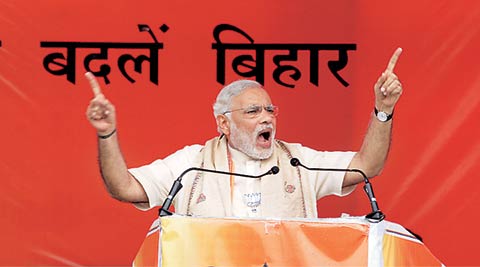


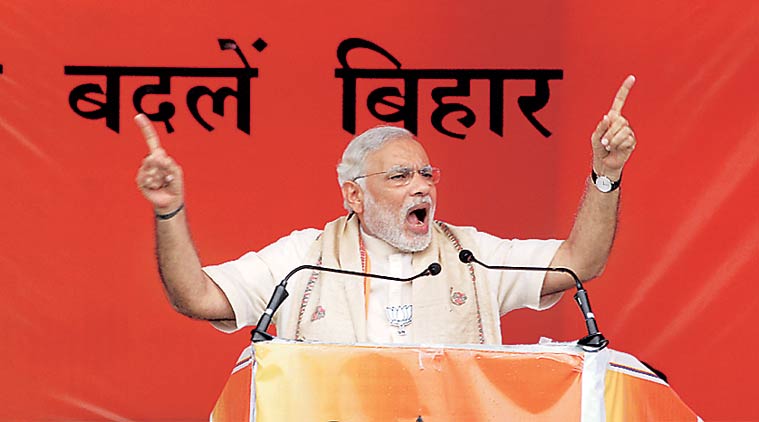 Narendra Modi at the Saharsa rally on Tuesday. (Express Photo by: Prashant Ravi)
The Rs 1.2 lakh crore special package that Prime Minister Narendra Modi announced for poll-bound Bihar on Tuesday has some new allocations, but it also includes amounts earmarked under schemes that were part of the Union budget for 2015-16. Regardless of just how much of it turns out, in the end, to be old wine, the package is the BJP campaign’s bold bid to zoom in and change the subject. Just as Nitish Kumar tried to do, for a while earlier, by seizing upon Modi’s “DNA” remark and portraying it as an insult to “Bihari pride”. In similar vein, Nitish is trying to work up Modi’s reference to Bihar’s “BIMARU” status into a controversy featuring the state’s self-esteem. Through it all, both Nitish and Modi are also attempting to convert the electoral contest into a presidential-style prime-time face-off. With the poll calendar yet to be announced in the state, one thing seems already apparent: Parties in Bihar are desperately trying to look for the sweeping message or idea or stratagem that can be the argument-stopper — one that can vault over the many glaring ground-level contradictions in the campaigns of both the main alliances in the fray.
This election in Bihar marks a new moment in the turbulent politics of the state that has gone through several transitions. In the early 1990s, Mandal seemed to entrench the backward-forward cleavage as the primary faultline. But the backward caste consolidation that Lalu Prasad presided over in the initial heady years did not last long. When Nitish began addressing the EBCs among the backward castes and wooing the Mahadalits among the Dalits, while joining hands with the upper-caste dominated BJP, it signalled a new phase of fragmentation and coming together, which involved the targeting of incompletely mobilised backward groups and an unlikely coalition of extremes. Nitish also sought to install “vikas” or development as a slogan alongside “samajik nyay” or social justice, in order to draw support from across the caste lines in the sharply divided state.

The impending election in Bihar, however, comes at a time when the various mobilisations have been exhausted, all possible alliance combinations tried out, and the reigning slogans have developed holes. There are no more unpoliticised backward caste groups waiting to be nudged into the fray. Lalu and Nitish have got back together after years of fierce rivalry. And all the leading players have their own definitions of “secularism”, “social justice” and “development” that are at odds with not just the versions of their opponents but also of their allies. In such a messy field, it is understandable that parties should try to find a strategy that skirts the ground. Their success, or lack of it, will set the tone for the politics of the future in a state still slowed down by burdens of its past.
 Share
Share


