
Opinion March 22, 1978, Forty Years Ago: Restrict Appeals
In its 58th report presented to Parliament, the commission, (then headed by Justice P B Gajendragadkar), said no amendment was needed in respect of appeals to the SC by “special leave under Article 136 of the Constitution”.
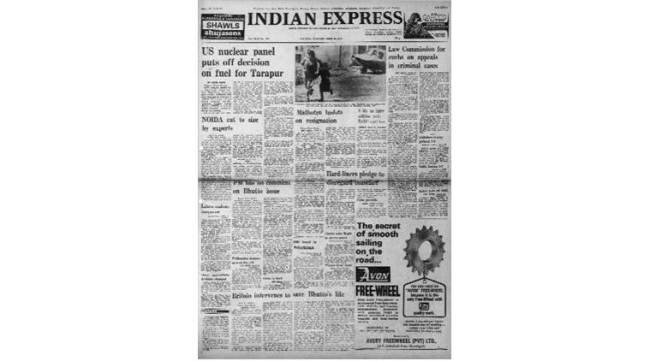

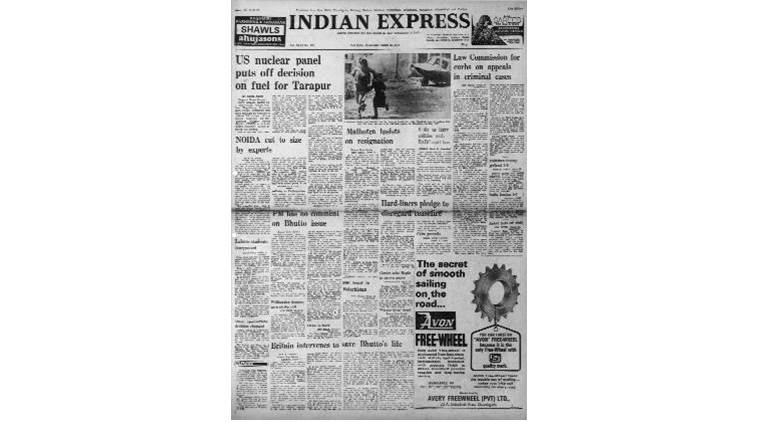 Take a look at The Indian Express forty years ago. (File)
The Law Commission has suggested that the Constitution should be amended to restrict criminal appeals to the Supreme Court (SC). Such appeals should only be on the basis of a certificate by the high court that the case involves a substantial question of law of general importance which needs to be decided by the highest judicial authority of the country. In its 58th report presented to Parliament, the commission, (then headed by Justice P B Gajendragadkar), said no amendment was needed in respect of appeals to the SC by “special leave under Article 136 of the Constitution”. Conferment of this wide power with the SC is considered necessary so as to have a salutary check on all judicial and other institutions.
US On Uranium Deal

The United States Nuclear Regulatory Commission (NRC) put off a decision on whether to release 7.6 tonnes of enriched uranium for the Tarapur Atomic Power Station (TAPS) or to hold public hearings before issuing the licence. Two of the four NRC members met in Washington to consider the Indian application, which has received a strong recommendation from the State Department. But it was decided to defer the matter until the remaining two members could also assemble for the final decision. After President Carter sanctioned the release of 7.6 tonnes, the matter, in normal course, went to the NRC. Before the NRC could issue the licence, three environment groups intervened, urging that public hearings be held before the fuel was released. The shipment is already overdue; it should have reached India by September 1977.
PM Silent On Bhutto
Prime Minister Morarji Desai refused to comment on the sentence to former Pakistan prime minister Z A Bhutto and stressed that India does not interfere in any country’s internal affairs just as it does not permit others to interfere in “our national problems”.
 Share
Share


