
Opinion Beyond platitudes
In Kashmir, the road to peace needs to be rebuilt. But first, it needs a new map
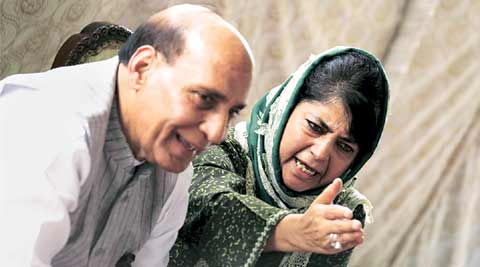




Union Home Minister Rajnath Singh and Jammu and Kashmir Chief Minister Mehbooba Mufti did well to open the way for a political dialogue on Thursday, by expressing willingness “to talk to anyone within the scope of Kashmiriyat, jamhooriyat and insaniyat”. They must, however, also be asked hard questions on whether they have anything resembling a strategy to achieve the ends they seek — presumably not just talks, but peace. The key fact on the ground is this: The state, and the political system on which it rests, has collapsed. In no Kashmir district is the administration able to function outside its barricaded headquarters. Terrorised leaders of the National Conference and the Peoples Democratic Party are publishing advertisements disassociating themselves from their parties. Ministers are unable to travel outside Srinagar, for fear of mob attack. Policing has all but collapsed. Government servants are observing a strike schedule dictated by secessionists; schools, universities and public utilities are all shuttered-up.
No purpose is served by the empirically legless debate over whether this is the work of a small minority of youth inspired by jihadists — the state government’s case — or, as Kashmiri nationalists assert, a mass uprising. The bottomline is that no secessionist interlocutor is willing to engage the government today. Mirwaiz Umar Farooq, the leading secessionist dove, has rejected the invitation for talks now, and his hawkish rival, Syed Ali Shah Geelani, has been steadfast in this position for years. For one, it is unclear what concessions New Delhi could bring to the table that might make it worth their while to give up the de facto power they enjoy. Nor is it clear, in any case, that the young Islamists driving the protests, and their jihadist backers, would follow political instructions to end protests the secessionist leadership had no role in organising.

The government’s only response appears to be a ceaseless battle of attrition with street mobs, each of which kills and maims more young people. This is not strategy, just a prescription for more rage, more violence. The two governments need a coherent framework to restore order, so political leaders may begin the work of reaching out to the people they represent — a precondition for politics. To imagine that calling for talks with secessionists — part of Prime Minister Atal Bihari Vajpayee’s toolkit — will help matters is the worst kind of magical thinking: The damage is too deep. It is delusional to imagine that strategies relevant in 2002, when the PDP-BJP alliance first germinated,
will still work today. The road to peace needs to be rebuilt — and that process must begin with a new map.
 Share
Share


