Yes, RJD is the largest party. But does that entitle Lalu’s son to a shortcut to the No 2 job?
Tejaswi Yadav
November 21, 2015 12:17 AM IST
First published on: Nov 21, 2015 at 12:15 AM IST
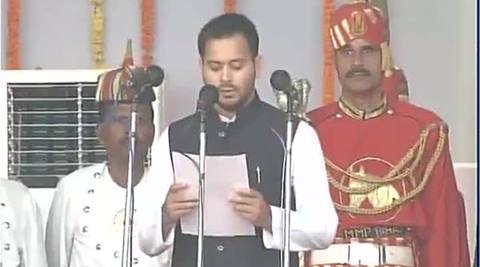
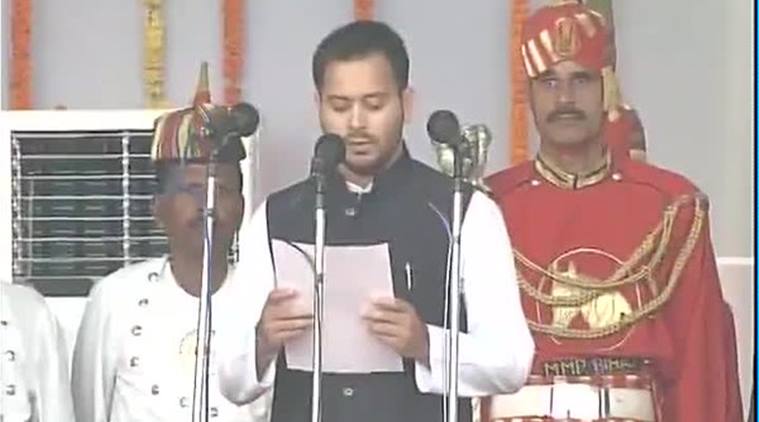
Tejaswi Yadav, taking his oath as Bihar’s Deputy Cief Minister on Friday.
If the overwhelming mandate to the Mahagathbandhan from Bihar’s electorate represented a vote for development, inclusive growth and social justice, the message of it was clearly lost in Nitish Kumar’s selection of ministers in his third term in office. How else does one interpret his alliance partner Lalu Prasad’s two 20-something sons, both novices in politics and first-time MLAs, finding place and primacy in the newly constituted government in Patna? This, notwithstanding the RJD having more numbers in the alliance.
The message that goes out when Tejaswi and Tej Pratap Yadav are sworn in just after the chief minister and ahead of senior RJD leaders like Abdul Bari Siddiqui is that Lalu intends to assert his influence — with 80 MLAs that was expected — on the government through his family. The move to make Tejaswi the deputy chief minister and entrust the brothers with crucial infrastructure portfolios like road-building and health recalls the unpleasant episode of Lalu installing his wife, Rabri Devi, as CM when he was forced to resign in the fodder scam. It reinforces the narrative that the RJD is no more than a family enterprise, far removed from the ideals of social justice. It also feeds into the opponents’ charge that a vote for the Mahagathbandhan would see the return of Jungle Raj, a euphemism to describe the years of RJD rule that were infamous for nepotism and lawlessness. Bihar’s voters had, of course, dismissed these concerns.
You’ve Read Your Free Stories For Now
Sign up and keep reading more stories that matter to you.
Perceptions eventually matter in politics and governance. The spectre of dynasty politics in the largest party of the coalition is bound to be a drag on Nitish as he sets out on his new innings as CM. The Yadav juniors could well emerge as rival power centres and Nitish could be expending more energy on alliance management than on governance. As for Lalu, the ministry formation was an opportunity for him to tell the world that the RJD’s political agenda was not tied to his family. Clearly, the ministry-making exercise has been an opportunity lost for Nitish — and Lalu. The task for the duo now is to ensure that inexperience and ambition of the GenNext in the RJD do not upset Nitish’s governance agenda. That is crucial since the Bihar coalition wishes to acquire a national footprint and emerge as a credible political alternative to the NDA.