
Opinion Face the spectre
Government is forewarned. It must plan carefully and wisely for a deficient monsoon.
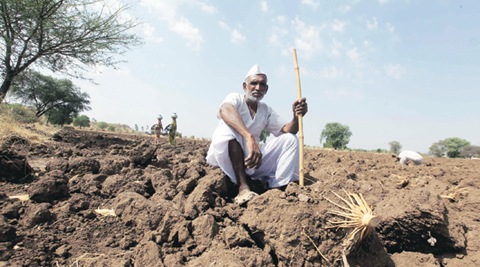 Over 63 per cent of Maharashtra had witnessed below average rain in 2014. (Express Photo)

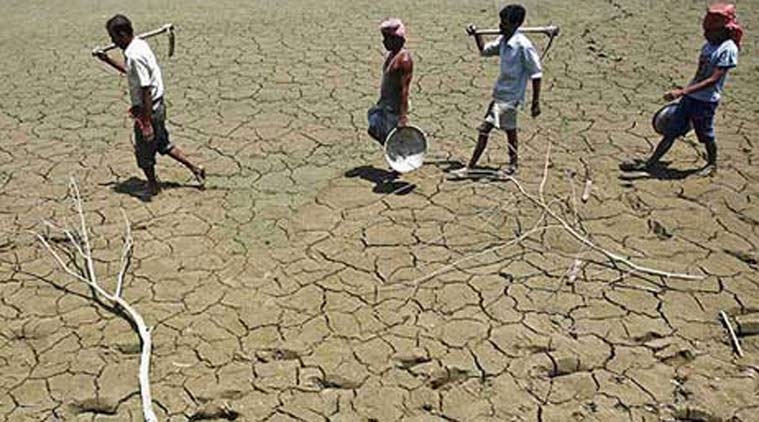 If 2015 does turn out to be a drought year, as is being forecast by the IMD, then 2014 and 2015 will become the fourth pair of years when India faced consecutive droughts since 1901.
The spectre of a second consecutive drought year — which is what the Met Department’s latest downgrade of its monsoon forecast, from “below normal” to “deficient”, portends — isn’t good news for Indian agriculture and the broader economy. But there is a silver lining. Unlike in past drought years, where farmers had little advance information and were often caught on the wrong foot after having already undertaken sowing, there is scope for better planning and for making cropping decisions that incorporate the high probability of moisture stress this time. Thanks to the weatherman’s sufficiently early warning and faster dissemination of such information today — including through the government’s own recently launched DD Kisan channel — farmers are likely to be more aware than before of the need for conserving soil moisture and planting less water-intensive crops.
This is where the government’s minimum support price (MSP) mechanism can make a difference. When the country is already sitting on surplus rice stocks and farmers, too, know they ought to go in for less water-guzzling crops this time, a freeze on the MSP of paddy makes eminent sense. Last year, the paddy MSP was raised by a marginal Rs 50/ quintal and if the withdrawal of bonuses granted by some states in earlier years was also factored in, farmers effectively received lower procurement prices. If, despite that, government agencies have still bought more paddy than in the 2013-14 season, it only shows the current MSP is reasonable. A freeze will, if anything, induce some diversion of paddy area to other crops, which isn’t a bad thing. Farmers, on the other hand, need to be encouraged to grow more pulses and indigenous oilseeds. The country’s combined import bill on edible oils and pulses amounted to $12.5 billion in 2014-15. And with their prices firming up considerably in the past few months, exacerbated by monsoon fears, there is an obvious case to substantially increase their MSPs. Raising the MSPs for tur or urad, for instance to Rs 5,000/ quintal from the existing Rs 4,350 levels isn’t going to be inflationary when consumers are already paying Rs 100-plus per kg for these dals. Higher MSPs, by promoting more plantings, will actually help in price stability by augmenting domestic production — more so in pulses as they aren’t easily importable.

But merely announcing MSP increases isn’t enough. The government should commit to procure at these rates, as it is doing for paddy and wheat. Procuring 3-4 million tonnes (mt) of pulses is preferable any day to buying 28-30 mt each of rice and wheat, grown mainly by farmers having assured irrigation facilities. The time has come for the government to show it cares equally for less well-off farmers who are cultivating crops that require less water as well as urea.
 Share
Share


