
Opinion Antagarh betrayal
Both BJP and Congress must answer the poll-fixing charges immediately and forthrightly.



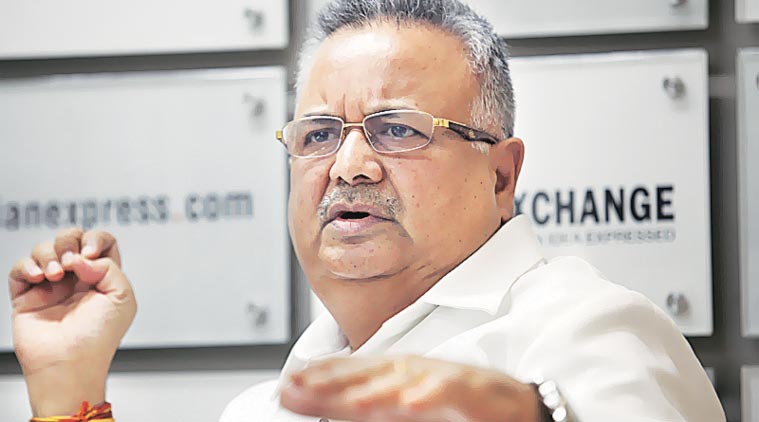 File photo of Chhattisgarh CM Raman Singh. (Source: Express)
When an assembly by-election was held in August 2014 in Antagarh in Kanker district of Chhattisgarh, part of the infamous Red Corridor and where 190 of the 202 polling stations were categorised as “hyper sensitive”, more dangers may have beset the democratic process than were then counted. It was not just that the polls were taking place amid the threat of Naxal violence. As a report in this paper reveals, new evidence has emerged to suggest that the last-minute withdrawal of the Congress candidate from the fray, which ended up providing a walkover to the BJP’s contestant, may have been the result of financial inducement. Phone conversations purportedly between the lead players, including former Chief Minister Ajit Jogi, his son and Congress MLA Amit Jogi, current Chief Minister Raman Singh’s son-in-law and the then Congress candidate Manturam Pawar, point to a secret pre-poll deal between the Congress and BJP. In the wake of the revelations, the Congress has served a show cause notice to Amit Jogi, apart from calling for an SIT probe and Raman Singh’s resignation. Given the gravity of the matter, the BJP must also call its own leaders to account, the Chhattisgarh government must institute a probe and the Election Commission must step in.
At stake is the people’s faith in the integrity of the poll process and its outcome. Amid the pull and tug of Indian democracy, despite the many contentions and disbeliefs and individual aberrations, a basic trust in the essential freeness and fairness of the poll process has endured. It is because of this that the Election Commission regularly tops the list of public institutions ranked according to the popular trust reposed in them. The alleged deal in Antagarh suggests that collusive match-fixing by the main players may have sabotaged the outcome even before the first ballot was cast. A betrayal such as this is all the more resonant in the Naxal-affected constituency. Here, democratic space is already endangered, and needs to be reclaimed from the Maoists. Here, political parties need to mount an especially vivacious and resolute campaign, a vigorous battle of ideas that can engage the electorate and repair and renew the democratic imagination. In Antagarh, a fixed match between the Congress and BJP would only cede even more space to the Naxal claim.

The BJP, in particular, has much to lose if perceptions of electoral corruption are not addressed quickly and forthrightly. The Raman Singh government in Chhattisgarh has been seen to be one that has delivered in many areas, and before the cult of Narendra Modi all but relegated its regional leadership, Raman Singh was seen to be a star performer in the BJP. Then, a major reason for the Modi-BJP’s decisive triumph over the Congress in 2014 at the Centre was its success in pushing the latter into a corner on the issue of corruption. Now, the party cannot afford to leave the serious allegations against its functionaries in Antagarh unaddressed.
 Share
Share


