
Opinion Zomato’s ‘pure veg food’ scheme is pure casteism. Here’s why many people don’t get that
Food in India is never an innocent choice. Zomato has acknowledged a faultline in society — and chosen to exploit it for profit
 Zomato CEO Deepinder Goyal announced the 'pure veg' scheme on X. (Photo: X/@deepigoyal)



On March 20, 1927, B R Ambedkar led the Mahad Satyagraha, to ensure “untouchables” could use water from a public tank in Maharashtra’s Mahad. Ninety-seven years later, a popular app has announced a special scheme to ensure “pure veg” food is not mixed up with impure pollutants before delivery. The Zomato episode once again highlights a very specific brand of Indian blindness — the obdurate refusal to see how caste continues to shape the most banal choices we make.
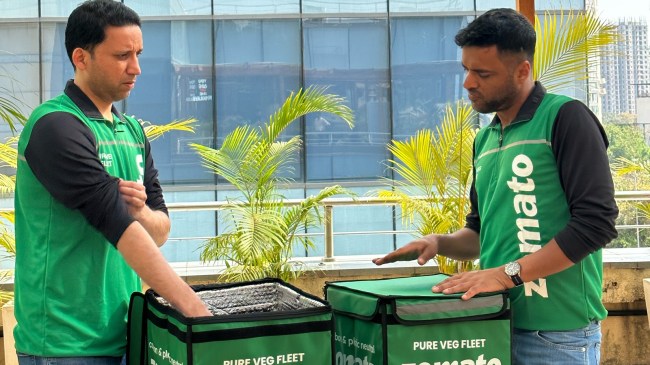
Zomato’s original idea of a new ‘Pure Veg’ mode came with colour-coded segregation. Founder-CEO Deepinder Goyal posted on X on March 19, “Pure Veg Mode will consist of a curation of restaurants that serve only pure vegetarian food… Our dedicated Pure Veg Fleet [in distinct green uniforms] will only serve orders from these pure veg restaurants. This means that a non-veg meal, or even a veg meal served by a non-veg restaurant will never go inside the green delivery box meant for our Pure Veg Fleet.”

A day later, Goyal went back one step. He posted: “While we are going to continue to have a fleet for vegetarians, we have decided to remove the on-ground segregation of this fleet on the ground using the colour green.”
Zomato’s argument
The reason behind the Pure Veg fleet, the CEO explained, was that Indian vegetarians “are very particular about how their food is cooked, and how their food is handled.”
Great. What next? Zomato ensuring only “pure veg” people are employed as cooks in those “pure veg” restaurants? That the “pure veg” delivery people don’t soil their hands with impure food in their own lunch boxes?
A matter of choice?
Zomato’s scheme has been defended by many on the grounds of “choice” — it is my decision to eat only from restaurants that don’t serve meat.
On the face of it, fair enough. But true choice operates in a neutral environment, and the context around food in India is anything but. Vegetarian food is linked with purity and virtue — saatvik — and those eating meat are seen as tamsik, impure, too given to pleasures of the flesh. Meat eating is popularly, though inaccurately, linked with “lower” castes, and a particular religion.
The very construction of “pure vegetarian” is also casteist and discriminatory. The moment you demand that even the shadow of meat not fall on your food, your preference goes beyond the simple matter of choice of diet. What you are insisting on is that your “pure” food is not polluted, and this has echoes of the untouchability practised for centuries in this land. The evidence of such thinking is everywhere: Meat eaters are frequently denied houses, children in schools have refused to eat food cooked by lower castes, people have been lynched over the suspected content of their lunch boxes. Seen in this context, it is difficult to imagine vegetarianism as an innocent choice.
The irony behind these arguments of choice and free market is also that they are being made by those who want the sale of meat banned on certain days or certain meat be made completely illegal.
Others have questioned why if halal food is okay, “pure veg” is not. But the distinction, here, is about segregation, not choice. And no delivery app has announced a “halal only” fleet for “pure halal” food.
Pure business?
Another argument is that “pure veg” customers do exist, and Zomato has the right to cater to them. Sure. But what the “pure veg” scheme does is recognise a faultline in society — a faultline that has, in recent times, had had fatal consequences — and try to exploit it for profit. Social reformers over the centuries have tried to loosen the shackles of caste by organising communal eat-togethers. Modern Indian businesses, meanwhile, are ensuring greater levels of segregation as long as you are willing to pay for it.
Goyal in his many X posts on this has said, “…why did we need to separate the fleets? Because despite everyone’s best efforts, sometimes the food spills into the delivery boxes. In those cases, the smell of the previous order travels to the next order, and may lead to the next order smelling of the previous order. For this reason, we had to separate the fleet for veg orders.”
If I ask for white sauce pasta, I would prefer if it was not delivered in a box soaked with gravy from a previous chhole bhature order. But Zomato’s solution to “separate the fleet for veg orders”, because the pure vegetarian’s distress “at the smell of the previous order” deserves more consideration, reeks of discrimination. In the West, White people’s objection to the smell of curry is rightly criticised as racism. In India, we refuse to even question why some smells are so particularly unappealing to some groups. We just hasten to make them comfortable.
The most egregious part of this scheme, of course, was the ‘kapdon se pehchan leejiye (recognise them from their clothes)’ rule for delivery personnel. Zomato has rolled back the separate uniform, but the “Pure Veg Fleet” business still puts delivery partners at risk. Can Goyal guarantee that Muslim men delivering “pure veg” food won’t be targeted and accused of ‘delivery jihaad‘? In 2019, Goyal was lauded for standing up for the “diversity of India” when a customer tweeted he was cancelling an order because the delivery person was Muslim. Did no one in Zomato’s thinking room remember this experience when the new policy was devised?
Pure blindness
This, of course, raises another question about how policies are formed by new India’s new businesses. How did no one at Zomato realise the purity and pollution connotations of their “pure veg as opposed to simply veg” scheme, especially after the criticism they faced over their “kachra” ad?
And this brings me back to the point I raised at the beginning — our willful blindness to caste. Acknowledging the workings of caste is the steepest hill to scale for most upper caste people, even for those sensitive to other forms of discrimination, including of gender. Is it because it is too shameful to look caste in the eye and acknowledge all that has been perpetrated in its name? Or is it the comfort of knowing that caste will never be a disadvantage to them, though gender can sometimes be?
An idea, a practice has to be adaptable, shape-shifting, to be able to survive for long. Brahminism has survived for millennia, by normalising itself, by calling itself different names — merit, preference, choice — by hiding in plain sight all along. Sadly, there is no app that can deliver awareness and consciousness in neatly packed boxes.
yashee.s@indianexpress.com

 Share
Share


