
Opinion Yogendra Yadav writes: A public debate on ‘Does God exist?’ takes us away from the real issues of religion and religiosity
We need to debate not God but godmen. The fact is that the intellectual and moral quality of religious leadership is fast declining across major religions in India
 Religion is a language and God is a concept. The best way to counter its misuse is not to quarrel with it, but to use it creatively. (Illustration: C R Sasikumar)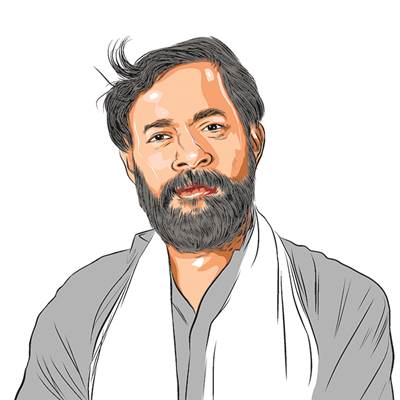


Last week, I declined an invitation to an unusual debate between poet and public intellectual Javed Akhtar and religious scholar Mufti Shamail Nadwi on “Does God exist?” Not just because I happened to be busy at that time, but because I found the very idea of such a debate pointless. I must be in a hopeless minority as that unusually civil debate, moderated deftly by Saurabh Dwivedi of The Lallantop, has gone viral online.
Popularity, though, is no proof of relevance. I have not known Mufti saheb and am sure a religious preacher had good reasons for such an exchange. But I cannot fathom why Javed saheb, who I have known and admired, wishes to spend his creative energies in this secular crusade against God. And that too, at this juncture in history.

I admire Javed saheb, not just for his evergreen film lyrics, but also for his poetry. He is, today, among the finest representatives of the tradition of progressive writers who walked across Urdu and Hindi. His is also among the most powerful voices against the ongoing campaigns of hatred and division. I draw strength and inspiration by reciting his anthem for our times, “Ek hamari aur ek unki/ Mulk mein hain awazein do”. He is among the few public intellectuals who have consistently and courageously spoken against Muslim bigotry as much as against Hindu supremacism.
Hence my disappointment — more intense as I belong to his tribe, the community of non-believers. Like him, I am a second-generation agnostic. My father was a no-nonsense rationalist who never invoked God or did anything remotely religious in his life. My mother rebelled against religion, in reaction to the miserable fate of her own overly religious mother, who never missed a vrata or pooja. So, there was no trace of religion in my upbringing. Over 30 years of being married to a believing and practising Hindu has not diluted my deep-seated agnosticism.
Yet I do not see the point of a public debate on “Does God exist?” in today’s India. It is, at best, a relic of a bygone age. More often than not, such a polemic is a display of two pathologies of our time — defensive dogma of the believer on the one hand and a deadly mix of ignorance and arrogance of the atheist on the other. Worse, such a debate takes us away from the real issues about religions and religiosity that deserve to be discussed in today’s India.
Debates on the existence of God are not always trivial. This question has triggered some of the deepest philosophical reflections in history. What does “existence” of God mean? If God exists, why do we have evil? How does God manifest itself — saguna or nirguna? In ancient India, debate between the Samkhya and Nyaya schools or the critique offered by Charvaka raise some of the foundational questions of philosophy. In Europe, the rationalist interrogation of God and religious orthodoxy opened the way for modern social and political thought. What made these disputes enlightening and meaningful were the shared philosophical assumptions of those who disagreed with each other. A debate where the two sides do not share something deeper — as in the exchange between modern believers and non-believers — generates a lot of heat and TRPs but little light.
Such a verbal duel could, however, be revolutionary at some points in history. Galileo’s refusal to accept the Church-ordained belief in the centrality of Earth or Jyotiba Phule’s questioning of the existence of Hindu gods or Ramasamy Periyar’s challenging of God were radical acts of defiance that undermined an established and oppressive religious and social authority. An attack on God serves no such purpose today. Religious authority carries little social power or a monopoly over truth. Faith in contemporary times desperately seeks to justify itself in the name of science and rationality. A critique of God is no longer a critique of an oppressive establishment or an unjust social and political order.
This tirade against God takes our attention away from the real and pressing issues about religions and religiosity in our times. We need to debate not God but godmen. The fact is that the intellectual and moral quality of religious leadership is fast declining across major religions in India. We should be debating why various religious orders do not attract high-quality leaders, leaving the field open for babas, saints and preachers of rather dubious calibre, when not outright thugs. We should be debating an overt and obscene rise in religious festivals and rituals, detached from their original meaning and significance. We should be debating how religiosity is becoming a display of wealth.
And, of course, we should be debating the deadly mix of religious identity and politics, again across all religions. Our real problem is not a religion centred around a love of God but a religiosity centred on love of state power. The most pressing issue of our times is not why people believe in God but why those who do so carry out all forms of ungodly things in real life, why they seek to deny someone else’s love for God in a different name. What we need, therefore, is not a debate between believers and non-believers but a conversation between and among believers of different faiths. A polemic between believers and non-believers is at best irrelevant, if not a distraction, for these critical debates of our times.
Such a debate does disservice to the cause of secular India as it conflates secularism with atheism. Now, atheism or agnosticism is a perfectly legitimate belief. That does not mean that every secular person must be or should ideally become an atheist. On the contrary, Indian secularism works only if it is accepted by a vast majority of believers.
Proponents of secularism must learn to give up their contempt for religion and realise that much of their hubris is grounded in their ignorance of the vast ocean that is called religion. Religion is a language and God is a concept. The best way to counter its misuse is not to quarrel with it, but to use it creatively. The idea that religion is nothing but blind faith, irrationality and superstition is itself a modern-day superstition.
The writer is member, Swaraj India, and national convenor, Bharat Jodo Abhiyaan

 Share
Share


