
Opinion Why Rahul Gandhi’s ‘left turn’ isn’t working: The real world isn’t JNU
Jawaharlal Nehru, ideologically inclined towards the Left, remained firmly anchored in the political realities of his time. For Indira Gandhi, being left of the Centre was a strategic political tool. Both leaders succeeded electorally not merely because of their ideological positions, but because they understood people’s anxieties, aspirations, and everyday concerns
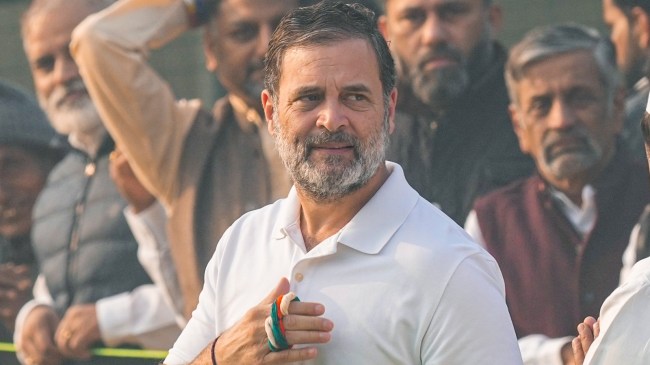 LoP in the Lok Sabha and Congress leader Rahul Gandhi. (PTI Photo)

Written by Khalid Akhter
In the late 1990s, when I arrived at Jawaharlal Nehru University (JNU) as a history student, a professor made an observation that has stayed with me. He said JNU is an exceptional space because it does not prevent you from moving towards any ideology, whether Left or Right. At the time, the ABVP was not a strong force on campus; student organisations aligned with Leftist ideologies clearly dominated.

Our professor explained that at a young age, revolutionary ideas tend to be far more appealing. He went on to say that the difference between the world inside JNU’s campus gates and the world outside is vast. Even while living on campus, he advised, one must remain deeply engaged with the outside world.
In hindsight, his words apply perfectly to the world beyond JNU in general, and to politics in particular. Leftist ideology—especially the ultra-Left variant that speaks of an ideal, perfectly just world—often feels utopian. While such ideas strongly appeal to sensitive and idealistic minds, they tend to strike the general public as unrealistic. This gap helps explain why the Left has steadily shrunk in Indian politics.
At a time when the Left itself is losing political ground and its narrative has limited appeal, the disproportionate influence of Left-leaning leaders and their ideas on the Congress’s top leadership—particularly Rahul Gandhi—often appears to pull him away from core, ground-level issues. In politics, a leader’s correct or incorrect decisions depend heavily on the feedback they receive from their team and advisors. As the saying goes: A leader is only as good as the team around them.
If we examine Rahul Gandhi’s political journey in recent years, one fact stands out clearly. Despite being mocked by opponents as a “part-time politician,” he has demonstrated a deep and sustained commitment to politics. That commitment is rooted in a particular idea of India—one he strongly believes in, and which he sees as being under threat from the BJP and the RSS.
Had this commitment been superficial, it is unlikely that Gandhi would have walked thousands of kilometres on foot after crossing the age of 50. Through the Bharat Jodo Yatra, he sought not only to spread a message of love and unity, but also to reclaim the political ground that both he and the Congress party had been steadily losing.
Polling agency CVoter tracked Gandhi’s journey on a daily basis. According to its data, his approval rating, which stood at around 40 percent in June 2022 before the Yatra began, rose to 48 percent by January 2023, when the march concluded. The electoral impact of the Bharat Jodo Yatra became visible in the 2024 Lok Sabha elections. Of the 71 seats covered by the Yatra, the Congress contested 56 seats on its own under the INDIA alliance banner, while its allies fielded candidates in the remaining 14 seats. The Congress won 23 of these seats, up from just 15 in 2019. Its allies won six of the 14 seats they contested—an increase of four compared to the previous election.
However, in recent elections, Gandhi’s broader team—where Leftist influence appears pronounced—has often struggled to accurately read public sentiment. Rahul Gandhi tends to aggressively take up whatever issues his team identifies through research and feedback. A recent example can be seen in the Bihar elections, where he made “vote theft” the central issue. Congress spokespersons amplified this claim forcefully on television, while the party’s IT cell simultaneously worked to build a narrative around it on social media. In the Bihar elections, allegations of vote theft were never a critical issue for the electorate. On the ground, when voters were asked about Rahul Gandhi’s claims of vote theft, they were willing to discuss it, but without much conviction. During the election campaign, even Rahul Gandhi’s Voter Adhikaar Yatra on the issue also failed to generate the kind of traction that the party had expected.
What remains difficult to understand is why Rahul Gandhi and his team did not make unemployment the central campaign issue—especially when Tejashwi Yadav had mounted a strong challenge in the 2021 Bihar Assembly elections by foregrounding the same issue. According to CVoter’s tracker, 68 percent of the public identified unemployment as their single biggest concern during Bihar polls. In such a scenario, shifting the campaign focus away from the issue that mattered most to voters and elevating a different narrative underscores a recurring problem: Rahul Gandhi’s team has often struggled to accurately read the public mood and grasp the electorate’s pulse.
In an era of hyper-localised, issue-driven politics, success increasingly depends on the ability to accurately identify what truly matters to voters and align political messaging accordingly. Ultimately, politics rewards not just sincerity of purpose, but clarity of priorities—and teams capable of reading the public mood with precision.
History offers useful perspective. Jawaharlal Nehru, ideologically inclined towards the Left, remained firmly anchored in the political realities of his time. For Indira Gandhi, being left of the Centre was less an ideological impulse and more a strategic political tool. Both leaders succeeded electorally not merely because of their ideological positions, but because they understood people’s anxieties, aspirations, and everyday concerns—and shaped their politics around them.
The writer is Editor, CVoter

 Share
Share


