
Opinion A voice, under 35: What’s not to ‘like’?
A word of advice to fellow young people: an innocuous Facebook post could affect your life in unimaginable ways.


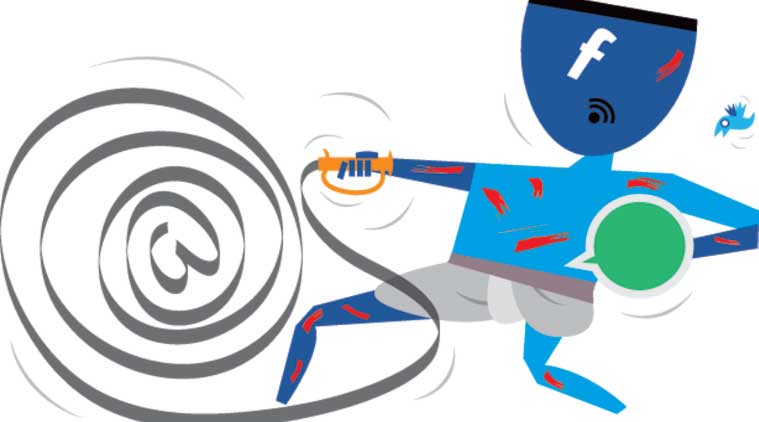 While it is important for people to behave responsibly on social networks, it is not too much to expect the government to behave responsibly as well. Successive governments have tried to curb free speech on the internet by bringing in several regressive laws and policies, the latest example being the draft National Encryption Policy. (Source: Illustration by CR Sasikumar)
Remember me? Rinu Srinivasan? Does the name ring a bell? It’s alright, don’t tax your brain. It’s been years since I faded away from mainstream news channels and the media in general. However, if you spin back the clock three years to November 2012, it was my Facebook friend, Shaheen Dhada, and I who hogged headlines across the country
for a period of two or three weeks. Back then, we were better known by the “Palghar girls” moniker.
Now that you’ve sort of recognised me, I will briefly recap what happened to me on the evening of November 18, 2012. It all started off with Shaheen, my Facebook friend, posting an update on her timeline that read: “Every day thousands of people die, but still the world moves on. Just due to one politician died a natural death, everyone just goes crazy. They should know, we are resilient by force not by choice. When was the last time did anyone show some respect or even a 2 mins silence for Shaheed Bhagat Singh, Azad, Sukhdev, or any of the people because of whom we r free living Indians… Respect is earned, not given and definitely not forced. Today, Mumbai shuts down due to fear and not due to respect!!!”

READ | A voice, under 35: Social media plays vital role in young people’s lives
I liked this status, commented on it and shared it on my Facebook wall. Several others commented as well, but as I later found out, they quickly deleted their comments.
I went back to my usual routine after doing this. Fifteen minutes later, I was at the Palghar police station, detained by the police and surrounded by a mob of over 500 people.
My dad was with me, shielding me from any possible attack. He was, however, unable to stop two women from slapping me on the face.
To this day, what happened at the police station sends shivers down my spine. After a harrowing seven hours at the police station, we were given leave to go and were ordered to come back early the next morning. The next day, we waited endlessly at the police station while the police looked for sections to book us under. Finally, they homed in on the now-defunct Section 66A of the IT Act and IPC Section 295(A). We were presented at the local court and granted bail. Through the rest of November and much of December, I lived under the constant fear of being attacked and was provided police protection. Thanks to my parents, brother, the media and a few friends who stood by me, I was eventually able to get relief from this ordeal and ended up in Kerala for my studies.
Overall, I was quite pleased with the speed with which our case was handled and eventually resolved. But then, we had massive media attention, which must have led to our plight being highlighted the world over. Had it not been for the media, I might still have been doing the rounds of the courts. For the same reason, my opinion on the Indian judiciary might be slightly skewed — my experiences with the judicial system have been largely positive. I am aware that there are others who are not so lucky. Whenever I hear about people who have been fighting cases for decades, with no solution in sight, I am sad and happy at the same time. Sad for them — and happy for me, as I thank my stars that I am not embroiled in a legal wrangle. So yes, I would like to see our legal system deliver justice more efficiently and faster.
That event was a life-changer. On that fateful November evening, I learnt a lot about what social media is and how powerful a medium it can be, even capable of making or destroying a person’s life. However, not to be deterred, I was back on Facebook within a week of this ordeal, and have remained active on it since then. A lot has changed in the intervening months, and Shaheen and I eventually got justice two years later, when the Supreme Court struck down Section 66A earlier this year.
Over the last three years, I finished my audio engineering course and as of today, am waiting for my internship. I also managed to sing for a Malayalam movie called Oraalpokkam. As a singer, I also want to master the arts of recording and audio-editing.
As someone who ended up suffering because of an innocuous Facebook post, I feel somewhat qualified to give my fellow youngsters a piece of advice. There is no doubt that social networks today are a perfect example of a double-edged sword. As long as you handle it with care and use it responsibly, it should be all fine and dandy. However, one careless move could end up affecting your life in ways you cannot even imagine.
While it is important for people to behave responsibly on social networks, it is not too much to expect the government to behave responsibly as well. Successive governments have tried to curb free speech on the internet by bringing in several regressive laws and policies, the latest example being the draft National Encryption Policy. It is high time lawmakers and policymakers realised that it would be near impossible to put a complete curb on the dissemination of information on the internet. We are a free-flowing, plural, secular democracy, and unlike North Korea or China, we do not wish to be ruled by a police state that tells us how to use the internet or social media.
The writer, 23, was booked under Section 66A of the Information Technology (Amendment) Act, 2008, for ‘liking’ a Facebook post critical of the funeral preparations for Shiv Sena leader Bal Thackeray.
Part 2 of this article appears online at https://indianexpress.com, in which Shaheen Dhada, whose Facebook post Srinivasan ‘liked’, writes about the importance of social media
 Share
Share


