
Opinion What Jharkhand’s economy needs
Since the thrust of economic policy-making is moving to the states, the newly sworn-in state government must understand what is holding it back and what needs to be done for the state’s economic resurgence.
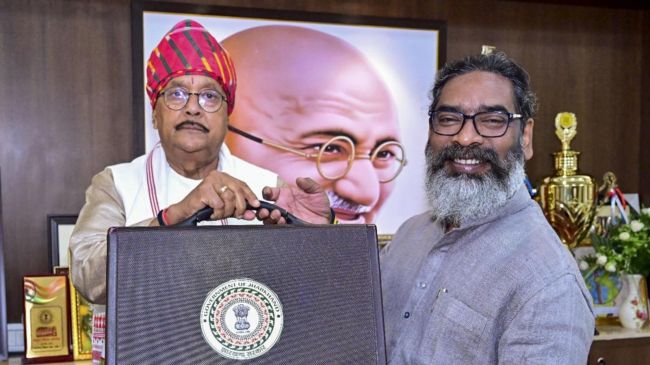 Jharkhand CM Hemant Soren unveiled the annual stae budget for FY 2025-26 on March 3. (X/JharkhandCMO)

On March 3, Jharkhand unveiled its annual budget for FY 2025-26, where the government projected a 7.5 per cent GDP growth for 2025-26, significantly higher than what is projected for India at 6.3-6.8 per cent. This projected outperformance is in contrast to the state’s tepid growth in the short run (2019-24) when Jharkhand’s real per capita GDP CAGR was 3.1 per cent compared to national growth of 3.4 per cent and this difference becomes more pronounced in the long run (2000-24) with the state and national per-capita GDP CAGR of 3.8 and 4.7 per cent respectively. Consequently, it is a lower income state with per capita GDP at about 57 per cent of the country’s average. What complicates matters further is that the three key economic centres of the state — Purbi Singhbum, Ranchi, and Dhanbad — accounting for about 40 percent of Jharkhand’s GDP have had an estimated real GDP growth of around 7 per cent per annum between 2000 and 2020 and the rest of the state has grown around 5 per cent per annum.
Since the thrust of economic policy-making is moving to the states, the newly sworn-in state government must understand what is holding it back and what needs to be done for the state’s economic resurgence. We argue that the state has lost its comparative advantage in mining and related manufacturing to other mineral-rich states, due to its significant and persistent weaknesses in physical and social infrastructure coupled with quality of governance.

Jharkhand is one of India’s mineral-rich states, accounting for 94 per cent of the country’s iron ore reserves, 17 per cent of coal, and 6 per cent of Bauxite. Consequently, nearly 15 per cent of its GDP came from mining in 1999-2000, compared to 3 per cent for all-India. This concentration of mining also implied that the state is a major manufacturer of related products, like base metal, a by-product of iron ore. This was reflected in manufacturing accounting for 30 per cent of state GDP in 1999-2000, significantly higher than the national average of 15 per cent, and even higher than the industrial heavyweights like Tamil Nadu and Maharashtra, whose share then was between 22-23 percent. However, as a result of the lacklustre performance over the last couple of decades, currently, the former accounts for 9 per cent of the state GDP (2024) and the latter 24 per cent. This is also reflected in the state’s share of national base metal production, which fell by 7 per cent from 21 per cent to 14 per cent.
This mellow performance is not fait accompli for all mining-heavy states. The picture is the polar opposite for neighbouring Odisha, where mining and manufacturing GDP grew by 7 per cent per annum and 8.9 per cent per annum, respectively, between 2000 and 2024. Consequently, their share in state GDP increased from around 7 per cent and 13 per cent in 2000 to 12 per cent and 27 per cent, respectively, by 2024. Such stark difference in the performance of the same industries across the two neighbouring states indicates that the industry is shifting away from Jharkhand to other states. For example, Tata Steel, which is the second-largest steel producer in India, accounting for 14 per cent of national production, has its biggest base in Jamshedpur in Jharkhand. Since 2015, it has expanded its operations to Kalinganagar in Odisha. The steel plant in Odisha is underway to reach 75 per cent of Jamshedpur’s production capacity by 2026, of 8 million tonnes per annum (MTPA) with future plans to expand to 13 MTPA, surpassing Jamshedpur’s capacity of 11 MTPA. Disrupting an established specialisation, especially one reliant on natural resources like minerals (and related manufacturing) with a century-long history, is incredibly difficult. What caused Jharkhand to lose out?
Jharkhand’s tepid performance in key sectors can be significantly attributed to the state’s poor performance on critical drivers that determine a state’s competitiveness and influence business decisions regarding investment and expansion. Inadequate infrastructure, like poor road connectivity, is a significant bottleneck for growth, both in big cities and in areas that are away from the key economic centres. The per-capita availability of roads in Jharkhand is half that of the national average and the second-lowest in the country. Likewise, by 2020, 79 per cent of all habitations of Jharkhand were covered by all-weather roads under the Pradhan Mantri Grameen Sadak Yojana (PMGSY), compared to 83-90 per cent for Madhya Pradesh, Bihar and Odisha, respectively. The state’s human capital condition is also concerning. Child stunting and wasting rates are 40 per cent and 22 per cent, worse than the national average of 35 and 19 respectively. Stunting adversely affects the physical and mental development of children and hence of tomorrow’s workforce. Also, its gross enrolment ratio in tertiary education is 40 per cent lower than the national average, making it difficult for companies to find trained people should they decide to enter or expand in Jharkhand.
In FY25, Jharkhand’s health expenditure as a share of total expenditure was 6.2 per cent, which matched the all-state average, whereas its education expenditure lagged the average of all states by 2 percentage points. It needs to tighten up its belt to improve these growth attributes in a short span of time. In contrast, Odisha has made significant strides in improving child nutrition and expanding access to higher education. Between the early 2000s and 2021, Odisha’s percentage of stunted children declined significantly from 44 per cent to 31 per cent, better than the national average. Similarly, in 2019 Odisha’s gross enrolment ratio in tertiary education surpassed Jharkhand’s, though the latter started at a 20 per cent higher ratio in the mid 90’s. Finally, while mining policies are under the jurisdiction of the Union, implementation of the same falls under the state government. Since 2016, there have been 48 successful mine auctions in Odisha compared to only 10 in Jharkhand, indicating significantly higher industry interest in the former.
A mission-mode approach to improve these fundamentals will go a long way in improving the state’s competitiveness and accelerating its growth performance, doing justice to its natural endowments. No state has grown fast at Jharkhand’s level of physical and social infrastructure.
Shishir Gupta is Senior Fellow and Rishita Sachdeva is Research Associate, Centre for Social and Economic Progress (CSEP). Views are personal and not those of CSEP

 Share
Share


