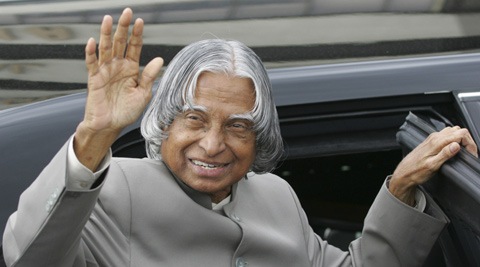
An Organiser editorial argues that former president “Dr A.P.J. Abdul Kalam is the legacy exemplifying change with continuity in Indian tradition, which we need to nurture and carry forward”. “Proponents of humanism tend to take anti-national stand on many issues. Kalam, who was a humanist at heart, established the fact that without being a nationalist you cannot be a true humanist. Though he was talking about welfare of all and a peaceful world, his reference point was always India as a developed and safe nation. He not only strived for that but also inspired many to follow the same,” the editorial adds.
The editorial says Kalam proudly carried India’s cultural heritage of respecting all ways of worship, while practicing his own religion. His religion did not come in the way of cherishing Indian music, philosophy or national personalities. His contribution to building institutions or providing new dimensions to existing institutions is exemplary. That is the reason he could become the “People’s President”. Besides being India’s “Missile Man” and the People’s President, his extraordinary qualities as a human being made him an inspirational leader. This is the legacy we need to nurture and carry forward, the editorial says.


Former CBI director Joginder Singh advocates death penalty for terrorists in his article in the Organiser. Accusing Yakub Memon and his supporters of misusing India’s liberal laws, Singh hits out at rights groups and all those who opposed the death sentence for the 1993 Mumbai blasts accused. There are more unpaid advisers and so-called rights activists than the problems the country faces. Instead of ensuring good governance, such people are finding fault with everything, he writes. Singh claims India has failed to tackle terrorism for the simple reason that all anti-terror laws were repealed by the then government in 2004 for appeasement and vote-bank politics. There is no effective law to deal with terrorism in our country, he writes.
Singh argues that the existing anti-terror laws are insufficient to battle terrorism. “We need to learn and absorb that if terrorism is not eliminated, we would be subjecting ourselves to being subjugated again,” he says. He argues that the Yakub Memon case shows how terrorists use every opportunity to misuse India’s liberal laws. Despite his execution being scheduled for July 30, Memon filed a case in the Supreme Court and sent a mercy petition to the president to delay the punishment, Singh writes.
Rishi Kalam
The Panchajanya editorial looks at the Gurdaspur terror attack, Yakub Memon’s hanging and the demise of A.P.J. Abdul Kalam. The editorial says that the vision of “Missile Man” Abdul Kalam needs to be appreciated. This is important not just for India or any specific geographical area, but for the entire planet. There should not be any hesitation in praising those who are busy in finding a cure for problems such as terrorism, which bring nothing but grief to humanity.
Kalam’s commitment to spreading unity and positivity throughout the world made him much more than a scientist, statesman and educationist. He is a symbol of India’s rich rishi tradition. Citing his life as a symbol, Kalam gave all answers like a true Indian. But there are many questions to which the answers will have to come from society. Who were the people who prevented Kalam from becoming president for a second term? Who were the people behind the signature campaign seeking clemency for Yakub Memon? Who went to the judiciary after midnight to argue for Memon?
The editorial wonders if a comparison of these lists would lead to a common face behind the conspirators.
Compiled by Liz Mathew


