
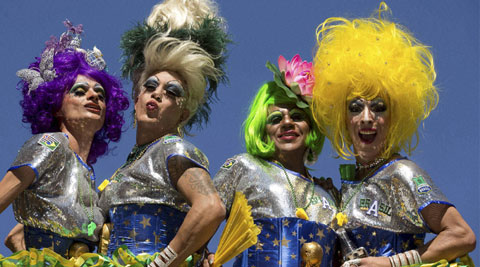
At long last, the transgendered, among our most persecuted communities, are poised to access their fundamental human rights, thanks to the April 2014 ruling of the Supreme Court, which directed the government to officially recognise and empower them. This is great news, but only so far.
The government has now put a spoke in the wheel, objecting to the court’s broad use of the term transgender. Apparently, at one point, the ruling suggests that “transgender” includes the L, G and B of LGBT (lesbian, gay, bisexual and transgender), the alphabetical tent that holds together a diverse spectrum of sexual and gender orientations. However, by the end of the same paragraph, the judgment clearly states: “while dealing with the present issue we are not concerned with this aforesaid wider meaning of the expression transgender”. Why then has the government engaged in such superfluous finger-pointing? In seeking an unambiguous interpretation for inherently ambiguous practices, it reveals its prejudice. Is it miffed at the imagined inclusion of homosexuals, a community that its conservative side has no truck with? The government should revisit the essence of the judgment, but only after it acquires a nuanced understanding of the differences, overlaps and similarities between the transgender and homosexual identities.


But the transgendered may not always be totally distinct from the homosexual: there are overlaps. In the application presented by the ministry of social justice and empowerment, the government defines “transgender” as “all persons whose own sense of gender does not match with the gender assigned to them at birth. They will include trans-men and trans-women (whether or not they have undergone sex reassignment surgery or hormonal treatment or laser therapy etc), gender queers and a number of socio-cultural identities, such as kinnars, hijras, aravanis, jogtas etc.” While this is an inclusive definition, it does not cover the overlaps. In an imaginary Venn diagram depicting the two sets of identities (transgender and homosexual), a trans-woman in a lesbian relationship exemplifies an overlap. In fact, the government’s application itself recognises this complexity — “it may be possible for some transgender persons to also be gay, lesbian or bisexual”. Since all transgender people are not “straight”, how will the government fit the homosexual-transgender in an unambiguous policy?
Nonetheless, this hyphenated identity does not always convey political kinship. There is common ground between L, G, B and T that, despite their differences, bands them together not just in letter (literally), but also in spirit. Personally, the transgendered and homosexual face harassment. Socially, they are seen as deviant and are discriminated against. Politically, they ride the same bandwagon as allies in a broad coalition against pervasive heteronormativity and sexism.
In this context, the government’s response is unsettling, to begin with. If it is concerned about semantics, why not object to “third gender”, a term based on the dated assumption that gender is a binary, not a spectrum? Second, it is lopsided: it supports self-determination of gender but rejects the right to choose one’s sexuality. Just as gender cannot be assigned to others, sexual identity cannot be marked conclusively. Gender and sexuality are textured and dynamic, elusive of our attempts to neaten, flatten and box. Perhaps they are best understood as multiple and conflictual. Yet, awed and bullied by the master-narrative of heteronormativity, our gender-sexuality orientations often stay in place, performing their “straight” scripts.
The writer is a Fox International Fellow at Yale University
express@expressindia.com


