
Opinion Tamil Nadu’s opposition to NEET is not about lowering standards. It’s about providing equality of opportunity
NEET’s alignment with the CBSE syllabus has systematically disadvantaged students from the Tamil Nadu State Board. The examination system is based on flawed notions of merit
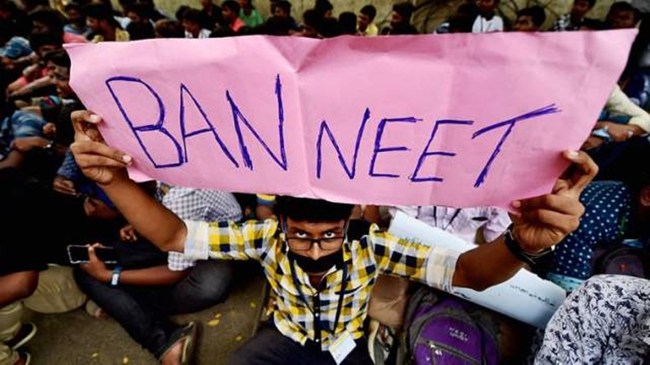 File Photo of Loyola College students during a protest seeking a ban on NEET, in Chennai. (PTI)

The rejection of a Bill passed by the Tamil Nadu assembly by the President, acting on the Union government’s advice, marks a defining moment not just in federal politics, but in the battle for educational equity. Passed unanimously by the Tamil Nadu Legislative Assembly in 2021 and 2022, the Bill sought an exemption for the state from the NEET examinations. It reflected the political and social consensus against NEET in its current form and underlined that the examination has deepened structural inequalities in medical education. The President’s refusal to assent to the Bill raises serious questions about the balance of power in our federal structure. It also compels us to ask if NEET is serving its purpose, or it is perpetuating privilege under the guise of merit.
NEET’s alignment with the Central Board of Secondary Education (CBSE) syllabus has systematically disadvantaged students from the Tamil Nadu State Board (TNSBSE). Before NEET results were made the yardstick of medical college admissions in Tamil Nadu, students who had passed TNSBSE accounted for over 70 per cent of such admissions. Today, that number has fallen to less than 47 per cent, while students who had studied in schools under the CBSE board hold 27 per cent of the seats — up from less than 1 per cent in the pre-NEET era. This isn’t a reflection of poor teaching or student quality in the state system but a consequence of curricular misalignment. State board students are being assessed through a test designed with another academic framework in mind. The result is a race they are forced to run with a handicap.

NEET has also institutionalised the coaching industry, with many aspirants spending Rs 1 to 5 lakh annually on preparation. Predictably, those from rural areas and low-income households, along with first-generation learners, are left behind. In 2020–21, the proportion of science students in Tamil Nadu government schools dropped from 43 per cent to 35 per cent — a silent indicator of fading aspirations. Many bright students, seeing medicine as inaccessible, opt out. The State had to introduce a 7.5 per cent horizontal reservation for government school students in medical admissions. All 622 seats under this quota were filled in 2024, proving that talent is not the problem; opportunity is.
Medical education is about far more than examination scores. It is about public service, empathy, and long-term commitment — qualities that standardised tests can’t measure. Tamil Nadu’s earlier +2-based admission system produced thousands of first-generation doctors, many of whom went on to serve in rural areas and bolster the state’s pioneering public health system. NEET risks breaking this pipeline and replacing it with urban-centric, examination-savvy professionals.
In Tamil Nadu alone, multiple NEET aspirants have taken their lives in recent years. These are not isolated tragedies but part of a larger pattern. The pressure-cooker environment created by a single high-stakes exam has led to rising levels of anxiety and depression. In a State that has traditionally emphasised inclusive and humane education, this is a crisis of conscience.
That both NEET exemption bills were rejected despite unanimous State support underscores the erosion of state autonomy in education. The Constitution may place education in the Concurrent List, but states must be allowed to account for their unique socio-educational contexts. Tamil Nadu’s model, built on social justice, cannot be replaced by a homogenised, central template without undermining the foundational principles of cooperative federalism.
One argument often made in defence of NEET is that it ensures the quality of medical professionals. This is misleading. Reservation and inclusive admission policies operate only at the point of entry. Every student, regardless of how they entered, must pass the same examinations, meet the same academic benchmarks, and undergo the same clinical training. There are no shortcuts to a medical degree.
If quality is indeed the concern, we should be asking what support systems exist to ensure that all students succeed, rather than using the language of merit as a screen for socioeconomic privilege. In fact, many students admitted through reservations go on to become exemplary doctors, often returning to serve in areas where few others will.
The NEET model, in its current form, is not delivering justice or excellence. It has created new hierarchies while failing to nurture the diverse pool of talent in the country. Tamil Nadu’s opposition to NEET is not on the grounds of lowering the bar; the state is resisting a flawed system that equates merit with means. We must stop seeing education as a standardised competition and start seeing it as a tool of empowerment and equity. The Centre must listen — not just to politicians but to students, educators, and civil society — and reimagine a medical admission process that is just, inclusive, and genuinely meritocratic. If India is to harness the full potential of its youth, it must ensure that exams like NEET do not become barriers to dreams but bridges to possibility.
The writer is a former judge of the Punjab and Haryana, and Madras High Courts

 Share
Share


