
Opinion Sholay again: Dharam is dead, long live Veeru, marna cancel
‘Sholay’ remains astonishing for the technical quality of its production. In the restoration, every distinguishing nuance of that amazing soundtrack hit afresh
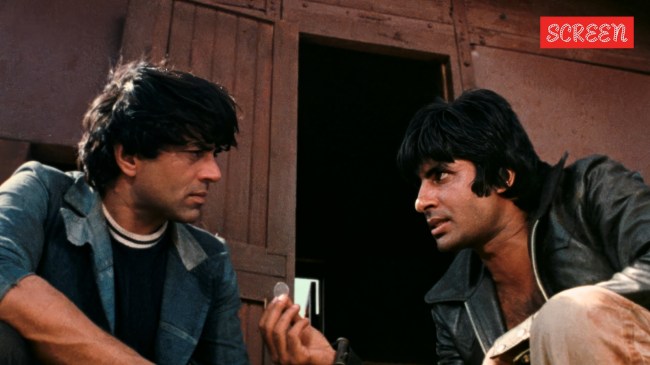 The Ramesh Sippy-directed film Sholay, which was originally released in 1975, is considered to be one of the most popular Indian films. (Photo: Sippy Films)


What’s 19 minutes in 50 years? It turns out very little. It may be moot to ask at this point whether we need Sholay: The Final Cut to love this film even more. Lesser movies, of a newer vintage, are getting a re-airing these days. The good news is that two additional scenes and a different ending don’t make Sholay worse for the wear. The bad news is that they don’t make Sholay better for it either.
Instead, in our distracted attention spans, the formidable new length of 209 minutes and some seconds does allow the mind to wander — are there too many horse-mounted fighting scenes and are they too long (were they always so?); why is Gabbar Singh not caught sooner when Thakur, Jai and Veeru, and never the police, seem to reach his hideout unerringly when they want (which is often); how many men does Gabbar have (40, 50, 100?); and why does the train to Ramgarh always run empty (maybe because of the village’s solitary tonga?).

For all that, Sholay remains astonishing for the technical quality of its production 50 years after it was released in the days following the Emergency.
In the restoration, every distinguishing nuance of that amazing soundtrack hits afresh — from the piercing trill accompanying the death scene of Thakur’s family, to the scraping of a leather belt on rock marking Gabbar’s entry, to the plaintive harmonica marking Jai and Radha’s unrequited longing, to the chugging of a steam engine and rattling of a goods train, to the gallop and saunter of its horses, to a single rifle shot ringing against a horizon .
What is also fresh, half-a-century later, is Sholay’s humour and its pathos, and Gabbar. A hall full of millennials who may have come to this movie via their parents’ memories rings out with laughter at Soorma Bhopali’s “kai raya hoon”, “Angrezon ke zamaane ke jailor”, “Tumhara naam kya hai, Basanti”, “James Bond ki aulad”, “chakki peesing”, “soocide”, and the poor harried Mausi. Many wipe their tears at “baap ke kandhe pe bete ka janaaza”, and Jai’s “kurbaani” and his coin with, curiously, George VI’s image. My teenage daughter shivers as Gabbar hisses “pachaas-pachaas kos door gaon jab bachcha rota hai…”. And remarks in amazement how “everyone in the hall knows all the dialogues”.
A temple and a mosque mark the landscape, an azaan calls for prayer, and a village called Ramgarh bows its head at an Imam’s invocation of “izzat ki maut” versus a “zillat ki zindagi”. It shouldn’t mean much, but we don’t need reminding, it does.
Perhaps the only new ending of Sholay that fans would have wanted is for Jai to live, and for Radha to not be “widowed”, in a sense, twice. In a film whose absolute lack of engagement with politics, in a time of much social and political upheaval, has been commented upon, was that too much to ask?
However, Salim-Javed may have known better, for Radha’s stirring pathos and that image of her turning down the lanterns as a handsome and quiet Jai looks on are the bleeding heart and festering wound of this story — long after Veeru and Basanti have married and settled down and had their “hatte katte” children.
No, Thakur killing Gabbar as the new ending does not come close, despite a fresh coating of menace — via one of the extra scenes — on the dacoit who needs no polishing. Director Ramesh Sippy has said this was how he ended the film originally, before the Emergency censors demanded that “Thakur not take the law into his own hands” (no, the irony is not that Thakur has no hands). But if that justice did not seem half-done at the time, this one seems empty — a film that puts great stakes on honour and bravery not rising above the basest emotions now.
It is the strangest coincidence that Sholay The Final Cut is hitting theatres just days after Dharmendra’s death. One can imagine him up above, like on that water tank in the film, chuckling at his own chutzpah. Dharam is dead, long live Veeru. Marna cancel.
The writer is editor (Planning and Projects),The Indian Express. shalini.langer@expressindia.com

 Share
Share


