
Opinion Shah Rukh Khan at Vaishno Devi: In the age of prejudice, SRK embodies a lived inclusivity
Be it Aamir Khan and Kiran Rao doing puja at their office, Sara Ali Khan and Janhvi Kapoor's all-girl’s trek to Kedarnath or Kareena Kapoor doing Ganesh puja with Saif Ali Khan in attendance, the images have positioned religion in its all-embracing benevolence rather than being just a reductionist trope
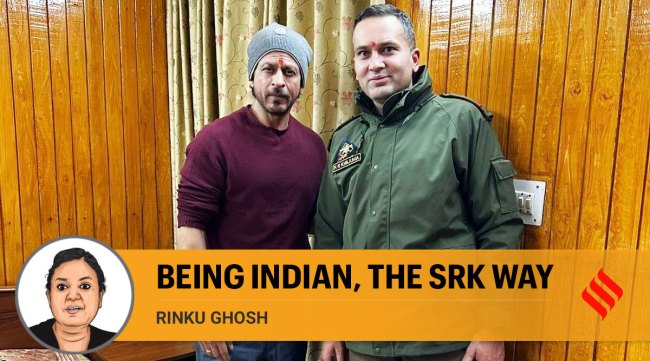 Shah Rukh Khan reclaimed the syncretism that’s our civilisational DNA and showed how it can be practised with ease from a position of strength and a conviction of belief. (Photo: @ISRKzBeliever/Twitter)


He didn’t quite grab headlines or make the noise that’s called the 9 o’clock news. But Bollywood icon Shah Rukh Khan, who did the umrah at Mecca and a darshan with tika at Vaishno Devi, made more than a statement. He reclaimed the syncretism that’s our civilisational DNA and showed how it can be practised with ease from a position of strength and a conviction of belief. As for those who felt that he was genuflecting to political correctness and “right”-sizing his image, know this: A one-man empire, who pretty much defined the hunger of our post-liberalisation years, cannot be seen as being hungrier for a compromise in his mellowing years. If anything, he was asking people like himself to stand up and be counted in the normal flow of everydayness. SRK’s spiritual sojourn is never meant to be screamed out as an exception, simply because he showed it is the only rule.
The larger question is why should anybody cede the right to define religion in an individual way, as it is meant to be, and let political power usurp the grammar of how it should be practised. It is for the same reason why Delhi Chief Minister and AAP leader Arvind Kejriwal’s Hanuman bhakti or Rahul Gandhi’s temple visits during the Bharat Jodo Yatra should not be seen as just peddling soft Hindutva or a me-too ritualism. In fact, they should be seen as attempts to prove that Hinduism is about cooperative ownership rather than a tool for proselytising an electorate, that it’s an inclusive life philosophy rather than a toolkit of statecraft, and that it should remain personal. This is what SRK exactly did.

The politics of otherisation has finally cemented as an accumulation of prejudices, both latent and overt, simply because it now has a stamp of officialese, courtesy a regime which predicates religion as not only proof of identity but loyalty. You cannot blame the fundamentalist fringe like the Bajrang Dal or the Vishwa Hindu Parishad anymore. For their thinking is mainstream now, accepted by the educated elite in drawing rooms. They may have pushed in from the fringes but it is the porosity of the intelligentsia which has yielded to their osmotic pressure. Had the Hindu liberal intelligentsia not chosen to be co opted by or accepted the prevalent discourse, Hinduism wouldn’t have become Hindutva. At the moment, there is no neutralising counterpoint in public discourse, no scope for dialogue or samvaad or any intention to wrest Hinduism back from misinterpretations.
Mainstream acceptance is the most dreaded monster, for it means obeying handed-down guidelines and abdicating your responsibility towards nation-building. Swami Vivekananda, who kept Hinduism relevant as a world religion, is sadly only quoted for superficial purposes while his vision of plurality gets trampled day in and day out.
That’s why what we call the soft power of Bollywood is actually muscular. Be it an Aamir Khan and Kiran Rao doing puja at their office, a Sara Ali Khan and Janhvi Kapoor doing the all-girl’s trek to Kedarnath or a Kareena Kapoor doing Ganesh puja with Saif Ali Khan in attendance, the images have at least positioned religion in its all-embracing benevolence rather than being just a reductionist trope. And since perceptions these days are built on a series of images, it is time the liberal intelligentsia stopped feeling apologetic about being Hindus too. This is precisely why Kejriwal’s reply to a question on why he visited temples and talked about Hindu gods, becomes relevant: “Are gods to be hijacked for political agenda? Why should Hinduism be seen from one prism only? Take that away and then it wouldn’t be their plank anymore.”
SRK embodies this realism and inclusivity of Indic culture, both on and offscreen. Through his many characters, he has defined the idea of completeness, battling his fears and insecurities, flashing his honest brown eyes, a heart full of good intent, sometimes comedic in his bravado and without muscular pretensions. These made him more endearing as the man you want to fall in love with. And when he got that acceptance, he spoke India’s truths. As the restrained and quiet emperor in Asoka (2000), the home-bound NRI in Swades (2004), or the inspirational hockey coach in Chak De (2007), nobody could have articulated the idea of nationalism better than the pop patriotism of propagandists.
Many on social media described SRK’s recent shrine trips as truly secular acts. That would be labelling them and setting up an obvious polarity that the other side would play up. No. In his own way, SRK simply showed that the Ganga-Jamuni tehzeeb can still withstand a rough tide or two.
rinku.ghosh@expressindia.com
 Share
Share


