
Opinion Rishi Sunak’s proposal: Mandatory math in schools could make for a better country and citizenry
A generation that is unafraid of mathematics can do itself a lot of favours. They can become balanced decision-makers, open-minded individuals, believers in solution-oriented approaches, trainable employees and smart citizens
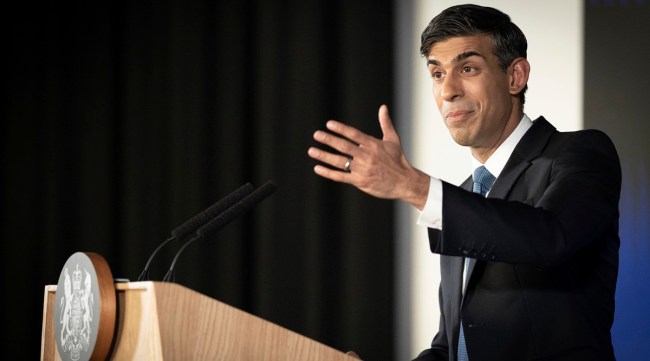 UK Prime Minister Rishi Sunak will pledge to make all pupils in English schools learn some form of maths to the age of 18. (Photo: AP)
Written by Abrar Ahmed
United Kingdom’s Prime Minister Rishi Sunak has come up with a proposal that verges on a pipe dream if his detractors are to be trusted. If he has his way, all students in the country will study math in one form or the other up to the age of 18.

His leading argument is that citizens should be confident about using their money, knowing finances, and mortgage deals and making sense of data in their personal and professional lives. In a country that prides itself on being a thriving democracy, it is to be seen whether this dream expires or sees the light of day. According to some sources, this endeavour will cause a serious burden on the exchequer. The severe paucity of trained math teachers in the country is another immediate roadblock. Since it is not a well-thought-out and structured proposal, the odds are stacked against it. Evidently, a lot needs to happen before one sees all 18-year-olds coming out of school with some degree of knowledge of mathematics.
Logistics aside, is it a happy, wise dream? One may argue, yes. At the school level, math presents itself as a categorically different area of knowledge from languages, humanities, and even science. If not handled, it exposes itself to questions like “why do we need math at all?”
The 21st century has come with the hope of changing the character of math classes. Instead of being just a syllabus that begs to be completed in a stipulated duration of time, it is slowly and promisingly turning into an endeavour that is enriching, engaging and satisfying. Thanks to the spread of modern technology, a rookie teacher can learn from watching stalwarts on YouTube. Videos of beautiful lessons can be taken from Facebook or even browsed on websites of learning institutions. Gone are the days when math was just an unwieldy study of numbers leading nowhere. Nowadays, students explore beautiful designs, study of different ratios, interesting 3D geometry, and properties of shapes of different sizes. They even find math in music, sports, art, and social problems. In a world like this, students dropping mathematics without having taken a deep flavour of it would be unfortunate.
It is interesting to imagine a time when young minds would have studied math till they were 18. A generation that is unafraid of mathematics can do itself a lot of favours. They can become balanced decision-makers, open-minded individuals, believers in solution-oriented approaches, trainable, unrigid employees and smart citizens in terms of money management. Chances are, they will not mind sharing their skills with others, making their society a little better.
Back to the present. Do we have enough people ready to be trained as enthusiastic math educators? Is every child assured of getting a conducive environment at their schools (even home-schools) in order to pursue mathematics? Will there be voices that will call this step anti-democratic? Is it even a priority for policymakers to lend such unprecedented attention to math in schools? Pursuers of this dream of universal upskilling in mathematics will go to great lengths to find answers to these questions and offer solutions.
The proposal is still to face the heat of frontbenchers and backbenchers in the British Parliament. However, there is every chance of Sunak going down in the history of British politics as a prime minister who dreamt. Nobody is sure of the measure of character Sunak will put in this proposal — a rather historico-moral fight. Remember Twain — “It is not the man in the fight, it’s the fight in the man that matters”.
Someday the UK may come very close to seeing this herculean academic adventure through, owing to limited population and resource pressures. One is tempted to think: What if India dared to dream? India has been dealt a rough hand by history. A motherland of ancient knowledge, a fountain of wisdom, the land of ancient mathematics. Fast forward to the 21st century. A large land to manage, diverse people of myriad cultures and languages, peeped over by suspecting and scheming neighbouring nations, unemployment a major worry, waking up from a demoralising spate of Covid deaths, numberless schools giving humiliating salaries to teachers, crests and troughs of crime, gender biases, stereotypes, simmering xenophobia — are we well placed to start dreaming?
Probably not. In my many conversations with school leaders, I have received two contrasting opinions. One, the school decides how deep the impact of math should be on a student. Two, the curriculum makers — which is, by proxy, the government — decide the fate of mathematics in schools. After 75 years of independence, we have not been able to pinpoint the major cause of the dilapidation of mathematics in our country. Before one starts questioning the intent of stakeholders, one has to agree to look at the ground realities. The lower stages of Maslow’s hierarchy of needs beg our attention more than mathematics spelling its charm on innocent children.
So while we look at our ground realities and wonder how soon we can start dreaming, we may wholeheartedly wish the UK prime minister the best with his lofty dream.
The writer is a school mathematics educator, NCR schools
 Share
Share


