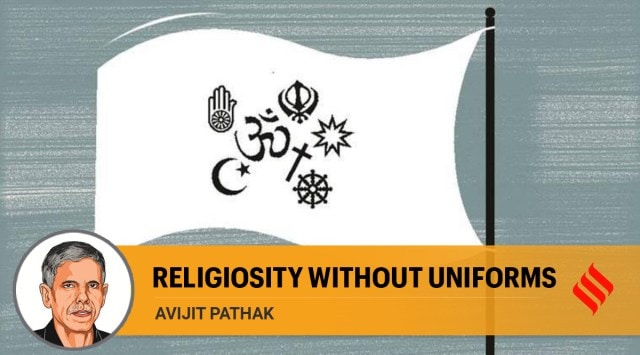

The gospel of modernity — or, its secular reasoning and techno-scientific project — has not yet succeeded in eliminating the tremendous hold of organised religions over our collective existence. In fact, in our times, the militant assertion of one’s religious identity in the politico-cultural domain has caused diverse forms of orthodoxy, and posed a challenge to the ideals of heterodoxy, symmetrical pluralism and the spiritual oneness of humankind. Is it the reason why, in our country, the debate on Hinduism vs Hindutva continues to occupy the imagination of political activists and public intellectuals?
It is not difficult to understand why there are Hindus who feel uneasy with what is going on in the name of Hindutva — an ideology of hyper-nationalism that stimulates one’s religious identity, prefers a monolithic discourse, and suspects or even demonises the “other”. In other words, the cultural narcissism or aggression implicit in the ideology and practice of Hindutva is something that hurts the sensibilities of those Hindus who believe that Hinduism is about pluralism, dialogue and assimilation. They refuse to be influenced by the likes of Savarkar and Golwalkar. Instead, they recall a largely decentralised tradition with multiple forms of worship, and diverse schools of thought in Hindu philosophy — from Lokyata to Vedanta; and they remind themselves of the music of harmony that characterised the spiritual practices of Ramakrishna Paramahamsa, Narayana Guru or Mohandas Karamchand Gandhi. In other words, they seek to convey a message that the loud champions of exclusivist Hindutva have no right to claim a monopoly over pluralist and dialogic Hinduism.


I ask this question because our true religiosity is a quest — existential, psychic and spiritual; it is a longing for a deep understanding of our location in this vast universe; it is an urge to see meaning for existence amid pain, suffering and impermanence of everything that is phenomenal; and it is a striving for the light of the infinite that illumines the finite. It is not about repeating the scriptures like a parrot, wearing special uniforms, and following the crowd. Jesus might have experienced the ecstasy and power of love. However, unless you and I experience it, there is no meaning in repeating his sermons, even if we are born in a “Christian” family. There is no meaning in glorifying the Bhagavad Gita, and asking a priest to recite it at the time of death ritual, if we are not convinced of niskama karma or detached action. Unless you and I choose to be authentic seekers with wonder, meditative quest and existential perplexity, and without any standardised manual, we will end up following the crowd, dividing ourselves into different and conflicting groups, and making noise. Ironically, organised religions with their priestcraft and heavy burden of ritualism seek to condition our minds, limit our horizons, and discourage our own quest. Hence, will it ever be possible to say that we are neither Hindus nor Muslims, and we are like tiny blue flowers experiencing the light of the sun, radiating our fragrance, and then withering away silently and gracefully, and merging with the soil?

As we love the false security that all sorts of “certainties” (I am a “Hindu”, she is a “Muslim”; I am an “Indian”, he is a “Pakistani”) provide, it is not easy to decondition our minds, and experience the spirit of being a wanderer — a seeker without the baggage of any fixed book or any fixed doctrine. Yet, even in these violent times, the quest for deep religiosity— without uniform, without boundaries — ought to continue.
This column first appeared in the print edition on December 4, 2021 under the title ‘Religiosity without uniforms’. The writer is professor of Sociology at JNU.


