
Opinion Smile, stand back, distract, disappear: The political wives’ labour behind the throne
Call it reticence or refusal; Rama Duwaji not slipping into the ceremonial template actually sits well within a spectrum where political wives negotiate visibility, often through emotional, narrative or reputational labour, by dodging, distracting, doubling down, or simply disappearing to shape the story of power
 Against the backdrop of gendered labour, Duwaji's refusal to play by the book becomes fascinating


By Namrata Roy and Soham Mukherjee
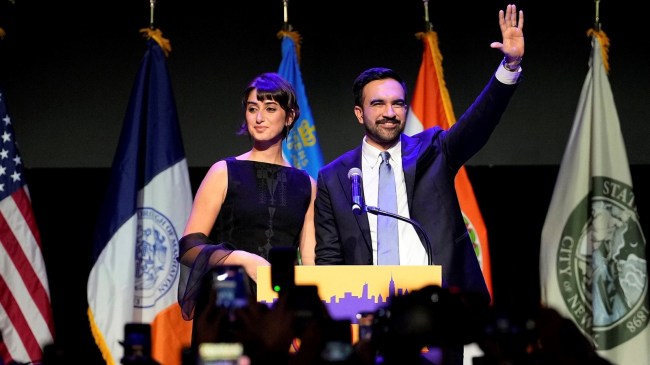
Rama Duwaji may be one of the most intriguing modern political wives precisely because she refuses to perform politics.

Even as Democratic Socialist leader and recently elected New York City Mayor Zohran Mamdani hogged the pop culture spotlight, with his rap video campaigns, up-to-date Gen Z lingo and a recent White House visit, Duwaji has remained conspicuous by her absence from every ceremonial frame.
Duwaji, an animator, illustrator and ceramist by profession, has her Instagram page carefully curated with art and activism, and has steadfastly remained Rama Duwaji the artist and not the ostensible Gen Z First Lady, with no hint that she is married to the New York Mayor.
Call it reticence or refusal; Duwaji not slipping into the ceremonial template actually sits well within a spectrum where political wives negotiate visibility, often through emotional, narrative or reputational labour, by dodging, distracting, doubling down, or simply disappearing to shape the story of power.
If Duwaji’s absence looks jarring, French President Emmanuel Macron’s wife, Brigitte Macron, represents the opposite end of the spectrum through her hyper-visibility. Macron shows that even when a political wife strictly adheres to the First Lady playbook, people reserve the right to redraw her womanhood itself.
For the most part, trolling her was largely restricted to the 25-year age gap between the couple, unconventionally favouring the woman. Faced with unsubstantiated claims that Brigitte was born a man surfacing in 2021, the Macrons are considering submitting photographic evidence, if necessary, to prove that Brigitte is, in fact, a woman. The couple’s lawyer has called this a “distraction” for Macron, who is “juggling a career and family life.”
Considering that Brigitte sacrificed her teaching career to support her husband’s political one and that as the French First Lady she now has a defined role in government, that her three children are extremely successful in life and that she has borne the brunt of the attention that Macron’s rise to power has brought upon them, an attack on her very identity can still be unironically and uncritically reduced to a distraction for her husband.
While Macron labours through symbolic omnipresence, US President Donald Trump’s wife, Melania Trump, perfects curated silence, communicating through her absences and outfits. Her “I REALLY DON’T CARE, DO U?” jacket in 2018 and perceived silence over the Rose Garden revamp comes across as a brand of aloof control. However, Melania purportedly “raising concerns privately” over the demolition of the East Wing of the White House raises the question of whether her silence is structured or strategic. Is she really a political interlocutor or a political accessory? Is her voice, or the absence of it, indeed a controlled articulation or a loss buried under the rubble and rancour?
If Melania’s detachment looks like a brand, deposed Syrian President Bashar al-Assad’s wife Asma al-Assad stands at the other end of the visibility spectrum, more in line with how political wives are generally criticised in the media. Only, she took her second shift in politics into overtime, well-paid overtime if the multiple allegations of corruption are to be believed. Her half-British identity made her much more fascinating to the Western media, with Vogue infamously calling her a “Rose in the Desert”, which later transformed into the “First Lady of Hell”.
Asma began her career as a political wife with charity work and humanitarian missions. Yet when the civil war broke out and she was offered safe passage by the UK government, she refused to return to the land of her birth and stood steadfastly by her husband, letting the state control her representation. Her silence looked more weaponised, designed to aestheticise authoritarian patriarchy.
But what about women born entirely in privilege? From upper-middle-class wealth in Karnataka to the power and luxury of 10 Downing Street, Akshata Murty has known little else all her life. How does one situate such a woman within the context of the second shift? There was minimal sacrificial labour in the supporting role she had in her husband’s career, simply because she was very much the main character in her own. Ostensibly a noted fashion designer, the undeniability of her would-be massive inheritance only served to diminish her husband’s stature, even as the British press could not stop finding cheap humour in his non-British height. Her pride in being able to celebrate Diwali and make rasam at Downing Street, in contrast with her husband fronting a party the overwhelming mandate of which has been staunchly anti-immigration brings us to question whether this lack of self-awareness comes from a life of privilege or is it symbolic of the aspirational Indian upper middle class that looks up to the Murtys, the Ambanis and the Tatas as heroes of the nation?
And then there is former US President Barack Obama’s wife, Michelle Obama, who broke the silence by actually spelling out the labour of being a political spouse. In her memoir Becoming, Michelle opened up about the impossible tightrope that wives are expected to walk, where “living under the microscope” requires an exhausting and never-ending blend of emotional, racial and reputational labour which is flawlessly yet invisibly performed. In the discourse of political second shift, Michelle is an example of how presence itself can be a form of labour.
Against the backdrop of gendered labour, Duwaji’s refusal to play by the book becomes fascinating. By drawing a boundary between her artistic identity and Mamdani’s political project, her silence becomes a critique of the second shift as she simply steps out of the narrative of manufactured expectation thrust upon a political wife.
Roy is an Assistant Editor at The Indian Express and Mukherjee is assistant professor of English at Presidency University, Bangalore

 Share
Share


