


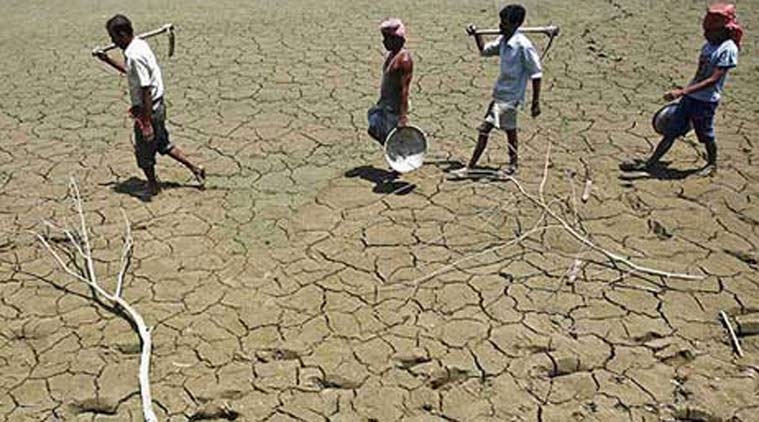
The Indian Meteorological Department (IMD) has predicted that India will get deficient rains in 2015, likely to be 88 per cent of the long period average (LPA) of 89 cm, which is the average seasonal rain (June-September) received by the country in the 50 years between 1951 and 2000. The probability of getting below normal or deficient rainfall is 93 per cent, which is in contrast to the first forecast by the IMD, which pegged a less than 70 per cent probability on below normal or deficient rains (at 93 per cent of the LPA) for the upcoming monsoon season.
But Skymet, a private sector forecaster, is still holding on to its first forecast of a normal monsoon, with rainfall likely to be 102 per cent of the LPA. It appears now that there is an open challenge and competition between Skymet and the IMD — and various stakeholders are keenly watching this contest. While one would wish that Skymet’s forecast came true, so that farmers would not suffer another year of increased distress, the government cannot take any chances and remain passive. In any case, the government will rely on its official agency, the IMD, rather than a private forecaster. Also, the IMD’s June forecast is taken very seriously due to its proximity to the monsoon season.


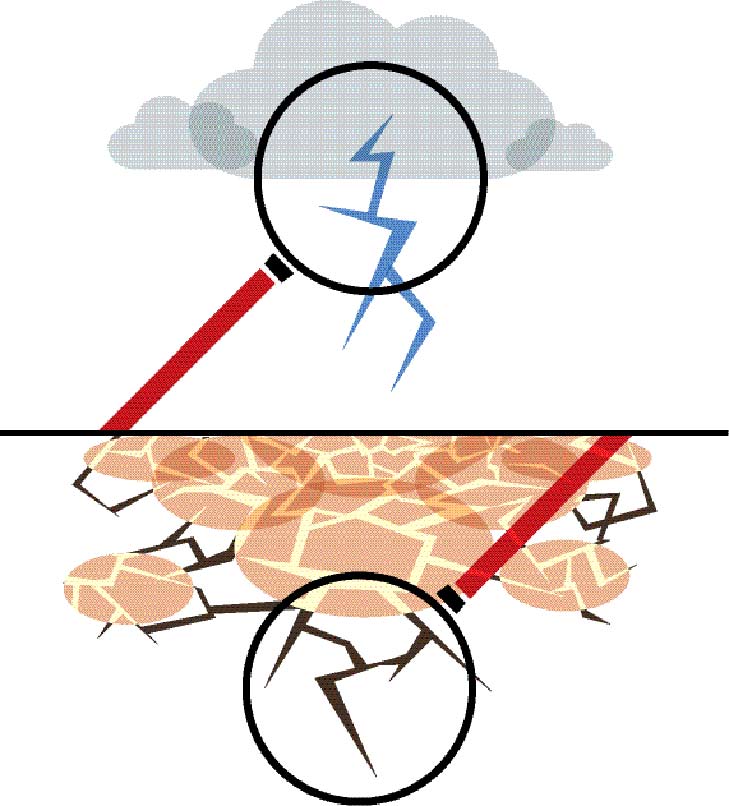
It would be interesting to see what the historical relationship between El Niño and drought is. Does every El Niño necessarily result in a drought? Our analysis of this relation over the last 35 years, since 1980, reveals that there have been 12 El Niño years and seven Indian droughts. Interestingly, six of these seven droughts were in El Niño years, while the 2014 drought happened in a non-El Niño year. This indicates an almost 58 per cent (7/12) probability of El Niño resulting in an Indian drought, but a high probability — 88 per cent (6/7) — of drought happening in an El Niño year. In fact, the El Niño years of 1994 and 1983 saw India receive excess rains, exceeding 12 per cent of the LPA. So it is clear that all El Niño years do not automatically get converted into drought years. A lot depends upon the IOD and other factors, and a continuous watch on these is critical as the monsoon season proceeds. That’s why, given the levels of technology today, it is difficult to forecast well in advance for the whole season with a high degree of accuracy.
Now, if 2015 does turn out to be a drought year, as is being forecast by the IMD, then 2014 and 2015 will become the fourth pair of years when India faced consecutive droughts since 1901. Particularly, in the last 115 years, the country experienced consecutive droughts in 1904, 1905; 1965, 1966; and 1986, 1987. This is a rare phenomenon, and the government will have to wake up and gear up well for this event. Its response so far is that it is well prepared for any eventual drought. Only time will show how well prepared it is, when drought hits the country.
Unfortunately, farmers already have had a rocky last year — from deficient rains drying up crops in the kharif season to unseasonal rains and hailstorms in March-April destroying the ready crop. The 2015 drought will be a third hit in a row to the already ailing farmer. The economy may now be growing at 7.3 per cent, but if the agri sector, which employs close to half the Indian population, limps along with an annual growth of 0.2 per cent in FY15, or probably even negative in 2015, then the sustainability of India’s growth story will be seriously undermined. “Growth for whom?” is the question that policymakers need to ponder, and make corrections in their strategy by bringing agriculture higher up on their agenda. Else, they will pay a heavy political price. And nobody knows this better than the prime minister himself.
Saini is consultant and Gulati is Infosys chair professor at Icrier.


