
Opinion Out of My Mind: We Indians
The surprise is that with the rise of the BJP in power, ideas and attitudes which were less known or heard are now centre stage.
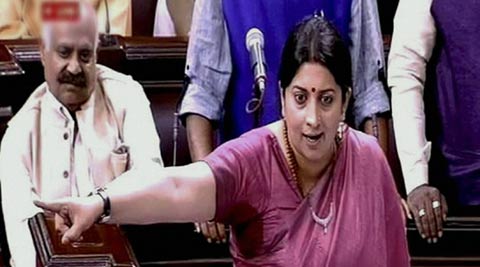

 HRD Minister Smriti Irani speaks in the Rajya Sabha in New Delhi on Thursday. PTI Photo / TV GRAB
At last, for the first time in many years, Parliament has become the national platform for a serious debate on a wide range of issues — of freedom, of limits of the restraints on free speech, tolerance, the many and competing visions of nation and nationalism, caste and especially untouchability, the difficulties of being lower caste or Dalit in modern India, the critique as well as the love of religion. It makes a great change from those rushes to the well, the constant disruption and endless adjournments leading to shutdown.
There is never a definite end to these debates and there can be no one final answer. But the surprise is that with the rise of the BJP in power, ideas and attitudes which were less known or heard are now centre stage. As are the Dalit notions rejecting mainstream religion. The alleged critique of Kali killing Mahishasur has been mentioned in books and articles but never in Parliament. There has been a Dalit critique of Hinduism as it pertains to the symbolism of the subjugation of the aboriginal people of India. The Dalits identify with Bali the King who grants the dwarf Vaman (unknown to him an avatar of Vishnu) three and a half steps worth of land. Vaman straddles Bali’s kingdom. This is meant to be the story of the subjugation of any Dalit who deigns to be powerful.

To say this in Parliament may hurt some people’s religious feelings. But it is just a rival view. Dronacharya is an ideal guru for many. But Dalits know him as the person who demanded Ekalavya’s thumb as gurudakshina. One person’s hero is another’s villain. One person’s religion may be another person’s oppression.
There are rival visions of what constitutes love of the nation. The Left has one. The Congress has a similar but not identical view. The BJP has a quite different vision. There has never been an articulation of these different views in Parliament. Right-wing nationalism has lived in a shadow for a very long time. Its heroes include those who chose the path of violence for India’s independence but are not honoured. Shyamji Krishnavarma, the heroes of Ghadar movement, Rashbihari Bose who went into exile in Japan, Savarkar who suffered the longest period of solitary confinement, longer than any other freedom fighter in a British jail, are marginal figures in the Congress version of Indian history. Even the early Communist heroes such as M N Roy are ignored. Naxals have their own pantheon which even some Communists may disagree with. For the Congress, it is Gandhi and Nehru and none else.
In the coming years, India will have to endure many debates of these differences. Like it or not, Kashmir is a beleaguered part of India as is Nagaland, where wars have raged since 1947. There are people who consider the assassins of Indira Gandhi as heroes if not saints. The people who want to build a temple to Godse are as Indian as those who loathe the idea. There will always be people who have doubts about Afzal Guru or those convicted in the Batla House murder as others who believe Naxalites are the real patriots.
It is this extreme heterogeneity of opinions which defines what India is and will remain.
We are like that only.
 Share
Share


