
Opinion It’s not stubble burning or firecrackers: Delhi is choking on its own emissions
When the air stands still, stagnation sets in, ventilation collapses, and the system is left with no buffer to protect public health. When the weather naps, there is nowhere left to hide. Yet, we continue to blame the weather instead of our emissions
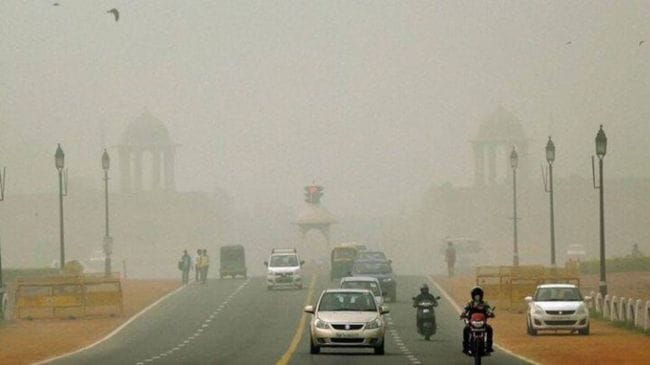 Scientifically, the Severe AQI episode reflects the city's condition. It represents Delhi’s true picture, its own emissions, laid bare.


There is no stubble burning in Delhi’s neighbouring states, no firecrackers accompanying festivals, and the winter chill has not yet peaked. Yet, Delhi’s AQI surged to Severe (from December 13 onward). Why did this happen, and what does it teach us?
This AQI may soon recede to Very Poor, but it will return, playing hide-and-seek for at least another month. Despite the hourly capping of PM 2.5 at 380 µg/m³ (equivalent to AQI 500), software glitches, and other much-discussed constraints, the AQI nearly hit 500, revealing a grim reality and offering a sobering lesson.

Such extremes occur when pollution consistently persists at peak levels for prolonged periods (24-48 hours or more), irrespective of the time of day. Put simply, wind speeds across Delhi and its wider airshed dropped close to zero. This meant nothing was coming in and nothing was going out. Vertical dispersion was also restricted by a shallow inversion layer, approximately 500-700 metres deep. As a result, emissions from fixed point sources linger where they were released, creating localised pollution hotspots instead of spreading, simply because there was almost no wind. But it’s the dynamic sources of pollution, widespread across the city, that are driving the sharp dip in Delhi’s air quality.
Scientifically, the Severe AQI episode reflects the city’s condition. It represents Delhi’s true picture, its own emissions, laid bare. These events reveal how heavily Delhi relies on daily atmospheric dilution to maintain its AQI below Severe, and how this dependence creates an illusion about the true culprit: Local source emissions. More worryingly, stagnation episodes are projected to become more frequent because of climate change. When the air stands still, stagnation sets in, ventilation collapses, and the system is left with no buffer to protect public health. When the weather naps, there is nowhere left to hide. Yet, we continue to blame the weather instead of our emissions.
When the atmosphere temporarily loses its capacity to clean itself — even for just a couple of days — the true magnitude of Delhi’s emissions becomes starkly apparent. It is revealed as a monumental and self-inflicted crisis. That’s the key insight this episode revealed. Our estimates for Delhi NCT show that nearly half the emissions of PM2.5, the particles that inflict the greatest harm, come from transport (43 per cent), with waste burning at 15 per cent, residential and industrial emissions each at 13 per cent, and only 8 per cent from resuspended dust, besides others. The priority for action is, therefore, clear for policymakers.
The math is simple. In such extreme stagnant conditions, if Delhi cuts its local emissions by 50 per cent, pollution levels drop by roughly 50 per cent. When the weather changes, the same logic applies — but emission reductions must happen across the entire airshed. To effectively reduce pollution, focus on coordinated, sustained, long-term action on source emissions, not short-term optics such as smog towers, cloud seeding, water sprinkling, or air purifiers.
The writer is Chair Professor, National Institute of Advanced Studies, IISC-Campus and Founder Project Director, SAFAR

 Share
Share


